
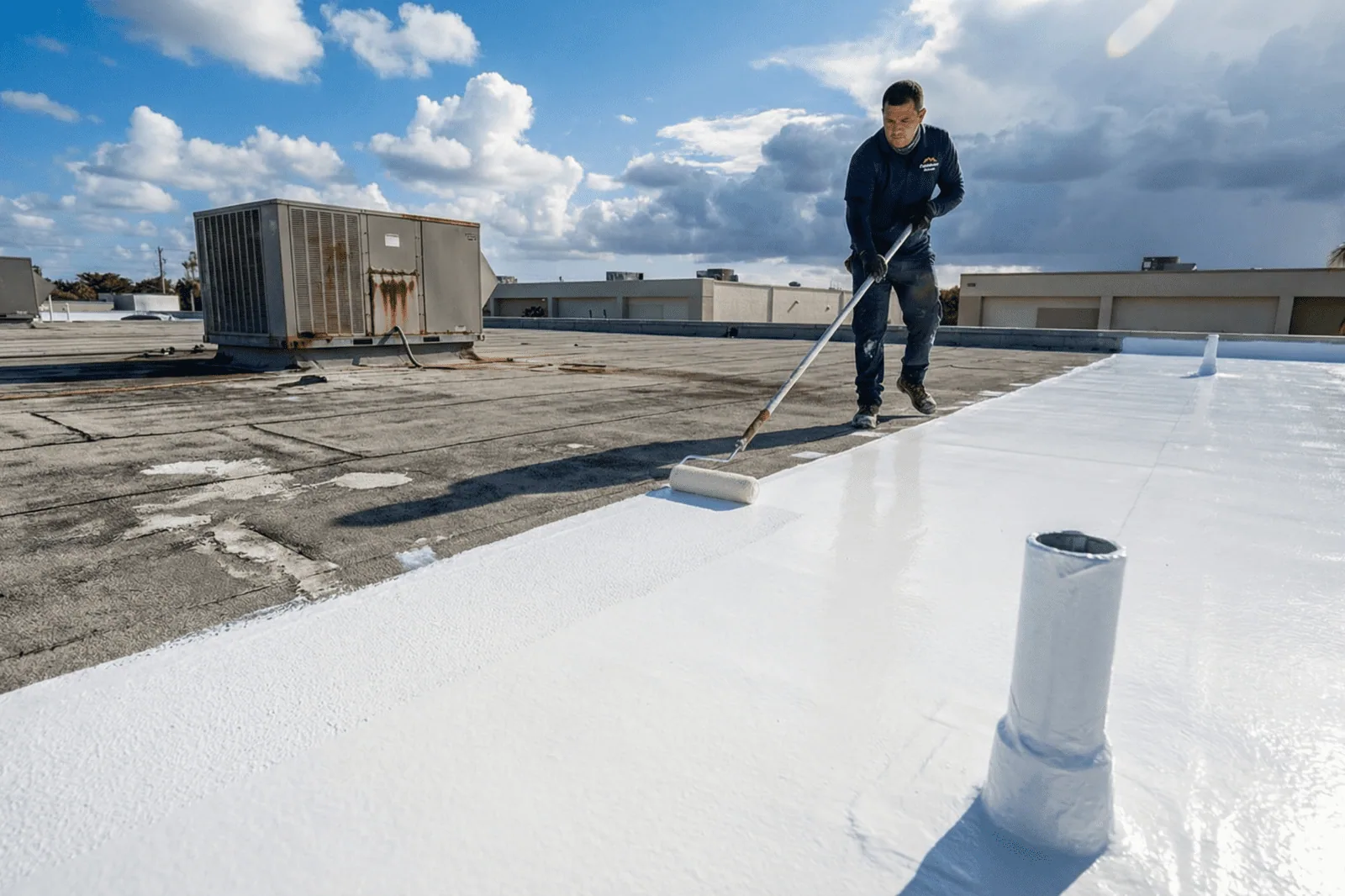
A shallow pond that sits beside a drain for a day after every melt, a pale ring marking where it stood, and a membrane that is otherwise in fair shape describe the roof a silicone coating was made for. Silicone is a liquid-applied coating that cures into a flexible, waterproof film, and among the common coating chemistries it is the one that tolerates standing water.
In West Jordan, UT, where melt can linger on flat roofs and summer sun is strong, a coating can restore a roof that still has sound insulation underneath without the cost of a tear-off. We apply silicone to membranes and metal that qualify, and we decline to coat roofs that do not.
Why silicone handles standing water
Silicone cures through a reaction with moisture in the air and forms a film that does not break down when it sits wet. Acrylic coatings, by contrast, can soften and wash out under long-term ponding. That difference matters on roofs where drainage is imperfect, such as older flat roofs with deflected decks, drains set high and ponds that hold after every melt.
Tolerating water does not mean ignoring it. Standing water adds weight, collects dirt, and feeds algae and bacteria that stain the surface. It can also point to a drain problem that needs correction. We measure the low spots, clear the drains, add a drain or taper where possible, and treat the coating as a way to live with minor ponding, not a license for a roof that never drains. Our ponding water repair work looks at the cause first.
Surface preparation and adhesion testing
A coating is only as good as its bond. The roof is washed, loose granules and failed material are removed, rust is treated, and the surface is checked for chemical contamination. Many surfaces need a primer, and some, such as old coatings of a different type, need a test patch to prove silicone will stick. A patch cured for a few days and pulled by hand tells us in minutes what a guess would take years to reveal.
Before any coating goes on, we scan for wet insulation. A coating over wet boards seals the moisture in, and the roof loses insulation value and sheds paint-like blisters. An infrared moisture survey and a few core samples settle the question, and any wet areas are cut out and replaced. Seams, penetrations and fasteners are reinforced with fabric and extra coating, since those details take the stress of movement.
Edges and drains get a closer look than the field. The perimeter is where wind lifts a membrane and where wall flashing meets the coating, and a drain bowl is where ponded water, dirt and the coating all meet. We cut back any loose flashing, reset it, and carry the coating onto it with fabric so the film bridges the joint instead of stopping at it.
Thickness, coats and cure
Silicone is applied by spray or roller, in one or two coats, and the specified thickness is measured as wet film while the crew works. A thin coat fails early, so we check thickness at multiple points, especially on edges and around penetrations. The film cures by absorbing moisture from the air, which means humidity and temperature affect cure time.
Rain before the film has cured can wash the coating off, and cold or damp air slows the reaction, so the Salt Lake Valley's winter freezing and snow, shown in the NOAA normals for Salt Lake City International Airport, limit the coating season to dry, warm periods. We watch the forecast, work in sections that can be finished before a front arrives, and schedule larger projects for the dry months. Sealing and priming can often go ahead earlier, which shortens the coating day. A final walk the next day checks for pinholes, thin edges and any area where dirt or moisture kept the film from curing, and those spots are touched up before the crew demobilizes.
Dirt, slickness and the recoat question
Silicone attracts dirt more than other coatings, and a white surface can darken in a few seasons, which reduces reflectivity. Rain washes some of it away, and a periodic wash restores much of it. The film is also slippery when wet, so rooftop access routes need walk pads with traction, and service technicians need to be warned.
The larger limit is recoating. Silicone is difficult to cover with other chemistries, and even another silicone coat requires a clean, prepared surface. That is a reason to choose silicone with care. If the plan is to switch to a different coating or a membrane later, the silicone has to be removed or overlaid with a compatible product. We note the coating type and date in the roof record, so the next contractor does not have to guess, and an annual look at wear and dirt fits into a preventive maintenance visit.
Which roofs are good candidates
A good candidate is a roof whose membrane or metal is still sound, whose insulation is dry, and whose problems are surface wear, small leaks and heat. Single-ply roofs such as TPO and PVC, aged modified bitumen, built-up roofs with a smooth surface, metal roofs and spray foam all take silicone when they are properly prepared. A roof with widespread wet insulation, rotted decking or membranes that are blistered and detached from their substrate is not.
The comparison with other options is financial and practical. A coating costs less than a replacement and avoids tear-off, but its life depends on the roof beneath it. Our roof coating restoration service begins with condition and moisture, and ends with a recommendation that may be a coating, a repair or a replacement.
Coating candidates in the south valley
Cottonwood Heights identifies Canyon Centre as its active Community Redevelopment Area, and its general plan calls for identifying infill and redevelopment opportunities that use existing infrastructure. Draper reports more than 1,000 businesses and identifies technology-sector companies among its local employers. Existing buildings in areas like these can be candidates for restoration when ownership changes or tenants turn over, and a roof coating can be part of a building improvement without disrupting tenants.
We work with owners in Cottonwood Heights, Draper and West Jordan, comparing silicone with an acrylic coating on ponding, budget and the plan for the building. Redevelopment timelines affect that choice, as a building held for a short term needs a different roof plan than one held for a long term.
Commercial Roofing Questions
Can silicone go over any roof?
No. It needs a sound, dry roof and a surface it can bond to. We test adhesion on a small patch and scan for moisture before committing to the full area.
Is silicone better than acrylic?
On roofs that pond water, yes, since acrylic can soften under standing water. On well-drained roofs acrylic is often a lower-cost choice and easier to recoat.
Will the roof be slippery?
When wet, yes. We add traction at access points and along walking routes, and we tell service staff to take care.
How long until rain can hit the new coating?
That depends on the product, temperature and humidity. We schedule application in dry spells and cover or stage work in sections so a front does not catch an uncured area.
Does a coating stop leaks?
It seals small defects, seams and fasteners that have been reinforced. Large splits, wet insulation and failed flashings need repair first.
Test a small patch first
Share the roof type, its age and where it ponds. We will schedule a roof walk, run an adhesion test and a moisture scan, and confirm whether a silicone coating is a fit before any price is set.