
A pale, greasy film that spreads downwind from a kitchen exhaust fan, with a membrane under it that has turned soft and tacky, tells an owner something about the roof before any inspector arrives. PVC, or polyvinyl chloride, is the single-ply membrane that holds up best to that kind of contamination, and it is the usual answer when a roof carries oils, fats or chemical vapors that would attack other sheets.
In West Jordan, UT, a PVC roof also has to stand up to snow cover, freeze-thaw cycles and warm summers. We install PVC, repair it, and say plainly where it earns its higher price and where a cheaper membrane would do the job just as well.
Why PVC resists what other sheets do not
PVC membranes are made from a plastic resin blended with plasticizers and stabilizers, reinforced with a polyester scrim and topped with UV protection. That mix resists many fats, oils, acids and salts, which is why PVC shows up on restaurants, food processing plants and laboratory buildings. Its seams are welded with hot air, so they become part of the sheet, and the membrane is inherently fire-resistant, a point that matters to insurers and building officials.
The cost is a heavier, stiffer sheet that costs more than most competitors, and a requirement for care around other materials. PVC does not get along with asphalt or with some foam insulations, so a separation layer or cover board must sit between. When we look at an existing roof, those interfaces are the first thing we check, since a membrane lying on an incompatible base can fail from the underside.
How PVC ages: plasticizer and the sun
The plasticizers that keep PVC flexible are also the part that slowly leaves it. Over many seasons of heat and sunshine, the sheet can become stiffer, shrink along its seams and pull at flashings. The weather normals recorded at Salt Lake City International Airport show warm summers and cold-season freezing, and that swing works the membrane every year. A stiff sheet in January cracks where a flexible one would bend.
On a roof walk we look for hardening, hairline cracks at corners, and shrinkage where the sheet meets walls and curbs. Dirt that has baked into the surface holds more heat than clean membrane, so we also look at where it sits. A sheet in that state may still be repairable, or it may be at the point where a replacement costs less over time than a string of patches.
Exhaust, grease and roof contamination
Rooftop exhaust fans on restaurants and commercial kitchens throw grease onto the roof, and the grease collects where air currents drop it. Left alone, it softens the membrane, collects dirt, and can slide down toward a drain and clog it. A grease containment system on the fan, along with regular cleaning, protects any roof, and PVC tolerates what leaks past.
Laboratories, industrial kitchens and chemical-handling buildings produce other contaminants. The city of Taylorsville lists ALS Laboratories and ICU Medical among the firms in Sorenson Research Park, and Murray identifies healthcare and transportation among its economic sectors. Whether a particular building's exhaust is a problem is a question for its mechanical plan, though PVC deserves a place on the list. For a restaurant roof, we also look at the walk path from the fan to the access ladder, where grease tracks on boots.
Welding in cold air and at tight details
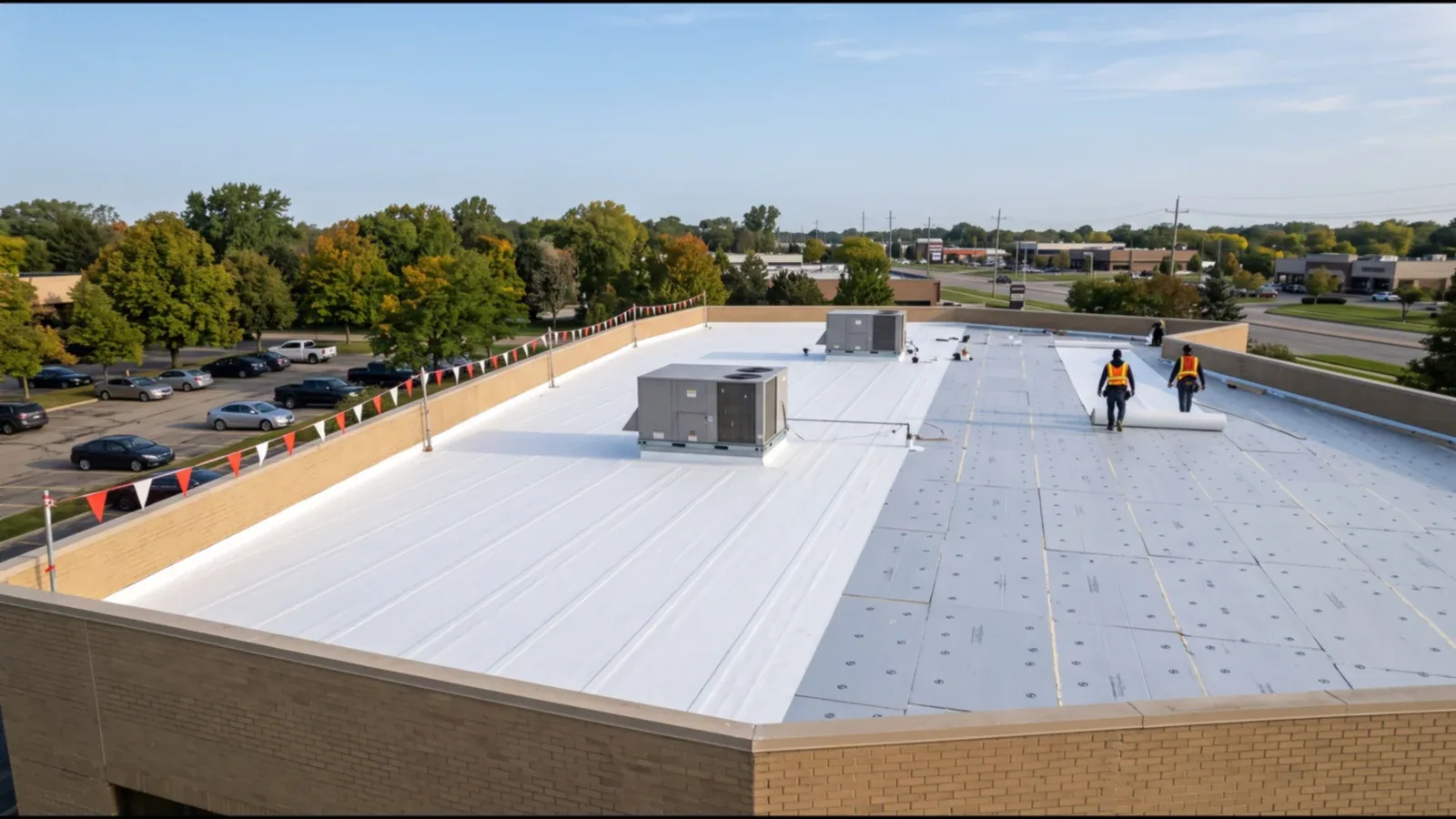
PVC welds at a lower temperature than some other sheets, which helps in cool weather, but a membrane that is frozen or wet still bonds badly. Cold air also stiffens the sheet, so a roll that is unwrapped in winter conditions resists lying flat. We stage rolls somewhere warm, check the sheet for moisture, and probe each seam after it cools.
Details are a separate challenge. Penetrations, inside corners and edges often use PVC-coated metal and pre-formed pieces, which weld to the field sheet and give a durable edge when installed correctly. A poorly formed corner or a weld that was rushed shows up as a pinhole leak a season later. Because of that, we inspect every welded detail and write down the probe results by location, and the same discipline applies when we perform a membrane puncture repair on an existing PVC roof.
Repairing a PVC roof that is still serviceable
Most PVC repairs are patches welded to clean, dry membrane. The sheet has to be wiped, and on an older roof the surface may need a mild cleaner to remove the oxidized film before a weld will take. A new PVC patch on an old, plasticizer-depleted sheet can fail around its edges, so we use patches with rounded corners and generous overlap, and we check the sheet outside the patch for hardness.
When repairs begin to repeat in the same area, the sheet itself is usually the issue. A scan for wet insulation, followed by a pass of core samples, shows whether water has already entered. At that point the owner's choice is between a local repair and reroofing the affected portion, and the commercial roof repair estimate lists both options with their trade-offs.
Foot traffic adds to the wear. PVC is slick when wet or frosted, and a service route to rooftop units that crosses bare membrane collects scuffs and grit. Walk pads along the route, laid out so they do not block drainage, protect the sheet and give a technician a safer footing on a frosty morning.
PVC in West Jordan buildings
West Jordan reports access to I-15 and I-80, and its general plan welcomes regional commercial, office, service and mixed-use projects, including the historic downtown core at Redwood Road and 7800 South. Restaurants, medical offices, labs and similar buildings are the places where PVC makes its case, because their exhaust and uses stress a roof harder than a plain office does.
For owners in West Jordan or Taylorsville, we weigh PVC against TPO and KEE using the actual exhaust, the rooftop traffic and the age of the building, then recommend the membrane the roof will use best. The decision also depends on the insulation below, the deck, and whether the roof is a full tear-off or a recover over an existing system.
The right choice also depends on the insulation below, the deck and whether the job is a full tear-off or a recover.
Commercial Roofing Questions
Is PVC worth the higher price over TPO?
On a roof with kitchen exhaust, oils or chemical vapors, usually yes, because the sheet resists what would damage TPO. On a plain office roof with little contamination, TPO often does the same job for less.
Why does PVC need a separation layer?
PVC reacts with asphalt and some foam insulations. A slip sheet or cover board keeps them apart so the plasticizers are not drawn out and the membrane is not damaged from below.
Can PVC be installed over an old roof?
A recover is possible when the old roof is dry and compatible, with a separation layer between. We scan for moisture first and remove any wet insulation.
How do you know a PVC roof is aging out?
The sheet turns stiff, cracks at corners, shrinks away from walls and leaves visible scrim. Local patches begin to fail at their edges, which is the sign that the surrounding sheet no longer bonds.
What happens to grease on a PVC roof?
PVC tolerates it far better than other sheets, but built-up grease still collects dirt and clogs drains. Containment on the fan and a regular cleaning route keep the roof working.
Tell us what vents onto the roof
Share the building use, the exhaust equipment, the roof age and where water has shown up. We will schedule a roof walk, check the membrane condition and confirm the repair boundary before the work is priced.