
Dark streaks running from a scupper, a corner of coping that rocks when pressed, or a soft spot that gives underfoot beside a rooftop unit are the sorts of things a person only sees by standing on the roof. In West Jordan, UT, the weeks after the last snow melts are when those signs are easiest to read, because the winter has already tested every seam and drain. An inspection is a walk across the whole roof with a clear plan: look at the surface, press on the details, probe the seams, and write down what is sound, what has moved and what needs another look.
The goal is a roof that the owner understands, with a short list of findings that can be repaired, watched or planned for.
Roof-walk notes: the route we follow
We start at the access point and photograph the roof from the hatch or ladder so the starting condition is on record. From there the route follows the drainage. We check each drain bowl, strainer and scupper first, since blocked outlets are the most common reason water stays on a roof. Then we move along the slopes, looking at the surface for blisters, cracks, punctures, ponding stains and worn walkways.
Penetrations and edges come next. Every pipe boot, curb, vent and unit connection is examined for sealant condition, flashing height and fastener backout. We press on coping and edge metal, test the termination bar on wall flashings and look for membrane that has shrunk away from a corner. In each case the finding is measured from a fixed point, such as a drain or unit, and photographed, so the location can be found again.
Drainage and melt: the spring check
Recurring winter snowfall and freezing periods are part of life in the Salt Lake Valley, and they put a particular stress on drainage. Weather normals recorded at Salt Lake City International Airport describe the cycle clearly: snow, melt, refreeze. A spring check after the thaw looks for the marks that cycle leaves behind. Standing-water rings show where the roof did not drain. Cracked sealant shows where metal moved. Debris piled against a parapet shows where meltwater had to push through.
A fall check works too. It catches clogged drains before the first snow and gives the owner time to repair flashing before it is covered. Between the two, most roofs need little more than cleaning, a few sealed details and a record of what has been done.
Seams, edges and penetrations
Most inspection findings sit at a joint. Heat-welded seams on a single-ply roof are probed along their edges for open fish mouths and cold welds. Lapped seams on modified bitumen are checked for lifting and granule loss along the laps. On metal roofs, we look at fastener heads, panel laps and the sealant at ridge and eave closures, since movement through hot and cold seasons loosens them first. Each defect is photographed against a ruler or a fixed reference so a later visit can compare size and spread.
Penetrations are checked as a group, because a roof with many of them has many chances to leak. Pitch pans that have dried out, gas lines with cracked boots and conduit supports that rub the membrane all go on the list, along with a note on how each one should be repaired.
Wet insulation: what the surface hides
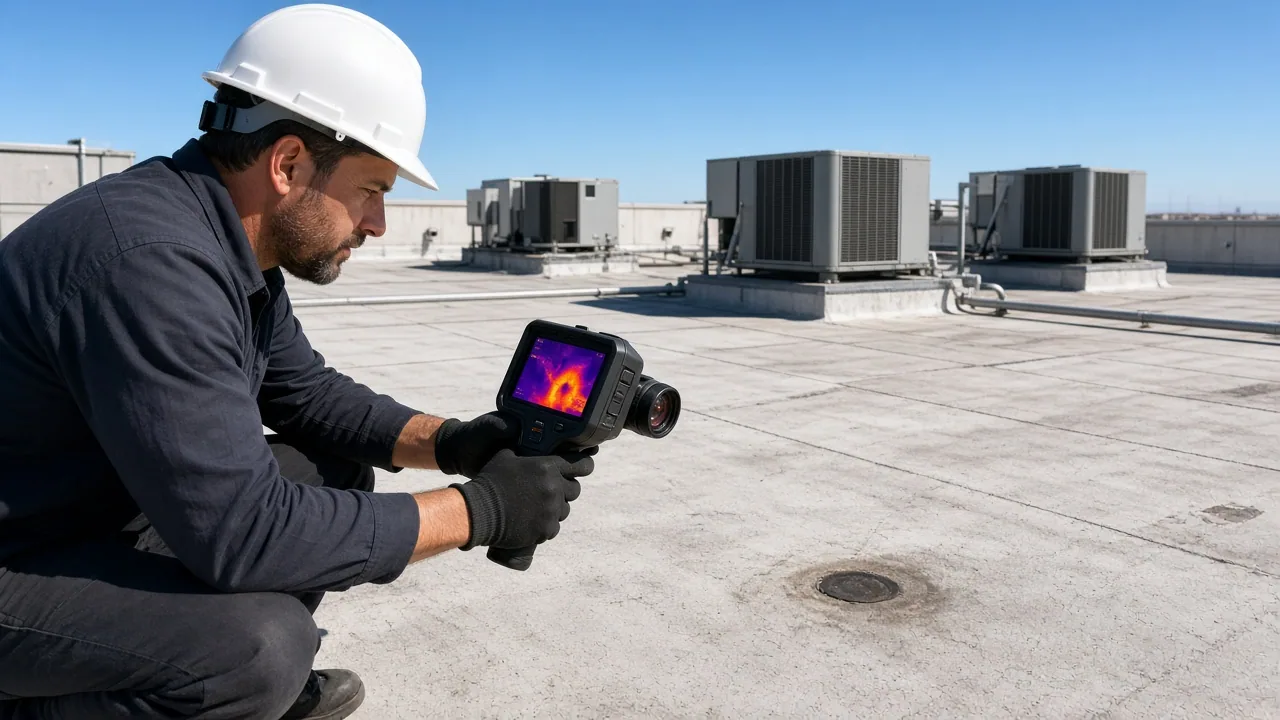
A dry-looking roof can still have water inside. Insulation under the membrane can take on moisture through a small split, a failed seam or a flashing gap and hold it for a long time. We check with a handheld moisture meter at suspect areas, and for larger or older roofs we recommend an infrared moisture survey to map the pattern. Where the readings are high, a core sample confirms what the meter suggests.
A hand inspection cannot see everything. That is why we separate what we confirmed from what we are inferring, and we say what test would settle the question. For roofs that are large, steep at the edges or hard to cross safely, a drone inspection adds imaging from above, which helps when the walk covers only part of the surface.
Findings that owners can use
The report is written for a manager who may not be on the roof. It lists each finding with a photograph, a location, a severity and a recommended action. We separate items into immediate repairs, items to watch, and conditions that point to a bigger decision. If a roof is near the end of its useful life, the report says so and gives the signs that support it, along with options such as a planned repair, a recover or a replacement.
A photo-backed roof condition report also serves property sales, lender requests and insurance reviews. It gives the next person a baseline, so a roof is not judged from memory or from a single stain.
Safety, access and scheduling
An inspection starts with how the roof is reached. A fixed ladder, a roof hatch, an interior stair or an exterior ladder each has its own limits, and some roofs have parapets low enough to need fall protection near the edge. We confirm access and the safety plan before the visit, and we tell the manager if part of the roof cannot be crossed on foot. That portion is recorded as unwalked, with a plan to use drone imaging or a return visit.
Scheduling follows the building. For an occupied office or a retail site with morning deliveries, we pick a time that avoids the busiest hours, and we let the front desk know when the crew will be on the roof and when it leaves.
Where inspections happen
West Jordan has regional commercial, service, office and mixed-use buildings, with planned station areas around Gardner Village, the downtown core at 7800 South and Redwood Road, and Old Bingham Highway. Roofs in those settings carry different loads. An office roof may have a quiet surface and a few units, while a distribution building can have many penetrations and a long path to the drains. We tailor the walk to the building use and note who controls access, because a locked hatch can hold up a whole inspection.
We inspect roofs across West Jordan, South Jordan and Midvale, and we can fit visits into a schedule that matches tenant hours.
Commercial Roofing Questions
What does a roof inspection actually include?
A full walk of the roof surface, drains, seams, flashings, penetrations and edges, with moisture checks at suspect areas and photographs of each finding. The report ranks items by urgency.
Can an inspection tell how many years a roof has left?
It can show the condition and the rate of wear. Remaining life depends on the membrane, how it was installed and how the building uses the roof, so we describe what the signs point to rather than a number.
When is the best time to inspect?
Spring after the thaw, when winter damage is visible, and fall before the first snow, when drains and flashings can still be cleared. A storm or a leak also justifies a visit.
Do you need to go onto every roof level?
Yes, where safe access exists. For roofs with fall hazards or limited access, we use drone imaging and record the areas we could not reach by hand.
Will an inspection find the cause of an interior stain?
Often, because the walk follows the water uphill. If the stain does not match a visible defect, we recommend a moisture survey or a controlled water test.
Should a new owner inspect a roof before closing on a building?
A roof walk before closing gives a buyer the condition and a list of near-term repairs. For larger properties, a moisture survey and a written report give the lender and the buyer the same facts to work from.
Schedule the roof walk
Share where water has shown up, when, and how roof access works. We will set the walk, photograph what we find, and say what must be confirmed before a repair line or schedule is set.