
A roof that looks fine from the ladder, with a clean surface and tight seams, can still be soaking wet inside. Insulation under a membrane takes water through a pinhole, a failed seam or a flashing gap, then holds it for months, and the first sign may be a stain that appears in a room far from the leak. In West Jordan, UT, where winter snow melts across flat roofs and then freezes again at night, that hidden water is a real concern, because wet insulation adds weight, loses its thermal value and can freeze and expand inside the roof. An infrared and core-cut survey finds it before the next repair is priced.
The survey is a map of where the roof is wet and where it is dry, and that map settles most of the repair-or-replace question.
How the scan works
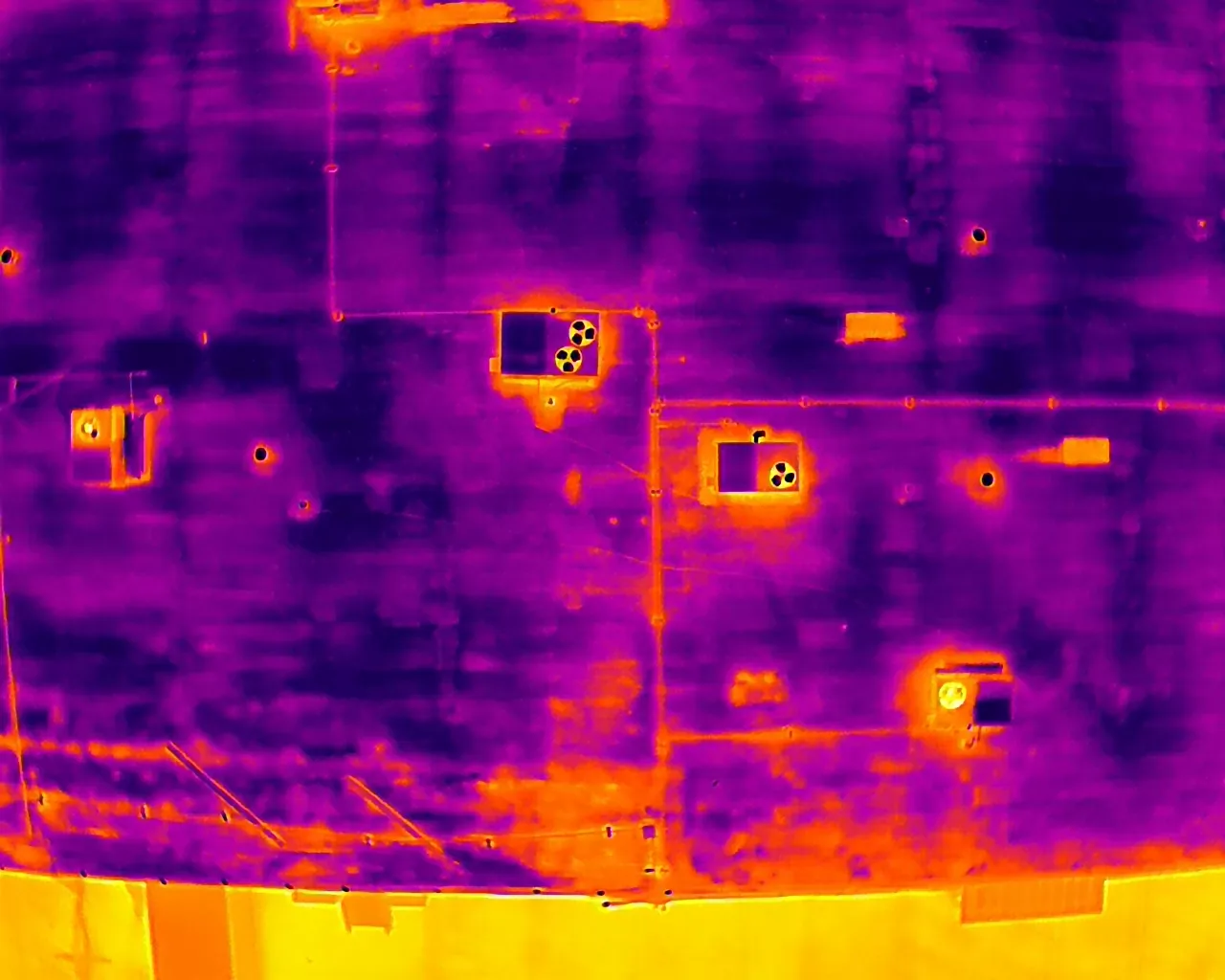
Wet insulation holds heat longer than dry insulation. After a sunny day, a roof cools in the evening, and the wet areas stay warmer than the dry ones. An infrared camera sees that difference as a pattern of warm patches against a cooler background. We scan the roof surface at dusk or in the hours after sunset, when the temperature difference is strongest, and we mark each warm patch on a roof plan.
The scan does not prove that a patch is wet. Dark surfaces, equipment shadows, ballast and thickened insulation can also read warm. That is why every suspect area is checked on the roof with a moisture meter, and why the final map rests on the combination of images, meter readings and core samples rather than on any single tool. We can run the scan on foot, or add a drone flight where the roof is too large or the access too limited for a walk.
Core cuts: the proof underfoot
A core cut is a small round sample taken through the roof down to the deck. We pull the layers apart, look at the insulation, the cover board and the underside of the membrane, and weigh or meter the material. A dry core in a warm patch tells us the reading was a false alarm. A saturated core in a patch shows the extent and depth of the water, and it also shows whether the deck beneath is sound or rusting.
Each core is patched immediately with a matching repair so the roof remains watertight, and the location is recorded. We take samples at the strongest warm patches, at the edge of each suspected wet area to set a boundary, and at a few places that read dry, so the map has a control. The result is a drawing the owner can use to decide whether to cut out wet areas, recover or replace the roof.
Seasonal timing and conditions
Infrared scanning needs the right conditions. The roof should be dry, the sun should have warmed the surface during the day and the evening should be calm and clear. Snow or standing water hides the surface, and rain after a scan can change the readings. Repeated winter snowfall, cold-season freezing and warm summers mark the Salt Lake Valley, and the airport normals that show it describe the region, not each West Jordan building. For scanning, that means the best windows tend to be late spring through early fall, when roofs are dry and evenings are warm.
A winter scan is possible after a dry, sunny spell, but the contrast is lower and the roof may be covered. If an active leak cannot wait, a moisture meter and a few cuts can locate the wet area first, with the full scan scheduled for the next good window.
Drainage and melt: where the water gets in
Wet insulation rarely sits in random places. It collects downslope of an opening, around a drain that has settled, along a seam that opened in a freeze or beside a unit curb whose flashing has pulled. A survey that shows a wet band running from a flashing toward a drain tells us the entry point as well as the extent, and the repair can start there. A survey that shows a wet zone around a low spot points to a drainage fix, such as tapered insulation or an added outlet.
After a melt event the pattern is fresh. Water that stood on the roof for several days has had time to find any weak spot, so a scan taken a few dry weeks after the thaw tends to show the problem areas clearly. We compare the map to the drainage plan and write down which wet zones follow the slope and which sit in isolation, because isolated zones often mean a failed penetration instead of a broad membrane problem.
What the map decides
The survey turns a vague worry into numbers on a plan. If wet insulation is limited to a few patches, we cut them out, replace the insulation and close the roof with a planned repair. If the wet area covers a large share of the roof, repeated patching will not hold, and a full replacement is the dependable path. The survey also tells us whether a recover is possible, since a recover over wet insulation is likely to blister.
It helps owners budget as well. A map that shows a wet section on the north side of a building lets the owner replace that section this year and plan the rest for later, with a clear edge between old and new. The same map is useful in a sale, because it gives a buyer a documented roof condition.
Buildings where we scan
Offices, shops, service buildings and mixed-use blocks are what West Jordan's plan expects, along with planned station areas at Gardner Village and Old Bingham Highway and the downtown core at 7800 South and Redwood Road. Office and retail roofs often have layers of insulation and cover board, which can hide water for a long time, and a survey fits those buildings because it can be done with limited disruption to tenants.
We scan roofs in West Jordan, South Jordan and Sandy, and we deliver the findings as a photo-backed report with the plan, images and core records together.
Commercial Roofing Questions
How accurate is an infrared scan?
It is a strong guide for where to look, but it is confirmed only by meter readings and core cuts. Together they give a reliable map of wet and dry insulation.
Do core cuts damage the roof?
Each cut is small and sealed with a matching patch the same day. The number of cuts is kept low and placed where they answer a specific question about the roof.
Can you scan a ballasted or gravel roof?
Stone ballast and gravel hide the membrane and distort the heat pattern. We rely more on meter readings and cores, and we may move ballast in small areas to read the surface.
Is a survey worth it for a small roof?
For a small roof with an obvious leak, a meter check and a few cuts may be enough. A full scan pays off on larger roofs where wet areas decide the scope.
How soon will I have the results?
Findings from the roof walk can be shared that day. The written plan, images and core records follow once the images are processed and the cuts are labeled.
What happens to the map after the survey?
It becomes the working plan for the repair or replacement. Wet zones are outlined, core locations are numbered, and the owner can reuse the same drawing at the next spring check to see whether wet areas have grown.
Find the wet insulation
Share where water appears, when it appears and how roof access works. We will schedule the scan, take the core samples and tell you which areas must be confirmed before a repair boundary is set.