
A thin dark line along a white seam, usually spotted first after a thaw when water stands for a day beside it, is how a TPO roof often announces that a weld has let go. In West Jordan, UT, where flat roofs carry snow through the cold months and swing through a wide temperature range between January and July, a single-ply membrane has to stay welded and flexible through every cycle.
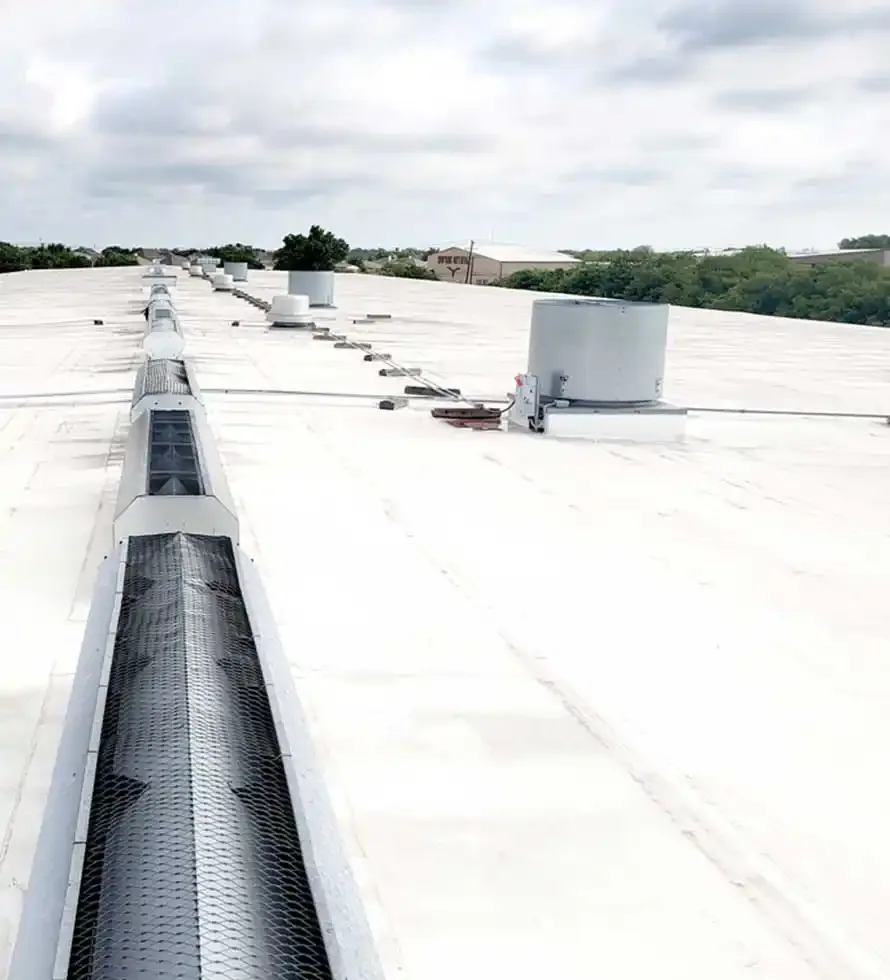
TPO, short for thermoplastic polyolefin, is a white, reflective single-ply sheet whose seams are fused with hot air instead of glued. Its popularity on commercial buildings comes from that welded seam and from a price that sits below many other single-plies. We install it, repair it and judge whether an aging TPO roof deserves another round of repairs or a replacement.
Seam welds: where a TPO roof earns its life
A hot-air weld melts the two sheets together so the seam becomes part of the membrane. A good weld has a consistent bead of melted material at the edge, and a probe run along it should find no gaps. Weak welds come from dirt on the sheet, a welder moving too fast, cool air or a membrane that was damp at the time. Cold weather makes all of these easier to get wrong, which is why we test welds with a probe as the crew works, not only after the crew has packed up.
On an existing roof, seam probing is a standard step in an inspection. We trace each seam, mark any lift, and decide between a hand-welded patch and a larger repair. Seams crossing a low spot where water stands are the first to fail, so the seam failure repair often goes hand in hand with correcting the drainage that exposed them.
Mechanically attached, adhered or ballasted
TPO is installed three ways. A mechanically attached system fastens the sheet along its seams with plates screwed into the deck, which is quick and economical but depends on the deck and the fastener pattern for wind resistance. A fully adhered system glues the sheet to the substrate across its whole face, which reduces fluttering and suits roofs with complex shapes or tight wind requirements. A ballasted system lays the sheet loose and holds it with stone or pavers, which adds load but avoids penetrations.
The right one depends on the deck, the structure's capacity and the budget. A steel deck takes plates well, a concrete deck suits adhesive, and an older structure may not carry ballast. We also think about the next owner: a mechanically attached roof can be recovered over with a new layer, while an adhered one is harder to peel apart for later repair. The choice ties into whether the job is a replacement or a recover.
Cold-weather welding and the Salt Lake Valley calendar
NOAA normals from the Salt Lake City airport station show recurring snowfall and cold-season freezing, which is a valley proxy and cannot predict conditions on each West Jordan roof. For TPO, the practical meaning is a narrower window. Welding needs a clean, dry sheet and a controlled heat, and a membrane that is frozen or damp makes a poor bond. Wind also steals heat from the weld zone, so a gusty afternoon on a roof with no parapet slows the work.
We schedule major membrane work for the drier, warmer months and use the cooler months for repairs, tear-off preparation and testing. When a repair cannot wait, we protect the work zone, warm the sheet where needed, test the weld and mark the repair for re-inspection after the next thaw. Freezing temperatures also stiffen the sheet, so we keep rolls in a warm place until they are unrolled.
Heat, UV and how TPO ages
The same normals show warm summers, and a white membrane faces that sun for decades with no shade. UV and heat gradually change the sheet. Over time it can lose flexibility, shrink slightly at its edges and pull at the flashings, which is why wall and curb details are often where age shows up first. Surface crazing, a network of fine cracks, is another sign that the top layer is wearing out.
Thickness matters here, because a thicker sheet has more material between the reinforcing scrim and the weather. A roof walk looks for exposed scrim, shrinkage at the walls and dirt that holds heat. A membrane in that condition may take a silicone coating if the substrate is dry, or it may be near the end of its life and ready for a recover, with a moisture survey to decide.
Flashings, corners and the details that decide the roof
Most TPO leaks start at a detail, not in the field of the roof. Inside corners, outside corners, pipe penetrations and the base of curbs all call for pre-formed or hand-shaped pieces, welded into the field sheet. Those pieces can be installed poorly or stressed by movement. A corner patch with a hairline tear, a boot that has pulled loose from a pipe, or a wall flashing that has slid down can let water in with no sign in the field.
We treat each detail as its own inspection item, press along the vertical flashings for hollow spots, and check termination bars and sealant at the top edge. Equipment bases are a common weak point, so our curb and support work follows TPO-compatible details, with correct reinforcement around any cut through the sheet. Where a roof drain or scupper meets the membrane, we check that the sheet is sealed to the drain body and that the surrounding area slopes toward it, since a drain set high leaves a ring of standing water that works on the weld every thaw.
Where TPO shows up around the valley
The city's general plan encourages regional commercial, service, office and mixed-use building, and it identifies Redwood Road and 7800 South as the historic downtown core and regional commercial setting. Whether a given building there carries a low-slope roof that suits a single-ply is settled on the roof, not by the district. Farther south, Bluffdale reports business and distribution development in Mountain View Business Park and retail and flex-office uses planned for Wardle Business Park.
For owners in West Jordan or Bluffdale deciding on a membrane, we compare TPO with PVC and EPDM against the building's use, rooftop exhaust, foot traffic and the budget before recommending one.
Commercial Roofing Questions
How thick should a TPO membrane be?
Thicker sheets give more material over the reinforcing scrim and tolerate more weathering and foot traffic. The right gauge depends on the building and the warranty terms the manufacturer attaches to each thickness.
Can TPO be installed over my old roof?
If the existing roof is dry and the deck sound, a recover is possible with a separation layer or cover board between. A moisture scan decides, and wet insulation must be removed first.
Why do some TPO seams fail early?
Dirt, damp sheets, cold air and rushed welding are the usual causes, along with standing water at a seam. Probing every seam during installation catches most of those problems before the crew leaves.
Does TPO handle grease and exhaust?
Not as well as PVC. Kitchen exhaust and oils can soften a TPO sheet, so roofs below restaurant vents usually call for a different membrane or a protective pad.
What does a TPO repair involve?
We clean the area, cut out the damage, weld a patch of matching material with overlap on every side, and probe the edge. Any area that holds water gets a separate correction so the repair does not fail again.
Schedule a seam check
Tell us when the roof was installed, where water appears and how access works. We will arrange a roof walk, probe the seams and flashings, and confirm the repair boundary before a repair or replacement is priced.