
A drip that appears two days after the snow starts to melt, in a hallway nowhere near the roof edge, is a familiar call to a property manager in the valley. In West Jordan, UT, a roof that held through December can start to let water in when the daytime sun softens the snow, the meltwater runs to a low spot, and the freezing night that follows locks it against a seam. The leak is real, but the place where it shows up is only the end of a path that runs a long way across the roof. Our work is to walk that path backward until we reach the opening, and to stop the water there instead of at the stain.
That takes a roof walk, a flashlight, a moisture meter and some patience with the sequence of what happened and when.
Tracing the water path
Water travels along the underside of a membrane, down a deck flute, across a purlin or along a pipe before it finds a gap in the ceiling. We start at the interior stain and note the direction of the roof slope and the location of the nearest drain, wall, curb and rooftop unit. The entry point is almost always upslope of the stain and often at a detail: a flashing termination, a seam crossing, a pitch pan, a split boot or a drain ring with a failed seal.
On the roof we look for ponding marks, torn or fishmouthed seams, shrunken flashing, open sealant and cracks near fasteners. Where the surface looks sound, we use infrared imaging or a small moisture survey to find wet insulation that marks the real route. If it is still unclear, a controlled water test with a hose, section by section, isolates the opening without guessing.
Usual suspects: drains, seams, edges
Some failures show up again and again. A drain bowl that has settled below the surrounding field gives water a path under the clamping ring. A heat-welded seam that opened at a cross joint after a hard freeze admits water at the edge of every storm. A wall flashing that has pulled from its termination bar lets runoff behind the membrane. Rooftop units with old curb flashing are another source, as are conduit penetrations that were added after the roof was installed.
We keep a short list of what we expect to find and check it in order, which saves time on a roof with many penetrations. When the leak is at a skylight or penetration, the repair is usually a rebuilt flashing rather than a smear of sealant, because a sealant bead on a moving joint is gone by the next thaw.
Snowmelt and refreeze
The Salt Lake Valley has recurring winter snowfall and cold-season freezing, along with warm summers. Salt Lake City International Airport's long-run weather normals speak for the valley, not for any one West Jordan roof, yet they describe a pattern worth planning around: snow accumulates, melts in a few warm hours, and the water that cannot leave the roof freezes again at night. Ice that forms at a drain or along a roof edge blocks the path the next melt needs.
That is why leaks tend to show in late winter and early spring. We treat a melt event as a prompt to check drains and low spots, and we look at the roof edge where ice dams can push water behind the edge metal. A leak that only shows during a thaw usually points to drainage or a detail near it, and that narrows the search before we climb the ladder.
Temporary stop versus permanent repair
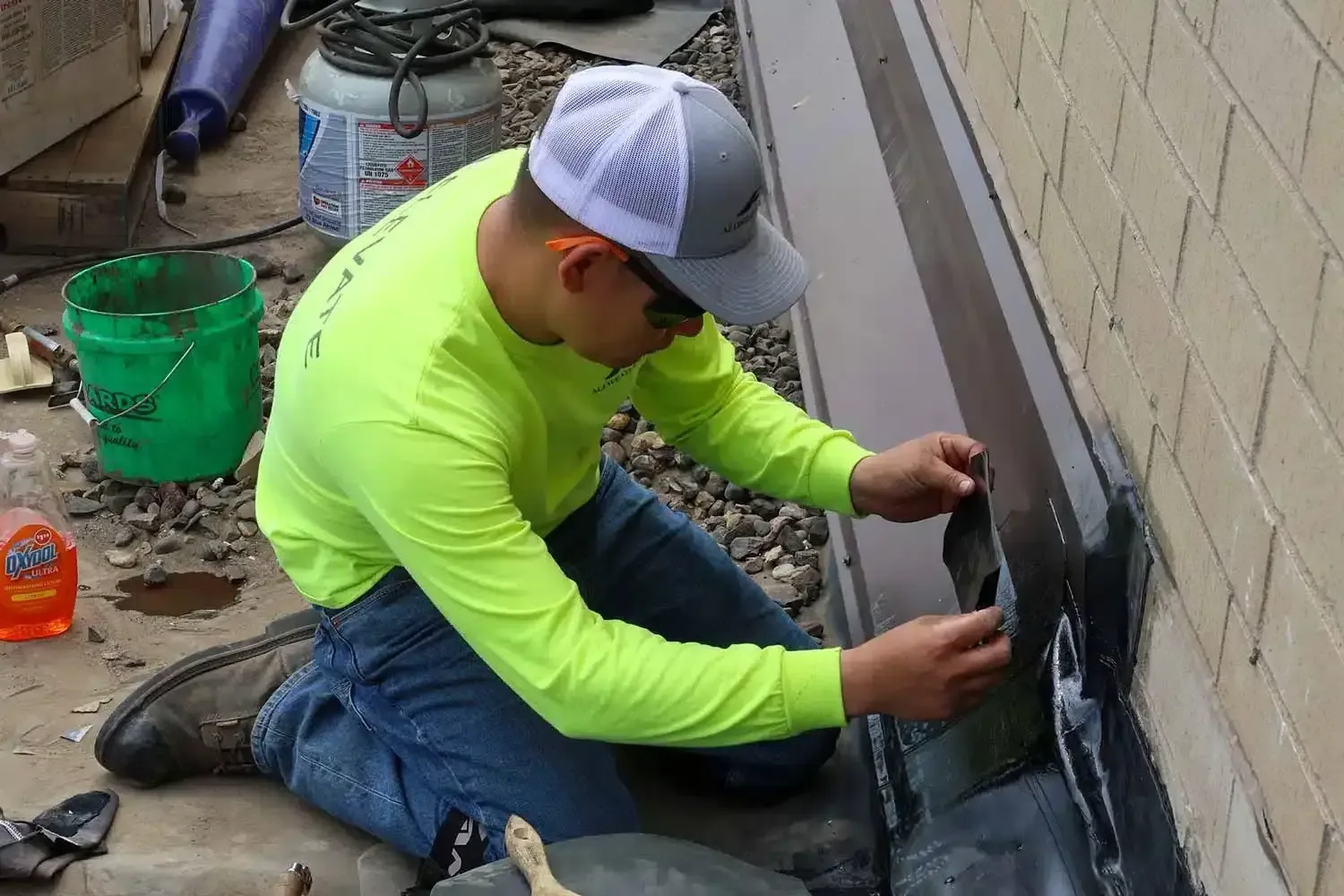
When water is coming in now, the first goal is to keep it out. A temporary stop might be a membrane patch, a sealed boot or a layer of tape and mastic across a split, applied in the conditions available. It buys time but it is not the finish. Cold, wet surfaces do not take adhesive well, and a patch put on in a freeze often needs to be redone in the dry window.
The permanent repair removes the failed material, cleans the substrate to a bondable surface and rebuilds the detail with lap and fastening that matches the system. If the insulation below is wet, we cut it out and replace it. If the leak is the third or fourth at the same spot, we say whether a repair is still the right tool or whether the section needs a planned repair campaign or a larger replacement.
Repair line and follow-up
Once the opening is repaired, we write down where it was, what failed and how far the repair reaches, with photographs of the area before and after. That record matters when a second leak appears a few feet away, because it shows whether the new water came through the same detail or a different one. It also gives a manager something to hand to an insurer if the damage reaches ceilings or stock, particularly when a storm or a melt event started the leak. Where the claim is larger, our claim documentation work organizes the photographs and findings in the order an adjuster reads them.
We recommend a short recheck after the next melt or heavy rain. A repaired detail is the first place to look, and the drain bowls nearby are the second.
Offices, retail and warehouse leaks
The city's general plan allows for commercial, service, office and mixed-use buildings and for transit-oriented station areas such as the Gardner Village area and the Old Bingham Highway station area. A leak in an office suite means ceiling tile damage and tenant calls. A leak in a warehouse can mean stained racking or product. A retail leak can close a store for an afternoon. The cost of delay is different in each building, and the order of the repair changes with it.
For owners in West Jordan, Sandy and Murray, we ask where the water appears, how long after weather, and who can give roof access. We then plan a roof walk in a window that fits tenant hours, and we protect interior areas with a temporary catch while the crew traces the opening.
Commercial Roofing Questions
Why does the leak show up far from where the roof is damaged?
Water follows the deck, insulation seams and fasteners before it drops. The stain marks where it found a gap in the ceiling, not where it entered the roof. We trace upslope from the stain.
Can you fix a leak while it is raining or snowing?
We can make a temporary stop, because the point is to keep water out of the building. A permanent repair needs a dry, clean surface, so we return in a suitable window to rebuild the detail.
How do you know when the insulation is wet?
We use infrared imaging, a handheld moisture meter and, where needed, a small core cut. Wet insulation reads warmer or heavier than dry, and it is mapped before we close any repair.
What should a tenant do while we wait for the crew?
Place a bucket, move stock and equipment out of the drip line and photograph the stain with the time. Those photos help us match the leak to a weather event and tell the insurer what happened.
Will the leak come back after the repair?
A repaired detail is built to hold, but a roof can have more than one opening. We recheck after the next melt or storm and flag any new entry so it is handled before it spreads.
Tell us where the water shows
Share where water appears, how long after weather it shows, and how roof access works. We will set the roof walk, trace the path, and tell you what must be confirmed before a repair boundary or schedule is set.