
A roof leak above a data room asks for a quick decision, but the first safe step is still to find the opening and protect the equipment zone below, because water travels along a drain line, a seam or a curb before it ever appears inside. West Jordan's winter snowfall and thaw periods make drainage a seasonal check, while summer heat and freezing nights stress exposed details at different times of year. A facility like this may have cooling, power and communications penetrations owned by different trades, and a roof walk that crosses an access boundary without an escort is a roof walk that does not happen. We map the reported area, list what can be inspected from the approved route, record the zone, the membrane and the nearby transitions, and coordinate equipment access before any layer is opened. A commercial roof inspection starts from the roof as it is and the site's own access rules.
Keep each system boundary visible
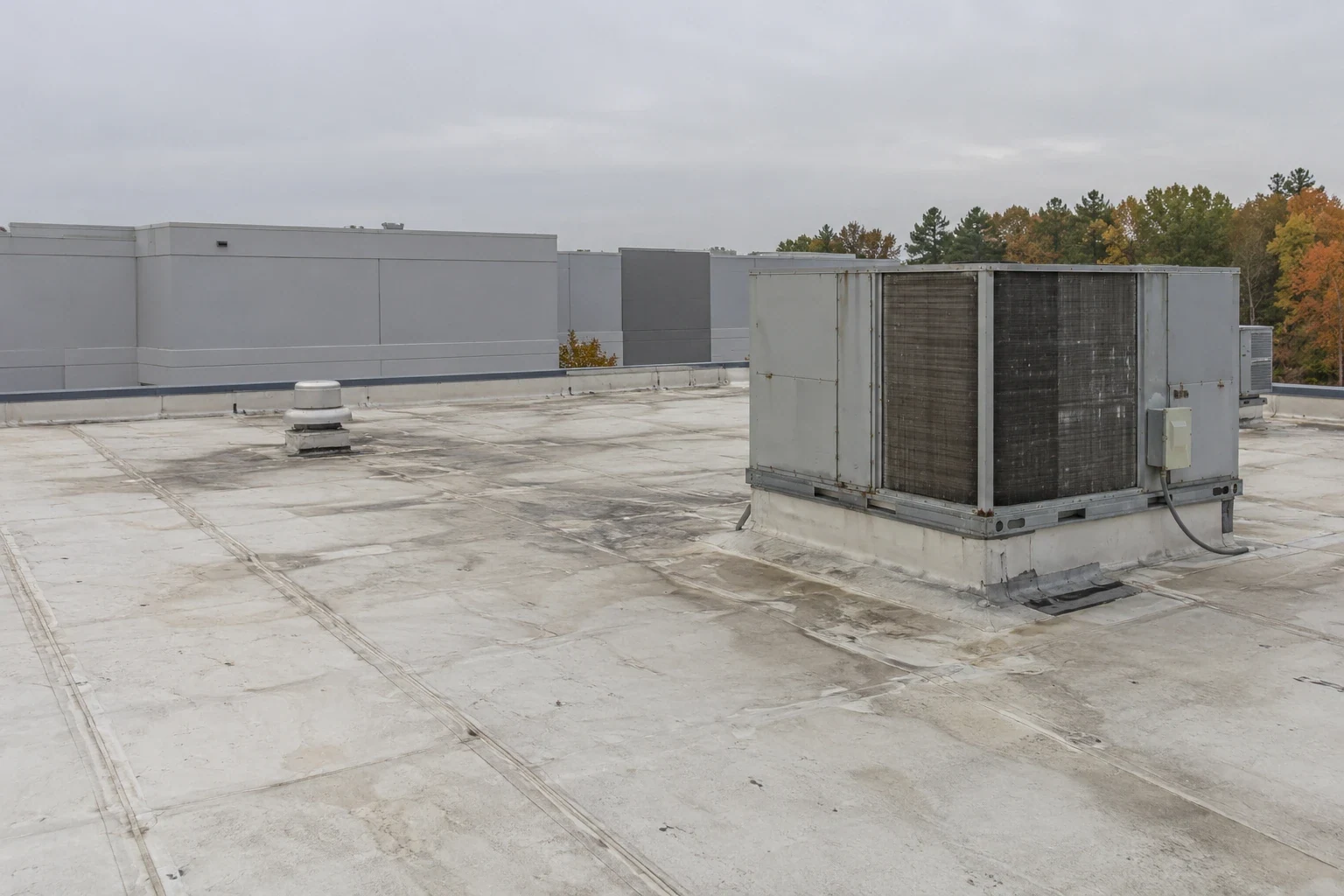
We divide the roof into sections that match the facility map and mark where cooling equipment, electrical conduits, screens and parapets interrupt the membrane. Each curb gets a location and a condition note. We check the attachment, the flashing corners and the drainage around each base, then list any area that cannot be reached without an escort or a shutdown. That keeps the walk from turning into a general look across the surface and gives the facility contact a clear record of what was inspected and what was not.
A roof opening near cooling equipment can involve several trades. We confirm who may move an item, who restores its connections and who answers for the roof seal when the work is done. A new conduit or a replacement unit changes the penetration, so the curb and the membrane are checked again after each trade handoff, and the equipment curb and support detail goes into the scope when that transition sits on the leak path.
Test moisture before widening the repair
A ceiling mark or an alarm near a roof line guides the walk, but neither one tells us how far moisture traveled. We compare the report with the roof slope, the seams, the drains and the nearby penetrations. Where the insulation condition will change a repair or recover decision, a targeted test confirms what the surface walk cannot. Infrared imaging can help locate thermal differences, and an infrared moisture survey is useful for choosing the places to open, but the finding needs roof context and, where it matters, a physical check.
We document the opening and the layers found there, then say whether the boundary needs another check before material is ordered. If wet insulation is confirmed, we mark the removal limits and the closure details so the repair includes the affected assembly and not only the visible membrane defect.
Water around drains and equipment
A drain near a large curb can be clear at the bowl and still leave water trapped behind the equipment base. We follow the slope, inspect the outlet connection and compare the low point with the membrane transitions around the curb. The valley's winter, as the Salt Lake City airport records it, brings repeated snowfall and long snow cover, and what actually reaches this roof depends on the building's elevation and exposure. The drain and scupper repair applies when the outlet or its tie-in has failed.
A wet seam or flashing joint takes a beating from freezing nights, and sun-facing surfaces take the heat of July. When a leak recurs, we look for the repeatable path instead of applying a wider patch without a boundary. We check adjacent seams, edge metal and penetrations, then note whether the location dries after the area around it. If water appears near a redundancy line or an equipment platform, access controls and interior protection may decide when testing is possible.
Repair, recover or replace
A localized opening in a sound membrane may call for a repair. A recover can be considered when the existing layers are dry, attached and compatible with the proposed system. Widespread moisture, failed attachment or repeated defects can push the decision toward selective removal or replacement. We inspect representative areas and identify any test needed to establish the assembly. The recover option is judged against the deck, the insulation, the drainage and the edge conditions, not chosen from a facility label.
For a larger project, price and schedule depend on roof area, the number of penetrations, the edge details, the insulation, the access and the need to keep critical operations protected. We separate confirmed work from hidden conditions and state what evidence would trigger a change. The proposal also needs a staging plan, a material route, dry-in steps and a person authorized to approve field decisions, and if the work touches a cooling curb, the roofing sequence has to line up with the equipment trade's schedule.
Roof access in West Jordan
For a facility in West Jordan, where the city reports access to I-15 and I-80, we confirm escort rules, restricted equipment zones and the truck route for materials before setting the roof route. Nearby office building roofs and manufacturing plant roofs share curb and drain questions, but a data center has its own access controls and continuity needs, so we work from its roof details, its leak history and its operating constraints, then identify what can be repaired immediately and what requires a planned outage or a test.
Shutdown windows deserve an early conversation. If a leak sits over equipment that cannot be powered down for a long stretch, the repair is split into steps that fit the outage the facility can offer, with the dry-in done first and the permanent work scheduled for the next window.
Make the closeout auditable
Before mobilization we confirm the roof entry point, the escort contact, the staging location, the permitted work hours and the interior areas that need protection. If a test cut or an equipment move is involved, the work order names who approves it and how the opening is closed. Each shift ends with a documented dry-in and a check of the work area, and the schedule keeps an alternate window for days when the surface or the weather is unsuitable.
After closeout, the record lists the roof zone, the repair materials, the photographs and any condition to monitor. A roof condition report can support the handoff, and planned maintenance can revisit the drain bowls, seams and curb flashings between projects.
Commercial Roofing Questions
Can a roof inspection happen without entering data rooms?
The roof route can often be inspected separately, though interior access may help compare a stain with the exterior condition. We agree on escort rules and restricted areas before the visit and note what could and could not be confirmed.
Does an infrared survey prove insulation is wet?
It identifies thermal patterns that help select follow-up locations. We read those patterns against the roof construction and, when the result would change the scope, confirm with a physical test.
How do you work around cooling equipment?
We map the curbs and service clearances, coordinate equipment access with the facility contact and confirm which trade owns each disconnection or move. The roof detail is closed and checked as part of that handoff.
When is replacement preferable to a repair?
Repeated openings, widespread wet insulation, weak attachment or failing edges may support a broader project. We inspect representative areas and explain the evidence that separates repair, recover and replacement.
What goes in a data center roof closeout?
The zone, the repair boundary, the materials, the photographs, the dry-in and any condition left for monitoring, with a note on which access or equipment coordination occurred and what the next check should cover.
Set the inspection around access controls
Share the reported roof zone, the escort rules, the equipment access limits and the timing windows. We will trace the leak path, identify any test needed and explain the repair boundary before setting work dates.