A brown ring that grows a little each spring on the ceiling tile under a rooftop unit usually has a simple origin: water found the edge of the curb, ran down the outside of the box, and followed a screw or a wire into the building. In West Jordan, UT, where snow sits on flat roofs through the cold months and then goes to water over a few mild afternoons, every curb, pipe stand and equipment rail becomes a place where melt is forced to change direction. The membrane may be sound across the open field and still fail at the one spot where someone cut through it years ago.
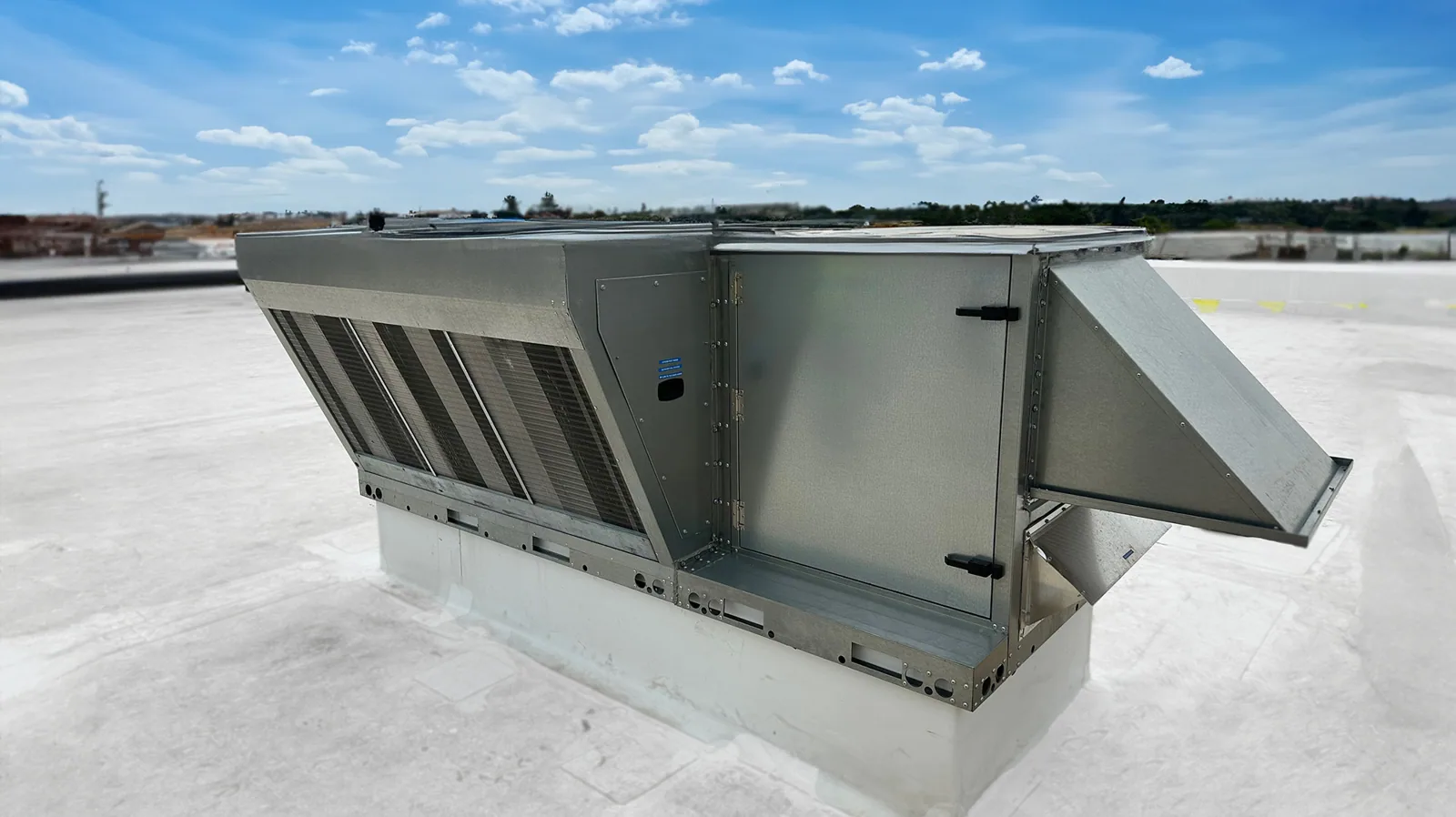
Equipment is where a roof gets opened, closed and opened again, so curbs and supports deserve their own attention instead of being treated as small details at the end of a repair list. We build, rebuild and flash them so the roof and the machinery on it can each be worked on without disturbing the other.
Curb flashing: the usual first failure
A curb is a raised frame, framed from wood, metal or insulated panels, that lifts a unit above the roof surface so water has to climb before it can enter. The membrane turns up the side of that frame and is capped at the top with counterflashing or a metal pan. Failure tends to show up in a predictable order: a corner where the membrane was folded and has since stretched, a seam that crosses the base of the curb, a sealant bead on the cap that has dried and split in the sun, and a vertical face where the membrane has slumped away from the frame.
On a roof walk we press along the turned-up membrane for hollow spots, look at the height of the flashing above the field, and check whether snow has been piling against the upslope side. Flashing that is only a few inches above the roof can be overrun when drifted snow melts in one push. When a curb needs more than a patch, we strip the flashing back to sound membrane and rebuild it with new base flashing, and where the system permits, we pair it with a flashing failure repair that carries the new work out onto clean, dry roof.
Unit supports and what sits under them
Not every unit sits on a curb. Many smaller units rest on steel rails, wood sleepers or pre-cast pads, and the membrane runs underneath them. Rails that rest directly on a membrane rub through it when the unit vibrates or when snow sliding off the sunny face of a slope shoves the frame.
We look at what each support bears on, whether a walk pad or protection layer sits below it, and whether the unit has shifted since it was set. If a support is bearing on wet insulation, the fix begins with the moisture survey and not with the support, because a new rail on a soaked board will settle again. Where a support is simply worn through, we lift the unit with the mechanical contractor's crew, replace the protection beneath it and set it down on a cleaned and reinforced area.
Pipe supports, conduit and the walk path
Gas lines, refrigerant lines and electrical conduit usually cross a roof on small supports, and they are the quiet cause of a lot of punctures. A pipe that was set on a block placed loosely on the membrane slides when the roof expands and contracts, grinding a hole in the surface under the block.
The remedy is a support that spreads the load, lifts the line clear of the surface and lets water pass below it. We replace loose blocks with purpose-made pipe stands, add a protective layer beneath each foot, and raise or relocate runs that cross the drainage path.
Snow drift and melt at the equipment
Salt Lake City International Airport records winter snowfall and freezing periods that serve as a regional reference for the valley, though snow depth and wind exposure differ from one West Jordan roof to the next. What does not vary is the way a tall unit behaves in a snowfall: wind drops snow on the lee side, a drift builds against the curb, and the melt at the base of that drift sits against flashing for days.
Where we see this pattern, we look at curb height, at whether a cricket or sloped board behind the unit would send water around the box, and at whether the drain nearest the unit is clear. A cricket is a small, sloped build-up that diverts water around an obstruction, and on a flat roof it is often the difference between a dry curb and a curb that is wet every March. For tall or closely spaced equipment, a correction to snow and ice damage at the base of the unit often starts with moving water, not with more sealant.
Changeouts and the dry-in plan
A unit changeout is the moment a roof is most exposed. The old unit comes off, the curb is open to the building below, and the weather is whatever it happens to be that day. A sound dry-in plan sets the order of the work before the crane is booked: who disconnects the unit, when the opening is covered, what temporary cover will stay on if the new unit is late, and who closes the flashing once the new unit lands.
Often the new unit does not match the old curb. We check the new curb dimensions against the opening, confirm that the curb height gives enough flashing, and rebuild the membrane connection to the manufacturer's detail for the roof system in place. A commercial roof repair at a curb goes faster when it is scheduled with the changeout, and a curb on a replacement job gets raised before the new membrane is laid, since thicker insulation lowers the effective flashing height.
Rooftop equipment in West Jordan's commercial areas
The city's general plan leans toward regional commercial, office, service and mixed-use projects, Office, service and commercial buildings of the kind that plan encourages commonly carry rooftop units, exhaust fans and piping, which is why curb work matters to them. The city identifies Redwood Road and 7800 South as its historic downtown core and regional commercial setting, and a property along that route with several units on one roof gives a manager many curbs to track.
For owners in West Jordan with several units on a roof, we map every curb and support, record its condition, and rank the work so the units most likely to leak are fixed first. Owners who already keep a preventive maintenance routine can fold curb checks into the spring visit, after the melt has shown where each curb takes water.
Commercial Roofing Questions
Can a curb be repaired without lifting the unit?
Sometimes. A split cap, a dried sealant bead or a lifted corner can be reached with the unit in place. Anything involving the base flashing, the frame or a wet curb interior needs the unit lifted so the flashing can run down to clean membrane.
How tall should a curb stand above the roof?
Taller than the deepest water or snow that can sit against it. Many manufacturers specify a minimum flashing height, and the number we use is the larger of that detail and what the roof's drift pattern asks for.
What is a cricket and do I need one?
A cricket is a small sloped build-up behind a unit or curb that sends water around it. A roof that holds water on the upslope side of equipment after a melt usually needs one.
Who handles the disconnect and reconnect on a changeout?
The mechanical and electrical trades do that work. We handle the curb, the flashing and the dry-in, and we set the order with them so the opening is never left uncovered overnight.
Do old pipe blocks need replacing on a newer roof?
Loose or cracked blocks do, because they move and wear through the surface. Stands that are solid, spread their load and have a protective layer under each foot can stay in service.
Walk the curbs with us
Tell us how many units and pipe runs the roof carries, where water has shown up below them, and how roof access works. We will schedule a roof walk, mark each curb as sound, patch or rebuild, and confirm the repair boundary before work is priced.