
Water that shows up on an interior wall just below the ceiling, or at the corner around a rooftop unit, usually traces to flashing and not to the open field of the roof. Flashing is the strip of material that turns a membrane up a wall, around a pipe or over a curb, and it moves more than the sheet beside it. In West Jordan, UT, a winter of snow and a spring of freeze and thaw followed by a hot, bright summer put a full range of movement on every one of those joints. Our first look after any leak call is at the vertical details, because they fail long before the field does.
Where flashing fails: the usual suspects
Wall bases are the first place to look. The membrane turns up the wall, a termination bar or sealant holds it at the top, and counterflashing or coping covers the joint. When the sealant dries and splits, the bar loosens or the coping shifts, water finds the gap and runs behind the membrane. Pipe boots crack in the sun, curb corners open where the sheet was folded, and skylight curbs leak where the flashing was cut short.
Edge metal creates a second group of failures. A drip edge that lifts, a coping joint that opens or a gutter that pulls away leaves the sheet's edge exposed to wind-driven rain and ice. Each is a short length of detail, and each can leak as much as a torn field if it sits over the wrong room. On a roof walk we put a hand on every termination and test the sealant by pressing it, not just looking.
Reglets and counterflashing at masonry or concrete walls need their own attention. A saw-cut reglet filled with sealant is only as good as the bond, and water that enters behind a loose counterflashing runs down the wall face and disappears into the building. Metal panels and stucco walls raise similar questions, with the roof flashing tucked behind cladding that cannot be seen from the roof.
Movement, heat and freeze
Flashing fails because the building moves and the materials do not move together. A parapet wall expands and contracts with temperature, a membrane shrinks as it ages, and rooftop equipment vibrates on its curb. Sealant that was fresh and flexible hardens under summer sun, and then splits in a cold morning. Water in the split freezes, widens the gap and lets more water in the next day.
The valley sees repeated freezing in the cold months and warm summers, and the pattern in the airport records is clear enough to plan around. Joints on the sun-facing slope age fastest, so those are the first we probe. A repair that ignores movement fails again in a season, so we choose materials that flex with the joint and details that let it move.
Ice dams and heavy snow at walls add load to flashing from above. Snow that slides off an upper roof onto a lower one lands against walls and curbs, and the weight can bend counterflashing or push on terminations. After a heavy winter, bent metal and gaps at the top of walls tell us where the load landed.
Roof-walk notes: tracing the stain
A flashing leak rarely shows directly below the opening. Water travels along the top of the wall, down a stud bay or across the deck before it appears, so we start from the interior stain and work upslope and toward the nearest wall or penetration. A water test with a hose, run in sections from low to high, can confirm the entry when the cause is not obvious. We run it only when the interior can be protected.
The notes list each flashing we tested: height up the wall, condition of the sealant, fastener spacing on the termination bar, and any open lap in the membrane, as part of a full roof inspection when the owner wants one. Photos and a plan sketch go with them. For an owner, that list separates a single failed boot from a pattern across every wall on the roof.
Repair line: reseal, rebuild or replace
The repair depends on how much of the flashing is sound. Resealing a termination with new sealant and a fresh bar works where the membrane is flexible and the substrate is dry. Rebuilding a pipe boot or a curb corner with new flashing material, reinforced with fabric where needed, restores the seal at that point. Where the membrane itself has pulled away from the wall, or a nearby seam has opened, we cut back to sound material and weld or adhere a new flashing strip.
If flashing failures run along most of the roof's walls, replacing the full set is the better investment, usually alongside a skylight and penetration flashing upgrade. A small leak repair at one detail is a fair choice when the rest are sound, and we mark the others for watch.
Weather affects the schedule. Sealants and adhesives need dry surfaces and moderate temperatures to bond, so in the cold season we make temporary seals that hold through the winter, then complete the permanent repair when the roof can take it. A short list of what was sealed temporarily, with a date for the permanent work, goes into the follow-up note.
Curbs, coping and edge metal
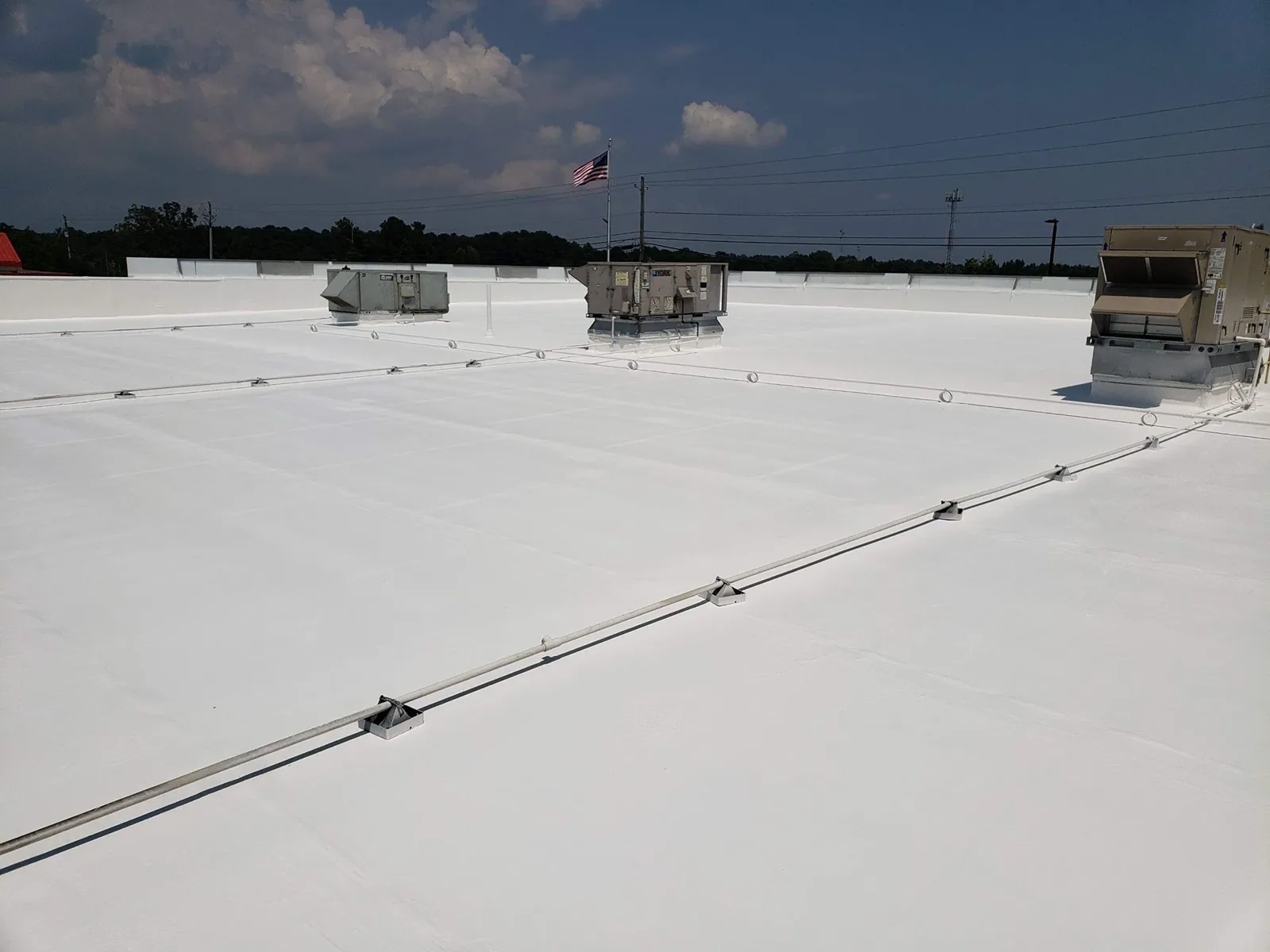
Rooftop equipment makes flashing work harder. Each unit sits on a curb, and each curb has four corners where the membrane must turn and seal. Units that were swapped over the years often leave abandoned curbs or patched openings. We check that every curb is flashed to the proper height, that counterflashing covers the top, and that nothing rests on the flashing.
Along the perimeter, coping needs a secure cleat and sealed joints, and edge metal needs a continuous attachment. Our edge metal and coping repairs replace failed lengths and add hold-downs where wind has loosened the line. Wind damage often starts at the same places.
Strip centers and corridor buildings
Taylorsville identifies Redwood Road and a set of numbered arterials as commercial access routes, and the city describes regional, community and neighborhood commercial centers along its main corridors. A commercial center with many short parapets, shared walls and rooftop units carries many linear feet of flashing, and each foot is a place to check.
For owners in Taylorsville and nearby cities, a flashing review of every wall, curb and penetration before the wet season is a practical use of a roof walk. It shows which details are due for resealing and which can wait.
Commercial Roofing Questions
How do we know the leak is flashing and not the membrane?
The stain sits near a wall, a curb or a pipe, and a roof walk finds a split sealant or lifted termination there. A water test can confirm the entry.
Can flashing be repaired without removing the membrane?
Often. We reseal terminations and rebuild boots or corners locally, as long as the surrounding membrane and substrate are sound.
How long does sealant last at a termination?
That varies with product, sun and movement. Joints on sun-facing slopes tend to wear first, which is why we probe them every spring.
Why did a repaired flashing leak again?
Usually because the joint kept moving or the substrate behind it was wet. A durable fix accounts for movement and dries the wall first.
Does failed flashing mean the roof needs replacement?
Not on its own. If the field is dry and sound, rebuilding the details extends the roof's service life.
What does a flashing inspection cover?
Every wall base, curb, pipe, drain and edge termination on the roof, with photos and a ranked list of what needs sealing, rebuilding or watching.
Tell us which wall or curb is stained
Share where water appears inside, when it shows and how roof access works. We will walk the roof, test each detail near the stain and confirm the repair boundary before work begins.