
A drip line of rust-colored streaks down a parapet wall, a coping cap that rocks when pressed, a length of gutter sagging between hangers: all of these start at the roof edge, the narrowest strip of the roof and the one that takes the most abuse. In West Jordan, UT, the edge handles wind that tugs at the perimeter, snow that slides and piles at the eave, and meltwater that runs along the fascia before it finds a downspout. When the edge metal fails, the membrane behind it is next.
The metal that frames a commercial roof includes drip edge and fascia, coping on parapet walls, gutters and downspouts, and the sealants and fasteners that hold them. Fixing it is detail work, and detail work is where small roof failures begin.
Roof edge: where wind gets its grip
Wind lifts a roof from the perimeter inward. If edge metal is loose or poorly fastened, wind catches the exposed lip, peels the metal back and gets under the membrane. A strip of membrane at the edge that is only lightly attached will begin to ripple and then tear free. Because the first few feet of a roof carry the greatest uplift, edge metal is held with closely spaced fasteners and a continuous cleat on many systems.
On the roof walk, we press and tug on every length of metal, look for gaps at the joints, check that fasteners are seated and not backing out and see whether the membrane beneath is still bonded. Sealant at the joints dries and cracks with sun and temperature swings, and a bead that looks intact from the ground may have a hairline split. Each joint is photographed, and loose lengths are marked on the roof sketch.
Coping on parapets
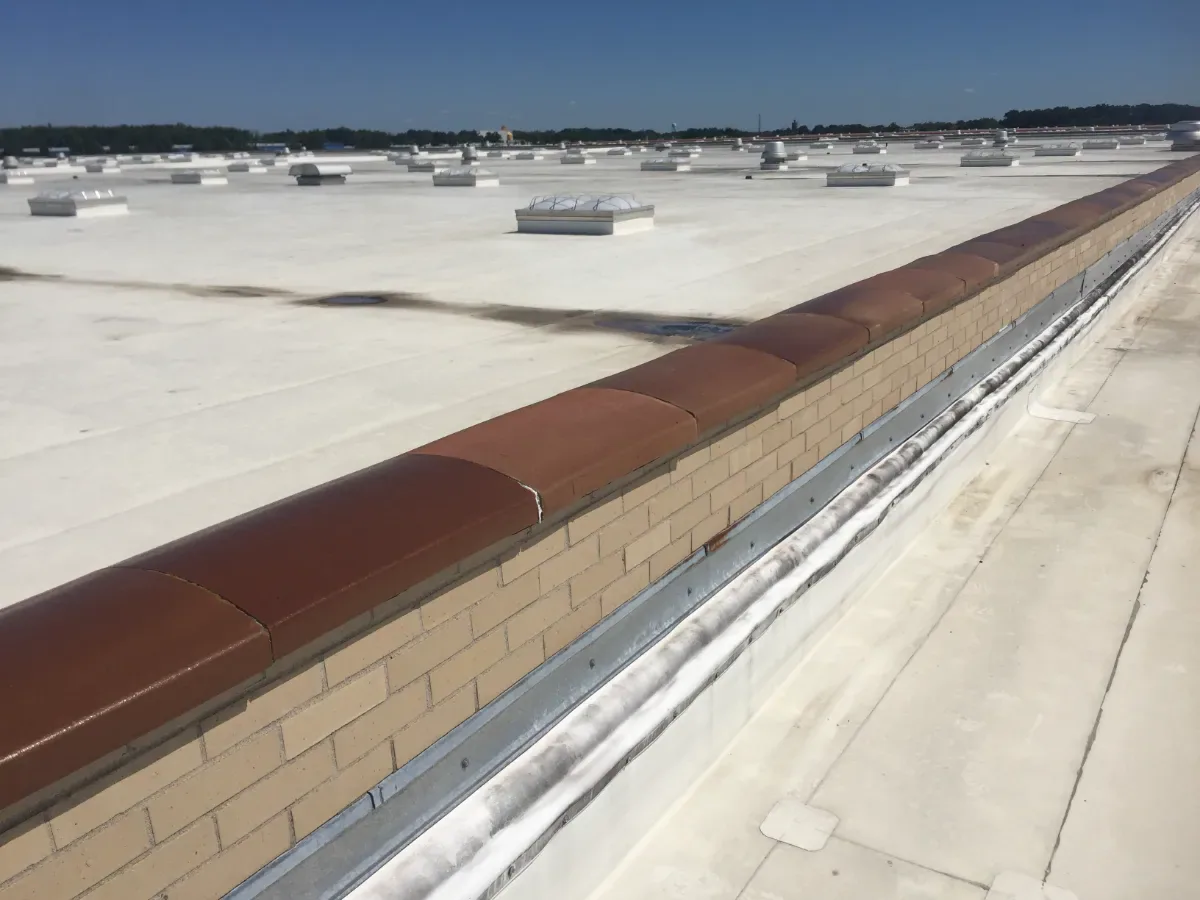
A parapet wall is a place where water can enter from three sides, so the coping cap on top does significant work. It sheds rain and melt, covers the wall's top edge and protects the flashing underneath. Coping joints are the weak spot: if the splice plates fail or the sealant opens, water runs into the wall. Over time it stains the interior finish, rots wood blocking or rusts steel supports.
We check coping slope, which should shed water toward the roof, the lap of each joint, the fasteners under the cap and the condition of the wall flashing beneath. A cap that has shifted can be reset, joints can be resealed and, where the metal has corroded or dented, it is replaced in sections. A leak at a parapet often turns out to be a flashing failure, and the coping repair is paired with a flashing repair so that both are sound when the work is done.
Gutters and downspouts in snow country
The airport normals for Salt Lake City list winter snow and freezing periods for the valley. They do not describe any single West Jordan roof, but they explain what gutters on low-slope buildings go through: snow sliding off, ice forming in the trough, meltwater refreezing at the downspout outlet. A gutter full of ice carries weight its hangers were not meant for, and a frozen downspout sends meltwater over the lip and down the wall.
We check hanger spacing, slope toward the downspouts, joint seals, end caps and the discharge at the bottom. Hangers that have pulled loose are replaced with stronger ones at closer spacing, and gutters that have bent under load are replaced. Where a building has no gutters and drains through scuppers, drain and scupper correction is the related repair, and we examine the two together.
Metals, finishes and joining
Edge metal on commercial roofs is commonly formed from galvanized or coated steel or aluminum, and each has a characteristic failure. Steel rusts at cut edges and scratches once the coating is breached. Aluminum resists rust but can dent and is more prone to movement at joints. Where different metals touch, galvanic corrosion can attack the less noble one, so isolation and compatible fasteners matter.
Finish and color are matched to the existing metal where possible, and the repair scope names the material, thickness and finish for each piece. Joints are made with lap lengths and sealants suited to the movement the metal will see. Cutting corners in these details is how a newly replaced edge turns into the next leak within a few seasons. On a building with a metal roof, the eave and rake trim must also match the panel profile, which is why a standing seam metal roof gets its trim measured from the panels and not from a catalog.
Where the edge meets the membrane
The line where the membrane ends under the edge metal is critical. On many systems the membrane is secured at the perimeter with a bar or cleat and then covered with the metal. If the membrane has pulled back or the securement has failed, replacing only the metal leaves the underlying problem in place. We lift a section of edge metal in a sample location to look at the membrane termination before writing the scope.
When the membrane is sound, the repair is limited to the metal. When it has lifted or split, the edge repair includes a membrane patch or a new termination. Where wind has already damaged the edge, a wind damage repair addresses the membrane and the metal at once, and the record shows the edge as found and as finished.
Wind ratings and the adopted code
Edge metal for commercial roofs is tested and rated for wind resistance, and a replacement should meet the rating the building's design requires. Edge details are reviewed against the 2024 International Building Code, which Utah brought into effect on July 1, 2026 along with state and local amendments. We ask for the building's existing documents and, where they are not available, state the assumption in the scope so the owner or the building department can confirm it.
A full replacement of edge metal around the perimeter is a bigger job than a repair, and it often happens alongside a re-roof, when the new membrane, cover board and edge are installed together. Planning that overlap saves cost and avoids tearing off new work.
Buildings and locations
Edge work matters on any commercial building with a low-slope roof and a parapet or gutter, whether it stands on Redwood Road, on 7800 South or inside one of the planned station areas. The edge is also the first thing to check between visits, so a preventive maintenance walk includes tugging on every length. In West Jordan, scheduled edge checks sit inside a commercial roof inspection, and the repairs cover sagging gutters, loose coping and failed drip edge.
Commercial Roofing Questions
How can an owner tell whether coping is loose from the ground?
Look for rust streaks, gaps at joints, sealant hanging out of seams and cap sections that sit at a different angle than their neighbors. A roof walk confirms by pressing on each length.
Is replacing edge metal alone enough after wind damage?
Only if the membrane under it is still attached. We lift a sample to check, and the scope includes membrane work if the termination has failed.
Why do gutters sag in winter?
Ice and snow add weight the hangers were not spaced for, and ice at the downspout holds water in the trough. Closer hanger spacing and clear downspouts help.
Can different metals be mixed on one edge?
They can, with isolation and compatible fasteners. Direct contact between unlike metals can corrode one of them.
Do edge repairs need a permit?
Minor repairs often do not, and a full perimeter replacement may. We check requirements and state the expectation in the scope.
Point us to the edge that worries you
Tell us where water or rust appears, when it appears and how the roof is reached. We will walk the perimeter, test each length of metal and tell you what must be confirmed before a repair line or schedule is set.