
A sudden thump and a rushing sound as a sheet of wet snow lets go of a metal roof and lands on the walkway below is a reminder that a metal roof sheds snow in a way no membrane does. Standing seam metal is a panel roof whose seams rise above the surface and whose fasteners are hidden beneath, and it has a place on many commercial buildings where a long, clean, steep-slope roof line is wanted.
In West Jordan, UT, where winter snowfall and freezing nights are part of the seasonal pattern, metal's speed at shedding snow is a benefit and a hazard in the same moment. We install, repair and restore standing seam roofs, and we plan snow, movement and penetrations before a panel is ordered.
Panel types, clips and what is hidden
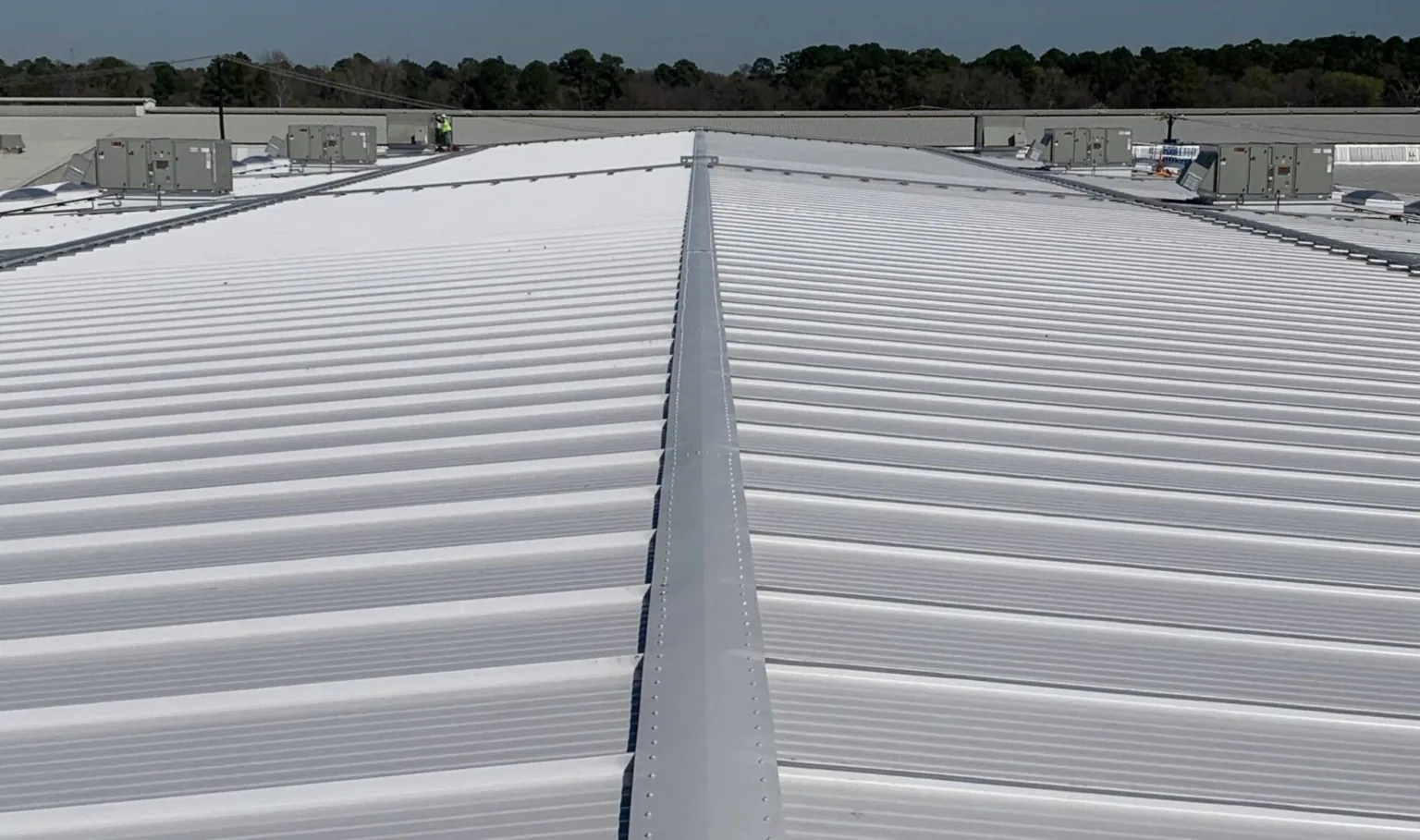
A standing seam roof is made of long panels with raised ribs that interlock or are mechanically seamed together. Each panel is held to the deck by clips that slide under the seam, so no screws pass through the visible surface. That concealed attachment is the reason standing seam resists leaks better than exposed-fastener metal, since there are no fastener heads on the surface to loosen.
Two broad panel families exist. Structural panels span open framing and carry load on their own, while architectural panels need a solid deck beneath and a water-shedding underlayment. Seam types vary too, from snap-lock panels that click together to mechanically seamed panels that are closed with a seaming machine for greater wind resistance. Which one fits depends on slope, framing and wind exposure, and the choice is made on slope, framing, wind exposure and the details of the building, not on appearance alone. A low-slope structure, for example, needs a seamed panel with sealant in the seam, while a steeper one can use a simpler snap-lock.
Thermal movement and the sliding clip
Metal grows and shrinks with temperature far more than a membrane does, and a long panel in the Salt Lake Valley's range from freezing nights to warm summer afternoons changes length every day. NOAA records from the Salt Lake City airport station stand in for that cycle across the valley, though the exact range varies by roof and exposure. Standing seam is designed for it: the clips allow the panel to slide as it expands and contracts, while the seams stay closed.
Problems arise when something pins the panel. A fastener driven through the panel face, a flashing soldered rigidly to a long run, or a clip that has bound with debris can force the metal to buckle or tear at the seam. We look for oil-canning that is out of pattern (a wavy look in the flat of the panel), seams that have opened at the ends and trim that has torn from its fastener. A metal roof that moves freely stays quiet and tight.
Fasteners at the ends of a run deserve a closer look, because the trim there takes the full travel of the panel. We check the slots in the trim, make sure sealant has not bridged the gap, and confirm that the end laps are not trapping water that freezes and pries the seam.
Snow retention and slide at the eaves
Snow does not cling to metal. After a storm, a mild afternoon can send an entire layer down the slope at once, onto a loading dock, a parked car, a mechanical yard or a doorway. Snow retention devices, rails or individual guards clamped to the seams, hold snow on the roof and let it melt in place or release in controlled amounts. They must be sized and spaced for the slope and the panel type, and fastened without piercing the panel.
We look at what sits below every eave and decide whether retention belongs on the roof. Where snow would land on an entry, a walkway or a roof section below, retention is part of the design. Gutters and downspouts on a metal roof also take a heavy load of melt and ice, so they are sized and heated where needed, and a snow and ice damage repair deals with whatever a slide or an ice dam leaves behind, from bent trim to torn sealant.
Penetrations, curbs and the places a metal roof opens
A standing seam roof is watertight in its field and vulnerable at its openings. Pipes, vents, skylights and rooftop units need curbs or boots that allow the panels to move while keeping water out. A curb built across several seams must have a cricket on the uphill side and sliding flashing at its sides. A boot that is clamped rigidly to a moving panel will crack.
We design each opening before the panels arrive, so the panels can be cut and the curbs framed together. On a retrofit, that means matching the new curb to the old panel profile and checking the structure beneath. Where an existing opening leaks, the repair begins with the flashing, and our penetration flashing work replaces rigid fixes with details that allow movement.
Condensation, underlayment and insulation
Metal is a cold surface in winter, and warm, humid air from the building meets it as condensation if the assembly lets that happen. Water that forms under a panel drips onto insulation and framing and mimics a leak. A vapor retarder, a ventilated space or a closed-cell insulation layer at the panel, together with a sealed underlayment, keeps the dew point out of reach.
Energy code matters here. The statewide energy code changed over to its 2024 edition on July 1, 2026, with local amendments, and an insulated metal roof is designed against whichever edition is in force at permit. We coordinate the insulation thickness, the thermal break at the clip and the vapor control with the design team, so the roof meets the code and stays dry on the inside as well as the outside.
Where standing seam fits in the south valley
Herriman's general plan directs higher-intensity commercial uses toward Mountain View Corridor, and Bluffdale's plan designates a Regional Core with a broad mix of uses and planned I-15 access. Draper's land-use plan includes business, light-manufacturing, industrial, commercial and office categories. New commercial buildings in settings like these can use standing seam for its clean lines, its long span and its performance under snow.
Owners in Herriman, Draper or West Jordan can pair a new metal roof with a retrofit of an older metal roof where a building already has one. We compare metal against TPO and other membranes on slope, budget and building use.
Commercial Roofing Questions
Does a standing seam roof need snow guards?
Where snow sliding off could land on a door, a walkway, a vehicle area or a lower roof, yes. We check what sits below each eave and size the retention to the slope and the panel.
Can individual panels be repaired?
Small damage can be repaired or a section replaced, but panels are continuous and interlocked, so replacing one means releasing its neighbors. The profile also has to be matched.
Why does my metal roof make popping sounds?
Panels expand and contract with temperature, and a clip or trim piece that sticks and releases makes noise. Persistent noise can also point to a pinned panel that is under stress.
Is standing seam louder in a storm?
Metal over open framing can carry more rain noise than a membrane roof. Insulation and a solid deck under the panels reduce it.
How is a scratch in the finish handled?
Small scratches are touched up with a compatible coating. Deep damage that exposes bare metal is repaired quickly, since corrosion begins at the exposed edge.
Plan the snow before the panels
Tell us the roof slope, what sits below each eave and where leaks or sliding snow have been a problem. We will schedule a roof walk and confirm the retention, flashing and repair boundary before work is priced.