
A rust-colored streak running down from a screw head, a drip that falls only in the first hour after the sun hits a frozen panel, and a fastener that spins freely when touched with a driver all describe the same aging pattern on an exposed-fastener metal roof. The panels themselves may still be sound; what has given out is the small rubber washer under each screw and the sealant along each lap.
In West Jordan, UT, where metal roofs are loaded with snow, then heated by the sun and chilled again at night, those small parts do a great deal of work. We restore exposed-fastener roofs and, when the panels are too far gone, retrofit a new standing seam system over them without a full tear-off.
Why exposed fasteners let go
An exposed-fastener panel is held down by screws driven through its face, each with a neoprene or rubber washer that compresses against the metal. The roof expands and contracts every day, which works each screw slightly loose in its hole. The washer dries and cracks in the sun, and water follows the shank of the screw into the building. Wind adds to the movement, and panels that were fastened too tight or too loose from the start fail sooner.
The weather normals at Salt Lake City International Airport show cold-season freezing and warm summers, which frames the swing a roof sees, and a roof exposed to that cycle moves a lot over a year. We probe fasteners, count the loose and rusted ones, and note whether the failure is scattered or concentrated at the panel ends and the ridge, since the pattern tells us whether to re-fasten or rebuild.
Restoration: re-fastening, tape and sealant
When the panels are sound, restoration begins with new fasteners. Oversized screws, with new washers and a proper pattern, replace the loose ones, and laps get butyl tape or a compatible sealant. Seams, ridge caps, rake trim and curb flashings are cleaned and sealed. Rusted spots are wire-brushed and primed. The result is a roof that sheds water again, with its remaining life extended.
Order matters on the roof. We start at the ridge and work down, because debris and loosened sealant fall toward the eave, and we finish with the trim and end closures after the field fasteners are done. Each repaired area is marked and photographed so the owner can see what was changed and where to look first at the next spring check.
The limit is the metal. A panel with rust that has gone through, panels that have buckled, or purlins that have corroded are signs that sealing will not hold. We press on panels, check the framing from below where we can reach it, and tell the owner which parts of the restoration will last. A restored roof still needs a yearly walk, which fits into a preventive maintenance visit.
Coating a metal roof
A liquid-applied coating over cleaned, primed metal seals fasteners and small seams in one pass and makes the roof more reflective. Silicone coatings and acrylic coatings are the two common choices, and each bonds to metal differently. Adhesion depends on surface preparation: rust must be removed, chalky paint scraped or washed, and the metal dry.
A coating does not fix movement. Laps that flex and fasteners that back out will crack the film again over time, so the fasteners are replaced and the laps are taped before the coating goes on. Reinforcing fabric at seams and penetrations gives the film strength where it will be stretched, and a second coat goes on after the first has cured, with the thickness checked at several points so thin spots do not become the first place the film wears through. Cold weather limits the work, because coatings need temperatures and cure time that winter does not give, so the job is planned for the drier seasons.
Retrofit framing and a new standing seam over the old
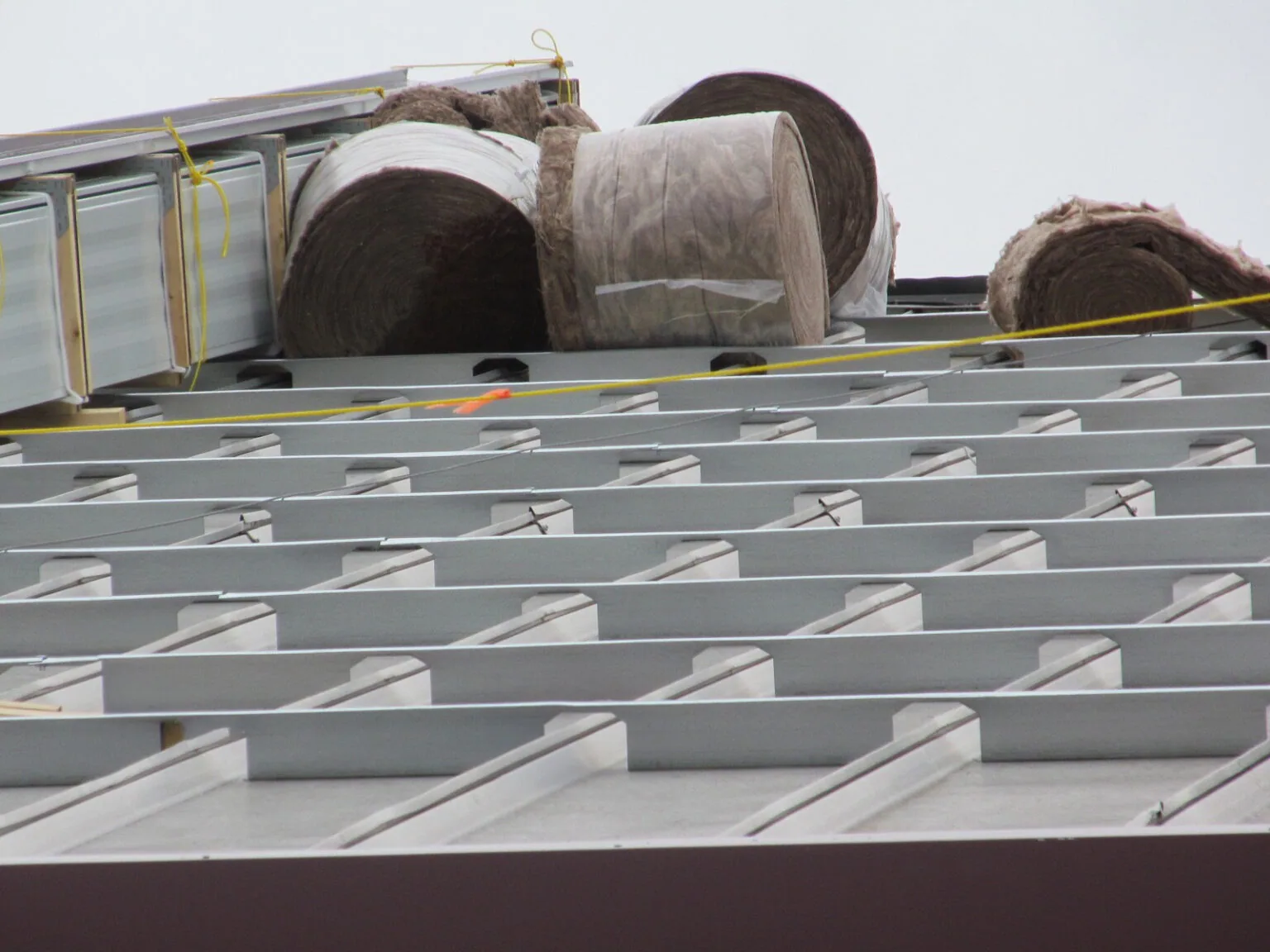
When the panels have run out their useful life, there is an option that avoids tearing the old roof off. A retrofit system adds sub-framing, sometimes called a retrofit purlin or a raised support, directly on top of the old panels, and a new standing seam roof is installed over it. The old roof stays in place as a ceiling and a vapor layer, the building stays occupied and dry, and nothing hangs open during construction.
The approach has conditions. The structure must carry the added weight, the old roof has to be sound enough to hold the new framing, and insulation can go into the cavity between old and new. The new system is specified against the wind and snow loads the building requires. We examine the framing and the old panels to confirm that a standing seam retrofit is practical, and compare its cost against a full replacement.
Condensation, insulation and ice at the eaves
Many exposed-fastener metal buildings have little or no insulation, and condensation is mistaken for leaks. Warm, humid air meets cold metal and drips, especially along the underside of panels on winter mornings. Adding insulation, a vapor retarder or a ventilated cavity changes the problem, and a retrofit is the moment to do it.
Eaves and gutters are the other winter issue. Snow melts on a warm part of the roof, runs to a cold eave and refreezes into an ice dam, forcing water under panel laps. We check eave closures, gutter slope, heat-trace cable where it exists, and the lap at the bottom of the panel. A snow and ice damage repair on a metal roof often ends with a change to the eave detail, not another round of sealant.
Metal buildings across the south valley
The training center at Camp Williams has warehouses, workshops and maintenance facilities according to the Utah National Guard, and Bluffdale reports business and distribution development in Mountain View Business Park. Taylorsville identifies the 2700 West Employment Center as an emerging local employment area. Warehouses, shops and light industrial space are often clad in metal, though a building's use does not tell us what its roof is made of, so each one begins with a roof walk.
We serve owners in Bluffdale, Taylorsville and West Jordan, and the first question is always the same: restore, coat or retrofit. The answer comes from the panel condition, the framing and how long the owner plans to keep the building.
Commercial Roofing Questions
Can I just replace the screws?
If the panels are sound, new screws with fresh washers in the proper pattern is the start of a restoration. Laps and trim usually need tape or sealant as well, or the leak moves to the next weak point.
How long will a restored metal roof last?
That depends on the condition of the panels, the framing and the exposure. We can say what the restoration should accomplish and which parts are unlikely to hold.
Is a retrofit cheaper than a tear-off?
Often, since it avoids removing and disposing of the old roof and keeps the building in use. Added framing and new panels still cost something, and the structure must carry the extra weight.
Will a retrofit change the building's look?
Yes, somewhat. The roof rises by the height of the added framing, and standing seam panels have a cleaner profile than exposed-fastener ribs.
What if the old panels are rusted through?
Rust that has gone through means sealing will not hold, and the area has to be replaced or covered by a retrofit. A roof walk and a look at the underside show how widespread it is.
Show us where it drips
Tell us the age of the roof, where rust or leaks show up and what the building holds. We will schedule a roof walk, count the failed fasteners and confirm whether restoration or a retrofit fits before any price is set.