• Client Login
  • Report a Leak

About Commercial Roofing West Jordan

ABOUT US

Commercial Roofing for West Jordan Buildings

A stain on a ceiling tile after a warm March afternoon is a common way a roof problem first shows in West Jordan, UT, and it is a good place to start, because it shows what a roof company is for. The stain is a symptom. It is a message from a roof that took on water somewhere uphill, held it in the insulation for a while and finally let it through. Our job is to follow that message back to the open seam, the loose edge or the blocked drain bowl, to say plainly what we found and what we could not confirm, and then to fix what the evidence supports.

We are a commercial roofing contractor. We repair, replace, recover, restore, coat, inspect and maintain low-slope and metal roofs on commercial, industrial, institutional and multifamily buildings. We install and repair single-ply systems such as TPO, PVC, EPDM and KEE, modified bitumen and built-up roofs, standing seam and retrofit metal, spray foam, and silicone and acrylic coatings. Emergency response runs around the clock, every day of the week, holidays included, because water does not wait for the next business day.

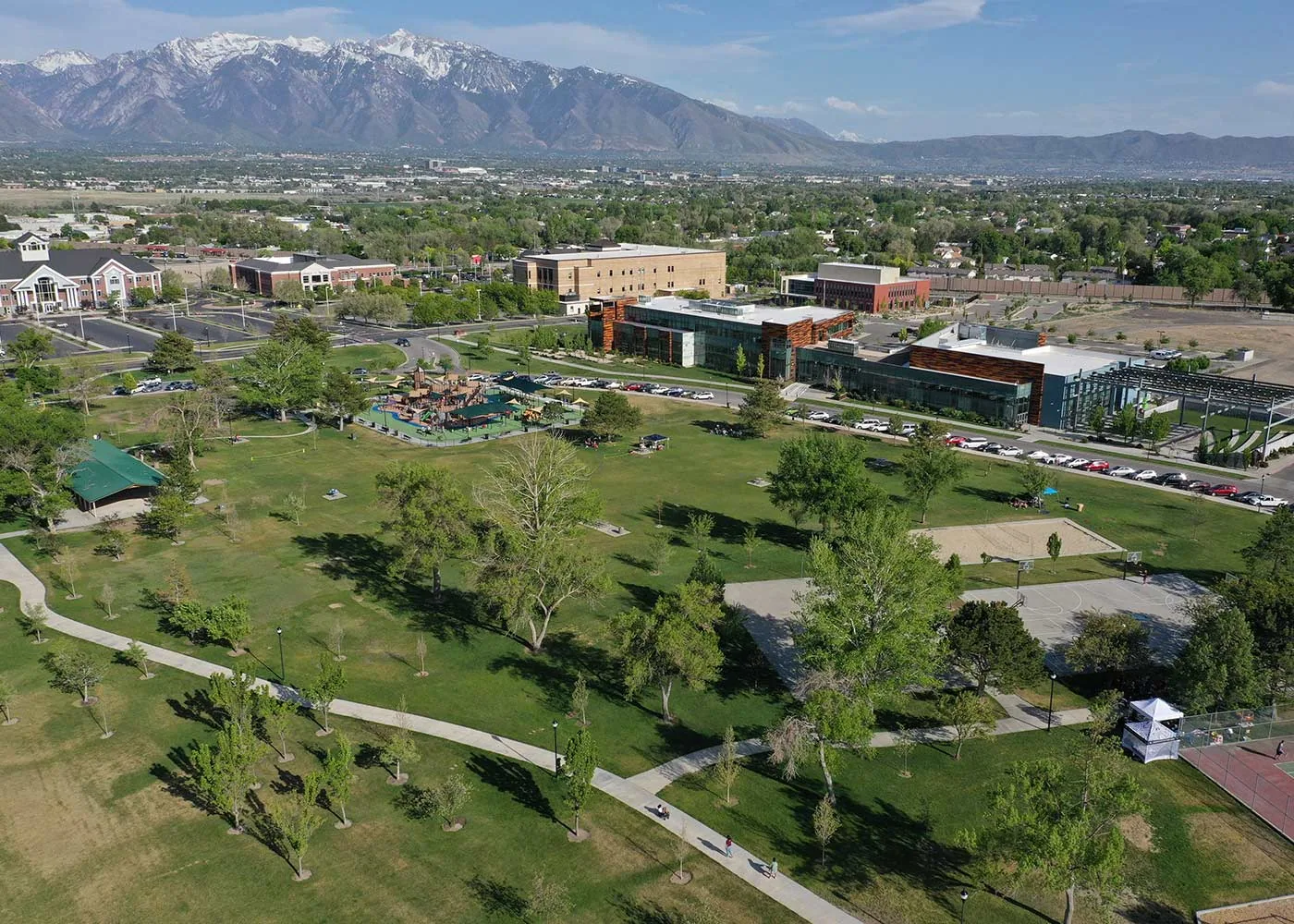
Parks and commercial buildings in West Jordan, Utah

The roof walk: where every job starts

Every job begins on the roof, with a walk that follows a set route. We find the access, note anything that makes the walk unsafe, and then work through the roof section by section: drains and drain bowls first, because standing water shows a failure sooner than any other sign, then seams and field membrane, then edge metal and flashing, then each curb and penetration. Photographs are taken from marked positions so that a later visit can repeat them, and the findings go onto a roof plan with numbered sections.

When the surface cannot answer a question, we test. An infrared moisture survey maps wet insulation, a core sample confirms what the scan suggests, and drone imagery covers areas that are hard to reach on foot. The walk ends with a written condition report that separates what is confirmed from what is unknown, so a repair line or a replacement scope rests on findings that can be checked.

Who we work for: owners, managers and operators

Our customers are the people who answer for a building: property managers, owners and investors, facility directors, school and public-agency staff, healthcare and manufacturing operators, and general contractors who need a roof scope that fits a build schedule. They ask different questions. A manager wants to know which tenant to call. An investor wants the cost and the date. A facility director wants to know what is protected right now.

We answer each of them with the same file: dated photographs, the roof plan, test results and a scope with its cost drivers listed. If a roof sits over occupied space, the work is staged by section and the noisy steps are set for hours the tenants can live with. Interior protection goes up before the first seam is opened. A property manager with a dozen tenants and a healthcare system with strict access rules need very different schedules from the same roof walk.

What we roof: the buildings of the valley floor

West Jordan's general plan supports regional commercial, service, office and mixed-use development, including planned station-area districts, and the economic development office highlights business attraction and retention. The city's list of businesses includes Danone, Oracle, PayPal, Amazon, Boeing and Sysco. The buildings here range from storage and distribution space to offices, clinics and retail.

That range shapes how we plan. A warehouse roof puts drains and penetrations first, an office roof puts tenant spaces first, and a hospital roof puts access rules first. The system on the roof matters as much as the use under it, which is why we read the surface and the layers before suggesting a repair or a replacement.

The valley season: snowmelt, freeze-thaw and sun

The Salt Lake Valley has real winters, and roof stress follows them. At Salt Lake City International Airport, NOAA's 1991 to 2020 normals record repeated winter snowfall and snow depth, cold-season freezing and warm summers. Those normals are a regional proxy and not a weather record for each address, because elevation and exposure vary across the valley and the foothills, so we confirm a building's own exposure on its own roof.

Still, the pattern gives us a calendar. Autumn is for clearing drains, securing edges and photographing seams before the first storm. Winter is for temporary dry-in and for repairs that cannot wait. Spring, after melt, is for the check that tells us what the winter did to the insulation, the seams and the low spots. Summer is for the long membrane work that needs dry surfaces and steady temperatures. A maintenance program follows the same calendar.

Access and approvals: the paperwork around the roof

Utah's 2024 building and energy codes, with statewide and local amendments, took effect on July 1, 2026, and the current statutory edition is set to be superseded on January 1, 2027. A replacement that changes insulation thickness or touches the structure may need review, so the scope lists the permit and code questions before the date is set. Where a building sits near Camp Williams or another controlled site, base access, badging and escort rules enter the schedule as well.

For insurance work, the file separates emergency items from permanent ones and ties every line to a photograph, which is the backbone of insurance claim assistance. For owners with several buildings, a multi-site roof program puts every roof on one cycle and one report format.

What you keep: the closeout file

When a job ends, the owner receives a closeout file: before and after photographs, the roof plan with the repair line marked, test results, product data for the materials installed and a follow-up date. The file is written in plain terms, so a lender, a buyer, an insurer or the next manager can read it without a guide. If something could not be tested, the file says so and names the test.

What we hand over is a record. If you are deciding whether to repair or replace, the record shows the options side by side with their cost drivers and the weather window each needs.

Questions from West Jordan Building Owners

What areas do you serve?

West Jordan and the nearby Salt Lake Valley cities, including South Jordan, Taylorsville, Sandy, Murray and Salt Lake City. Travel time is planned into the schedule.

Do you work on occupied buildings?

Yes. Work is staged by roof section, interior protection goes up first and noisy steps are set for hours that suit the tenants.

Can you respond to emergencies?

Emergency crews answer at any hour, every day. The first step is safe access, a temporary dry-in and interior protection, with the permanent repair following in suitable conditions.

What do I receive after a visit?

A written report with dated photographs, a roof plan, any test results and a scope with its cost drivers. After a job, a closeout file adds product data and a follow-up date.

Request a Roof Assessment

ServicesRoof SystemsIndustriesProperty TypesService AreasDamage RepairCapabilitiesManufacturersContactAboutRequest a Roof Assessment555-555-5555
Call555-555-5555