
Water running down an interior wall at six in the evening, a ceiling tile bowed with weight, or a section of membrane flapping loose after a gust: each of these is the kind of moment that cannot wait for Monday. In West Jordan, UT, a roof that has carried snow all week can fail fast once the melt starts, and a manager standing in a wet hallway needs a crew on the way, not a callback. We answer around the clock, holidays included, and our first job on arrival is to stop water from reaching the interior, whatever the cause turns out to be.
The permanent repair comes later, once the roof is dry enough to inspect and the conditions allow a proper tie-in. The emergency visit is about the dry-in plan.
The first call: what we ask
When the phone rings we ask four things: where the water is showing, when it started, whether anyone is at risk, and how the crew will get onto the roof. Those answers decide whether we send a tarp crew, a membrane repair crew or both, and whether we need a lift, a ladder or access through a tenant suite. We also ask whether power, fire alarm or sprinkler systems are exposed, because water near electrical gear changes what the building needs before the roof does.
If anyone is hurt or a structure looks unsafe, the building should be cleared and emergency services called first. A roof crew cannot work on a deck that is unstable, and we do not ask a tenant to stay in a space with sagging ceiling material or active electrical contact.
Dry-in plan on arrival
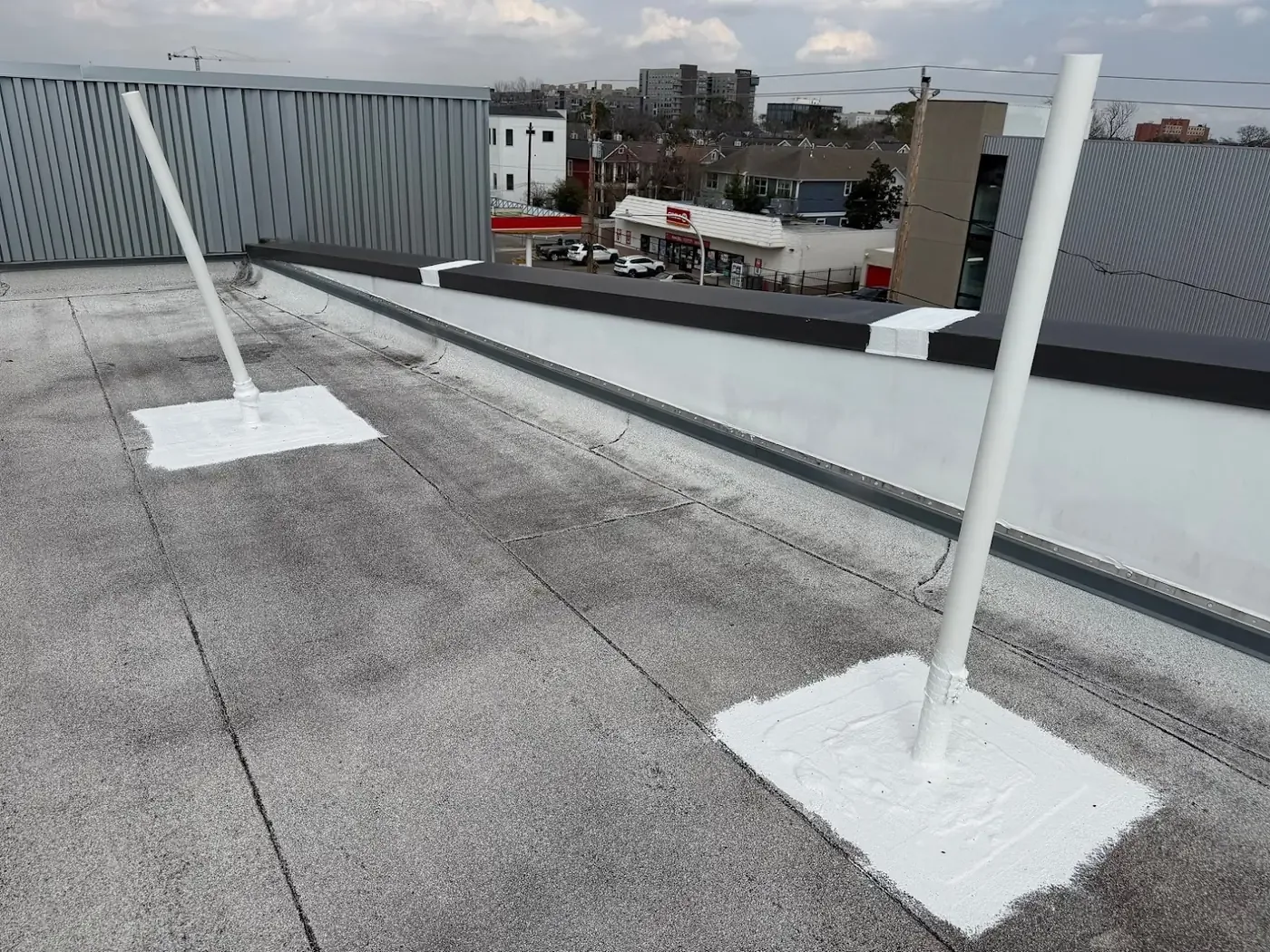
On the roof, we find the opening before we cover it. A tarp thrown over the wrong spot only moves water. We follow the interior damage upslope, check drains and flashings, look at open seams and torn membrane, and decide where the cover needs to extend. A tarp is secured to the deck or a solid substrate beyond the damage, with sandbags, wood battens or fasteners chosen for the roof type and the wind that day. For a punctured or split membrane, a temporary patch or mastic and fabric can seal the opening more tightly than a tarp.
Where debris has fallen or equipment has shifted, we clear a safe path first. The dry-in is photographed from several angles so the owner, the insurer and the permanent repair crew all see the same starting point.
What stays on the roof
Temporary materials are chosen so they can be lifted off cleanly when the permanent repair starts. Heavy tarps weighted with sandbags or secured at the parapet are removed in one piece. Mastic and fabric patches over a split can be cut out with the failed membrane. A temporary cover left over a drain, however, can send water to the wrong place, so we keep outlets clear and mark every temporary item on the roof plan. Anything left behind is listed in the follow-up, with a date for removal or replacement.
Wet insulation under the stop is also marked. A moisture reading on the first visit, and another at the permanent repair, shows whether the insulation dried out or kept holding water. That record helps decide whether the repair area stays small or grows to a section replacement.
Snow, melt and wind events
Winter in the Salt Lake Valley means repeated snowfall and freezing, which loads roofs and stresses drainage all season. Airport weather records describe the region and not every West Jordan roof, yet the pattern is clear enough to plan around. Snow load on a roof with a blocked drain, a thaw that sends water behind a flashing, or a melt-refreeze cycle that splits a seam are all reasons for an urgent call.
Wind and storm damage add to the list. After a windstorm, a corner of membrane can lift, coping can loosen and debris can strike a roof at an exposed edge. For a roof with snow and ice damage, we remove only what is needed to expose the opening, because heavy shoveling can tear the membrane. Permanent work follows the storm damage repair plan once the weather clears.
Occupied buildings during an emergency
A building that stays open while its roof is being stopped has people under the work, whether it stands in the downtown core at 7800 South and Redwood Road or in one of the planned station areas near Gardner Village. The crew needs to protect the interior while working above it. We place catch basins and plastic sheeting under active drips when the building allows, ask for tenants to move stock and equipment out of the path, and coordinate noise windows with the manager.
For a warehouse or distribution tenant, the concern is stock and racking. For a clinic or office, it is patient and employee access. For a restaurant, it is the kitchen and the dining room. We work the order of the stop around the use of the space below, and we tell the manager what to expect over the next hour.
After the stop: photos, claim and repair line
Once the water is out, the next question is what caused it and who pays. We write down the cause as far as the roof walk shows it, record the dry-in method and list the materials left on the roof. Photographs go with every note, since an insurer wants to see the damage and the temporary work separately. Where the loss is large, our insurance claim documentation keeps those records in one place.
The repair line follows. A temporary stop is not a repair, so we set a time for the permanent work, list what must be confirmed first and plan around the weather. For roofs near West Jordan, Taylorsville and West Valley City, we set the follow-up in the first window the deck and membrane can take it.
Commercial Roofing Questions
What counts as an emergency roof call?
Active water entering the building, a lifted or torn membrane, storm debris on the roof or a visible sag. If water is dripping on electrical equipment or stock, treat it as urgent.
How fast can a crew be on the roof?
We answer around the clock and send a crew once access and safety are confirmed. Arrival depends on the hour, road conditions and how far the crew travels, and we give an estimate on the first call.
Is a tarp a real repair?
No. A tarp keeps water out while the roof dries and the cause is found. The permanent repair replaces the failed membrane or detail and restores the tie-in.
Can you work in snow or freezing weather?
Yes, for dry-in. We use temporary materials that bond in cold weather and remove only the snow needed to see the opening. Permanent adhesives and welds are saved for a dry, moderate window.
What should a manager photograph before the crew arrives?
The interior stain or drip, the time, any wet equipment and a wide shot of the room. Those images help the insurer and help us match the water to the roof location.
Does an emergency visit mean the whole roof is failing?
Not necessarily. Many emergency calls trace to one detail such as a split seam, a clogged drain or a torn flashing. The roof walk afterward shows whether the failure is local or part of a wider pattern in the membrane.
Call when water is coming in
Tell us where water appears, when it started and how roof access works. We will send a crew, set the dry-in plan on arrival and confirm what must be checked before a permanent repair line is set.