
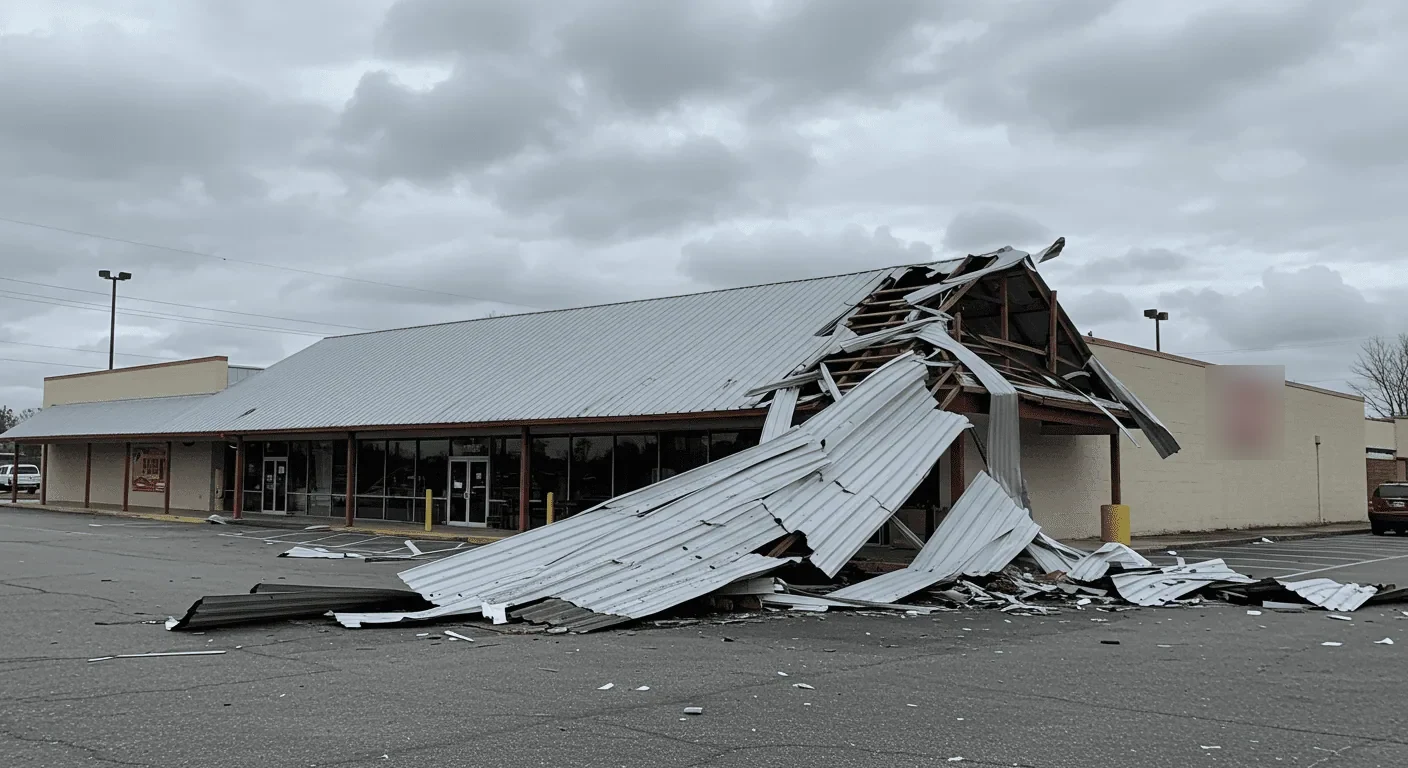
Sheets of flashing lying in a parking lot, a rooftop unit cover that has walked a few feet from its curb, a corner of membrane flapping against a parapet: those are the obvious signs after a hard wind. The less obvious ones show up days later as a stain on a ceiling tile, a damp smell in a back office or a line of drips beside a wall. Storm damage repair in West Jordan, UT begins by finding both kinds, the damage that can be seen from the lot and the damage that has already let water inside.
The work has an order. Stop the water first, document what happened by roof section, then decide what is repaired now and what needs a fuller scope. Doing it in that order protects the building's interior, preserves evidence for any insurance claim and keeps the permanent repair from being rushed over damage nobody has found yet.
First hours: stopping the water
The first crew on a storm-damaged roof has one job: keep water out. That usually means tarping an exposed deck, sealing a torn section of membrane with temporary patches, re-securing loose edge metal and covering open penetrations. Where a wall of water is already entering the building, we work from inside as well, directing it away from equipment and stock where we can. These measures are temporary and are described as such in the record.
Every temporary measure is photographed before and after, with its location on the roof sketch. Those photographs matter later, because they show the roof as the storm left it, before any repair could change the evidence. We take them whether or not the owner plans to file a claim.
Wind: the edges go first
Wind finds the weakest line of a roof, and on a low-slope commercial roof that line is usually the edge. Wind pulling at the perimeter lifts edge metal, peels the first few feet of membrane and can loosen the fasteners or adhesive beneath. Once an edge opens, wind gets under the membrane and can lift it across a wider area. Rooftop units, vents and skylights are the other usual victims, since they stand above the surface and take the full push.
The assessment follows the wind's path. We walk the perimeter first, check every edge detail and note the direction from which the damage runs, then follow the membrane inward looking for lifted seams and billowed sections. Where fasteners have pulled through, the deck below is checked for damage as well, and where an attachment pattern was weak, the repair restores a stronger one. The assessment is repeated after the repair so the second set of photographs shows the finished edge.
Snow load, ice and the melt that follows
The snowfall and snow-depth normals recorded at Salt Lake City International Airport repeat every winter, with freezing nights returning each cold season. Those are valley-wide readings and not measurements of any single West Jordan roof, yet they explain why heavy snow, ice dams and refreeze belong on the list of storm damage. Snow that drifts against a parapet or around rooftop equipment loads one part of the roof unevenly, and meltwater that cannot reach a frozen drain backs up under flashing or through a seam.
After a heavy snow event we look at the same few places: drains and scuppers choked with ice, flashing pushed out by ice behind it, seams opened by refreeze and low areas where meltwater collected. A snow and ice damage repair clears the drainage first and then repairs the opened details.
Hail and debris: bruises you cannot see from the ground
Hail damage often hides. A membrane can be bruised without being cut, and a cover board or insulation under it can be cracked, so that the roof looks intact until water finds the weakness weeks later. Metal panels show dents, but the dents alone do not always mean a leak path. Wind-driven debris adds punctures, gouges and crushed flashing.
Our assessment looks for impact marks in a pattern, checks soft spots by hand and uses an infrared moisture survey where the surface suggests trapped water. The result separates cosmetic marks from functional damage and records each affected roof section by area, so the owner and any adjuster work from the same map. A small membrane puncture repair is done in the visit, and larger areas are scoped.
Debris is worth a note of its own. Tree limbs, broken signage and loose rooftop covers can land on a roof or be thrown across it, and the marks they leave run in lines that point back to the source. We follow the line, photograph the point of impact and look at the deck underneath, since a heavy strike can crack the deck even where the membrane looks whole.
Repair line: patch, section or full roof
After the assessment, the scope sets a repair line. Some storm damage is local and a patch or an edge repair puts the roof back to its earlier condition. Some spreads through a section, in which case the membrane and wet insulation in that section are removed and replaced. In a few cases the damage reaches far enough that a full replacement makes more sense than a series of patches. We draw the line on the roof plan with moisture readings, not on a guess.
The scope also covers code. Utah moved to the 2024 International Building Code, with its own state and local amendments, on July 1, 2026, and once a repair grows past a certain size it can trigger present-day rules for insulation, attachment or drainage. We identify those before the price is set, so a change in requirement does not appear as a surprise.
Timing is part of the line as well. A repair on a day when the membrane is cold and damp does not bond well, so the crew uses temporary measures in the meantime and returns for the permanent work in a dry window. The schedule states which pieces are waiting on weather, which are waiting on materials and which are waiting on an adjuster, so the owner can see what is holding each one.
Photographs, dates and the insurer
A claim is stronger when the damage is documented in the first days. Our record includes dated photographs by roof section, the moisture map where one was needed, a list of temporary measures and a sketch of damage locations. Owners filing a claim can use it as the basis for the adjuster's visit, and our insurance claim work carries the paperwork that follows, from the damage summary to the repair estimate. We describe what we find. The decision on coverage belongs to the insurer.
Across the valley floor
Storm response in West Jordan reaches the commercial areas around Redwood Road and 7800 South, properties with I-15 access and the nearby station areas. Emergency calls are answered at any hour, including holidays, and the first crew is sent to stop the water. Calls about emergency roof repair go to the same line.
Commercial Roofing Questions
What should be photographed before the crew arrives?
Any visible damage from the ground or a window, any water inside, and the date and time. Do not go onto a wet or snowy roof to take them.
Can wind damage show up days after the storm?
Yes. A lifted edge or loosened seam may only leak after the next rain or melt. A walk right after the event finds those details before they leak.
Is a dent in a metal panel a roof leak?
Not by itself. We check seams, fasteners and coatings around the dent for any gap or split that gave water a way in.
Who decides what the insurer covers?
The insurer does. Our record documents what was found, where and when, which gives the adjuster a clear map to work from.
How soon can permanent repairs begin?
Once the roof is dry enough and the damage is documented. Temporary protection goes on first, and the schedule for permanent work depends on weather, materials and any adjuster visit.
Tell us what the storm left behind
Share where water appears, when it started, and how the roof is reached. We will send a crew to stop the water, document the damage by roof section, and explain what must be confirmed before a repair line or schedule is set.