
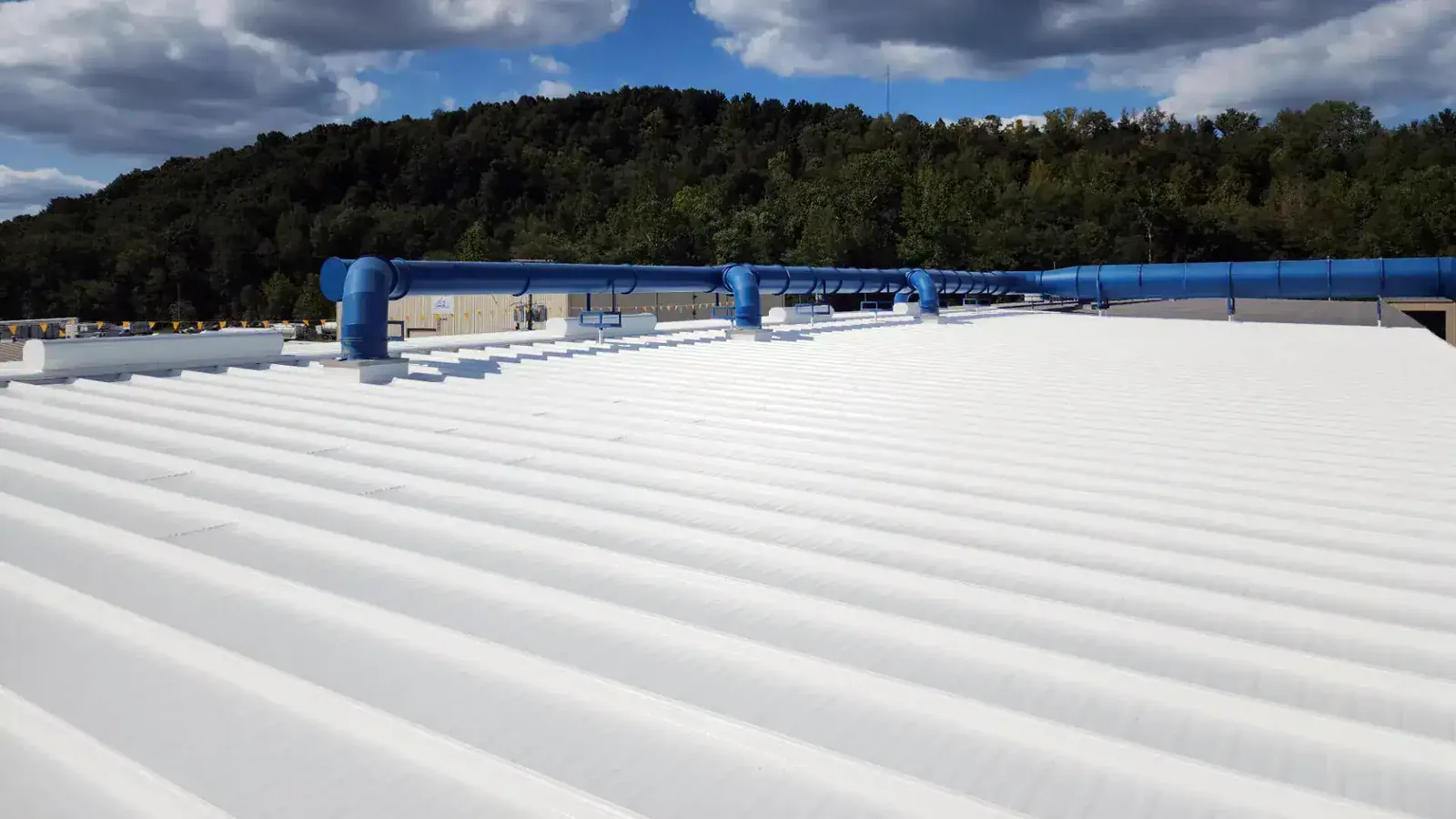
White paint on a roof sounds simple, and an acrylic coating is the closest thing to it in commercial roofing: a water-based liquid that is rolled or sprayed over a sound roof, dries into a flexible film, and turns a dull, hot, weathered surface into a bright reflective one. Done on the right roof, it adds years. Done on the wrong one, it peels, blisters or washes away within a season or two.
In West Jordan, UT, where summers are warm, winters bring snow and freezing, and melt moves across flat roofs for days, the right roof for acrylic is one that drains well and has dry insulation underneath. We help owners decide which side of that line the roof sits on.
What acrylic is and what it does well
Acrylic coatings are water-based polymers that cure by evaporation. They are easy to apply, clean up with water, and accept a range of reinforcing fabrics, granules and colors. They are strongly reflective when white, and they bond to a variety of surfaces, including aged single-ply membranes, modified bitumen, built-up roofs, metal and foam.
Their strengths are reflectivity, workability and cost. A reflective surface lowers roof temperature in summer, and the film seals pinholes, small seams and worn spots. Because the material is water-based, tools and splashes clean up without solvents, which matters on a roof above an occupied floor. Acrylic is also simple to recoat, because a new coat bonds to an old acrylic that is clean, so a maintenance plan can renew the roof instead of replacing it. That combination suits owners who want to hold a good roof together for a while longer, and it is a frequent companion to roof coating restoration projects.
Where acrylic fails: standing water
The weakness of acrylic is water that does not leave. A film that sits wet for long periods can soften, blister or lose its bond, and ponded areas tend to fail first. That is why we measure the roof for low spots and check drains before recommending acrylic. A roof that holds a pond for days after each melt is a candidate for a silicone coating or a drainage correction, not acrylic alone.
Snow adds a seasonal test. NOAA normals for the Salt Lake City airport station show recurring snowfall and freezing across the valley, and the melt that follows can pond at drains and along parapets. We walk the roof after a thaw when we can, since the marks left by water show where it stands. Where the roof drains cleanly, acrylic does well, and where it does not, we say so before the coating is ordered.
Dry time, rain and the application window
Acrylic needs time to dry, and the film is vulnerable until it has. Rain on fresh coating washes it off the roof and into the drains, and dew or fog can leave a film cloudy or poorly bonded. Cold air slows evaporation and may stop the cure entirely, so acrylic is a warm-season product in a place with freezing winters.
We schedule coating work for stretches of dry, warm days, with a forecast that gives the film enough time between application and the next front. Work moves in sections that can be finished and protected before the end of the day, and the crew stops when humidity or wind changes. Overspray is a concern near parked cars and glass, so we mask what is nearby and keep the sprayer's pressure low when the breeze picks up. Preparation, such as washing, repairs and priming, can take place earlier in the season, which leaves only the coating itself for the best weather.
Preparation: wash, repair, prime, reinforce
Everything under the coating shows through it. The roof is pressure-washed, loose material is removed, and failed seams, flashings and blisters are repaired. Rust on metal is treated, and primers are applied where the manufacturer calls for them. Cracks and seams get reinforcing fabric bedded in coating, and penetrations and curbs are treated as separate details.
Metal edges, gutters and counterflashing are checked and refastened first, since a coating stretched across a loose edge will crack the first time wind moves it. Pitch pans and old mastic around pipes are cut back and rebuilt, and any ridge or hump in the old surface that would telegraph through the film is flattened.
Moisture is the question before all others. We scan the roof and take cores, because acrylic over wet insulation traps the water, and the film blisters as the trapped moisture tries to escape in warm weather. Our infrared moisture survey maps the wet areas, which are cut out and replaced before coating. We then test adhesion on a small patch and wait for the result before the full roof is coated.
Thickness, coats and the reflective surface
The performance of a coating depends on how much of it is on the roof. A thin film wears through and fails in a few seasons, so we apply the specified number of coats and measure wet-film thickness during the work, with a gauge pressed into the wet film at set points along the roof and the readings written down. Edges, seams and areas around penetrations get extra coating, since those are the places that fail first.
A white acrylic surface reflects much of the sun's energy, and the benefit is felt in the rooftop units and the top floor. Dirt, pollen and mineral deposits reduce reflectivity, so a periodic wash brings back much of what was lost. Reflective coatings also relate to the energy code: Utah adopted the 2024 International Energy Conservation Code, effective July 1, 2026, and a coating alone does not satisfy insulation requirements where a roof is being replaced or substantially rebuilt. We confirm what applies with the permit office.
Retail and office roofs around Sandy and Murray
Sandy maintains plans for its downtown commercial district, the 90th South Gateway, Historic Sandy, Sandy Corners and South Towne Promenade, and it identifies Sandy Corners as a strategic master-plan area for revitalization at 700 East and 9400 South. Murray lists healthcare, transportation, retail, professional office, education and community services among its sectors. An owner holding a retail or office building in those areas may be weighing whether to restore a sound roof or replace it, and a coating is one of the options.
We serve Sandy, Murray and West Jordan, and for each roof we compare acrylic with a replacement and with other coatings. The comparison turns on drainage, moisture and how long the owner expects to hold the building.
Commercial Roofing Questions
Is acrylic cheaper than silicone?
Often, because the material and the recoat cost less. It is the wrong choice where water ponds, since a cheaper coating that fails early costs more in the end.
How soon after application can rain hit the roof?
Only after the film has dried through, which depends on temperature, humidity and thickness. We schedule coating work for settled weather and stop when a front approaches.
Can acrylic be recoated later?
Yes. A clean acrylic surface accepts another coat of the same type, which makes a maintenance plan simple. The surface must be washed and inspected first.
What if my roof has a few ponds?
We assess how long water stays and whether the drains can be improved. Roofs with persistent ponds usually call for silicone or a drainage fix.
Will acrylic stop all leaks?
It seals small defects that have been reinforced. Open seams, torn flashings and wet insulation are repaired first, as a coating cannot hold back water that is already inside.
Check the drainage first
Tell us the roof type, how long water stays after a melt and what the surface looks like now. We will schedule a roof walk, scan for moisture and confirm whether acrylic is a fit before any price is set.