
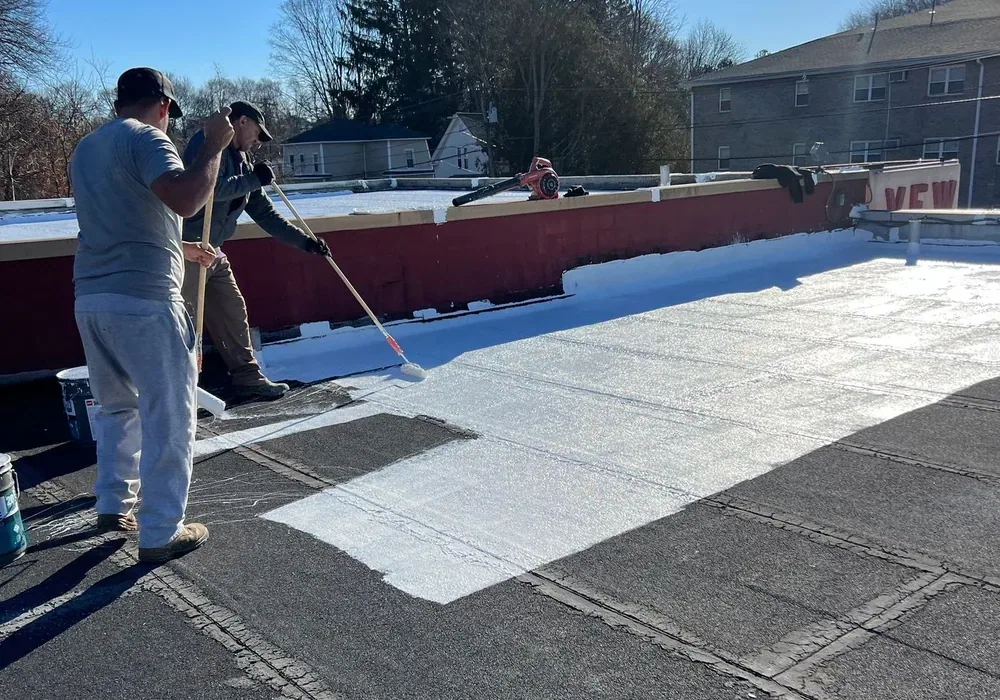
A membrane that has faded to chalk, shows hairline cracks along the seams and gives off a powdery residue when rubbed is telling the owner that its surface is spent, even if the roof has not leaked yet. In West Jordan, UT, that is the moment a coating restoration comes up: a liquid system applied over the existing roof to seal it, reflect heat and add years of service, without the cost and mess of a tear-off. It works well on the right roof and badly on the wrong one, and the difference is almost always what is trapped underneath.
Before anything is priced, the roof gets walked. We look for wet insulation, open seams, failed flashing and low spots that hold water, because a coating covers a sound roof and hides nothing. If the walk finds a roof that qualifies, the restoration plan follows. If it finds one that does not, we say so and describe the repair or recover that fits instead.
Qualifying test: what has to be true first
Four conditions decide whether a roof can be coated. The insulation below the membrane must be dry, because a coating seals moisture in as effectively as it seals water out. The membrane must be firmly attached, with no large areas where it has lost adhesion. The seams and flashings must be sound or repairable. And the surface must accept the coating, which means it is clean and compatible, with no residue of a previous incompatible product.
We test each condition. An infrared moisture survey maps the suspect areas and a core cut confirms them. Adhesion is checked by hand at several points, and a small test patch of coating shows whether it bonds. The results go into the record by roof section, so the owner sees which parts pass and which need work first.
Silicone or acrylic: choosing from the roof
The two common liquid systems behave differently, and the choice depends on the roof, not habit. A silicone coating tolerates standing water well, which matters on a roof with shallow ponding, and it stays flexible in cold. An acrylic coating costs less per coat, reflects well and works on many surfaces, but it is not meant to sit under standing water for long and needs good drainage to last. The cure, the ponding tolerance and the cost of silicone coatings and acrylic coatings differ enough that the roof's drainage should pick between them.
On a West Jordan roof that sheds melt cleanly to its drains, either system may fit. On a roof with chronic low spots, silicone has the edge, or the ponding is corrected first with tapered insulation or added drains. We lay out the options with the reasoning, and the owner decides which trade of cost and performance suits the building.
Preparation decides how long it lasts
Most coating failures are preparation failures. Dirt, mildew and chalking must be washed off. Open seams are reinforced with fabric and sealant. Cracked flashings are rebuilt or covered with reinforcing fabric. Blisters are cut, dried and patched, and any wet material is removed. Metal roofs get rust treated and fasteners sealed. A coating sprayed or rolled over a dirty or damaged surface will peel from the weak points first.
For that reason, the proposal lists preparation as its own line, with quantities from the roof walk: linear feet of seam, number of penetrations, area of patching. Owners can see how much of the project is below the coating line, and revisions in the field can be tied to a measured quantity.
Cold, melt, and when the coating can go on
Normals recorded at the Salt Lake City airport include winter snow, freezing spells and warm summers. An airport stands in for the valley rather than for each West Jordan roof, yet the pattern still points to the right calendar. Coatings need dry surfaces and moderate temperatures to cure, so the application window is late spring through early fall, with the roof walk and prep planning done earlier.
The winter side of the calendar still matters. The coating has to survive freeze-thaw cycles and ice at drains, so seams and terminations are inspected first in spring and the roof is walked again after the first melt. A coating that sheds water fast, sheds snow melt cleanly and bridges small cracks is a good winter performer, but no coating fixes a blocked drain, and the drain gets cleared before it is covered.
Reflective surface and the energy code
A white or light-colored coating reflects sunlight, and on a sun-facing slope that can lower roof surface temperature in summer. The NOAA normals describe warm summers for the valley, and a cooler membrane ages more slowly. The energy code in force matters once a permit is involved. Since July 1, 2026 Utah has used the 2024 IBC and 2024 IECC, amended at state and local levels, and a coating project is checked against that edition for any insulation or reflectance requirement. We look at that before the plan is final. A reflective coating is one route to a cool roof, and the plan states what reflectance the chosen product reaches.
Coat, recover or replace
Coating extends a roof's life, but it is not a repair for a failed one. Where moisture has spread through the insulation or the membrane has lost adhesion over large areas, a recover overlay or a replacement is the route that lasts. Where isolated problems exist inside a sound field, a repair followed by coating gets the most from the existing roof.
The roof walk gives the answer in writing. We show the owner where the line falls, in photographs and on the roof plan, so that the decision is based on what the roof can bear and not on a hope that a coating will cover a problem. The follow-up date is set for the first melt after application.
Buildings that tend to qualify
Coatings suit sound low-slope roofs with plenty of life left in the base membrane, which can include office and service buildings, multi-tenant commercial blocks and flex space. Around the Redwood Road commercial setting and the 7800 South core named in West Jordan's general plan, a coating can be scheduled in phases for occupied buildings so tenants keep access. Whether a specific building qualifies depends on its test results, not its use. The same phasing applies on roofs throughout West Jordan: one roof section is prepared, coated and cured while the others stay in service, and the tenants below are told which area is next. Coating crews carry hoses and tanks across the roof, so walkways and the paths to the hatch are protected before work begins.
Staging is part of the plan. Product is delivered on the day it is needed, the weather forecast is checked against the cure time, and a section is not started if rain or a cold night is expected before it cures. A coating that is washed out or chilled before it sets has to be removed and redone, which is why schedule slack matters more here than on most roof work.
Commercial Roofing Questions
Can a coating be applied over a roof that already leaks?
Only after the leak is traced and repaired and the insulation is shown to be dry. A coating over a wet roof traps the moisture.
How do you know the insulation is dry?
An infrared scan maps suspect areas, and core cuts confirm what the scan suggests. Both go into the record with their locations.
Is ponding a reason to skip the coating?
Shallow ponding favors silicone, and chronic deep ponding is corrected first with tapered insulation or extra drains. We measure the depth and duration before choosing.
Will a coating change how the roof drains after a melt?
It does not change slope. It seals the surface, so water that reaches a drain leaves cleanly. Low spots stay low unless the drainage is corrected.
What does the prep list usually include?
Washing, seam reinforcement, flashing repair, blister patching, rust treatment on metal and fastener sealing, each with a measured quantity from the roof walk.
Find out if the roof can be coated
Tell us where water has shown up, how old the membrane is if you know, and how the roof is reached. We will walk it, run the moisture checks and report which sections qualify and what must be repaired first.