
A dark patch under the hood line, a drip near the pass-through window, a ceiling tile that sags above a booth after the first warm day following a snowstorm: restaurants show roof trouble in places where the kitchen and the dining room both notice. In West Jordan, UT, a restaurant roof has to shed winter snow and melt, ride out hot summer sun, and handle the grease that exhaust fans throw onto the surface every day. Each of those stresses has its own failure, and a repair that deals with only one tends to be undone by the others.
A restaurant roof walk begins at the kitchen exhaust, because that is where the roof wears fastest.
What grease does to a membrane
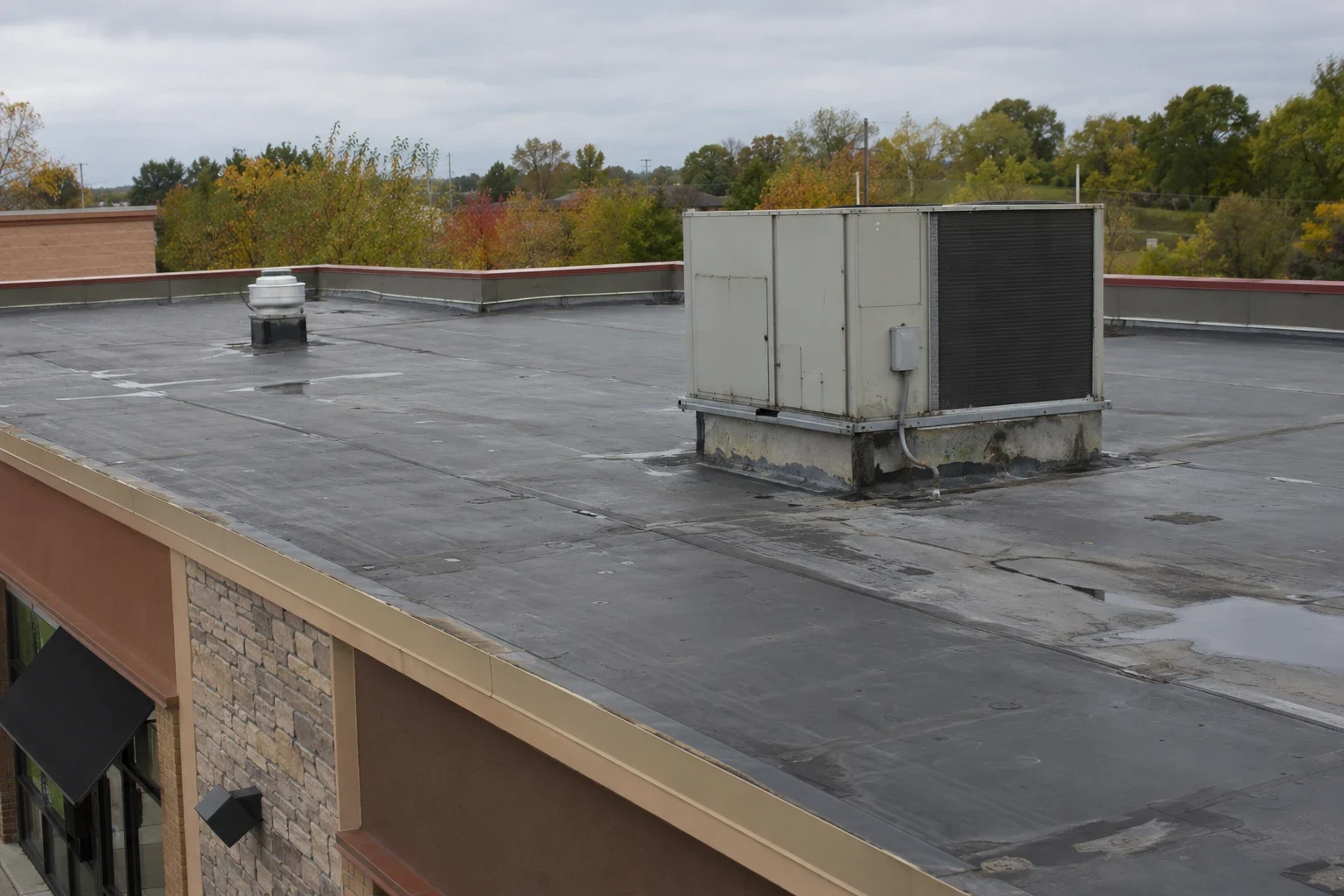
Exhaust fans push a fine mist of cooking oil up and out of the building, and some of it lands on the roof around the fan. Over months that film softens certain adhesives, stains the surface and collects dirt, and on some membranes it attacks the material itself. A patch applied over a greasy surface will not bond, and a seam that touches grease can lift at the edge long before the rest of the seam shows age.
We look at the surface around each fan for staining, softness and loose edges, and we clean the area with a degreaser compatible with the membrane before any repair. Where the fan discharges onto the roof, we recommend a containment tray or a grease-resistant membrane patch under the discharge. Fan curbs and hinged bases are checked for cracked sealant, since vibration and heat work at them every day.
Where leaks reach a dining room
A leak that lands in the kitchen is a nuisance. A leak that lands over a table or the bar is a lost evening. Because the dining room often has a lower ceiling than the kitchen, with a suspended grid and light fixtures, water that gets in at a wall flashing or a vent boot can follow a wire or a pipe a long way before it appears. A stained tile is a symptom, and the roof opening may be well away from it.
We trace the water path from the interior stain to the roof, checking parapet flashings, skylights, rooftop heaters and pipe boots in a line from the stain toward the nearest drain. Photographs mark each suspect spot with a distance from a fixed point so the manager can find it. For urgent leaks, a temporary dry-in is placed the same day, and the permanent repair is scheduled for dry, moderate weather.
Drainage and melt: the spring check
Long-run climate records from Salt Lake City's airport show snow, freezing weather and warm summers for the whole valley, and they offer only a general guide for a West Jordan restaurant. Still, the cycle is a reason to check drains and scuppers early. A restaurant on a pad site may have a small roof with a parapet on several sides, and then one blocked scupper can hold a pond against the wall.
After the first thaw we clear drain strainers, check scuppers for ice and debris, and look for low spots near the parapet. Kitchen roofs also collect leaves, paper and food packaging blown from a nearby lot. On a small roof that debris builds quickly, so we suggest a schedule for clearing it that matches the season.
Working around the dinner rush
Restaurants cannot close for a long roof project, and lost service hours are a cost the owner counts alongside the roof. We plan work for the quiet part of the day, usually morning before prep begins, and stage materials away from the front door and the delivery entrance. Fresh-air intakes and exhaust are protected from dust and fumes, and hot work is avoided near the kitchen make-up air.
For a full replacement, we split the roof into sections that can be closed up before the evening service, and we coordinate with the kitchen manager about which hours the exhaust must stay running. Fire-suppression systems and hoods stay in service. If the kitchen must close for a day, we give the owner that date early enough to order food accordingly.
Restaurants along the valley's commercial roads
West Jordan expects regional commercial, service, office and mixed-use growth, and it treats the area around 7800 South and Redwood Road as its original downtown. Restaurants sit in strip centers, on pad sites and in mixed-use buildings in those places. In South Jordan, Daybreak's urban center mixes homes, shops and entertainment, and Riverton's downtown plan calls for retail and restaurant uses.
Restaurant owners in West Jordan, South Jordan and Riverton can ask for a roof walk. A restaurant in a strip is often part of a larger shopping center roof owned by someone else, and the lease decides who pays for what. A restaurant in a hotel or on a pad is closer to a hotel roof in how it handles kitchen exhaust and guest-facing noise. Operators with several locations can use a chain roof program.
Repair, restore or replace
Restaurant roofs are usually small enough that a replacement can be broken into short sections, which makes the decision less about disruption than about condition. If the membrane is sound but stained and tired, a coating restoration can add life once the surface is cleaned. If wet insulation shows up in a moisture reading, replacement of the wet areas is cheaper than repeated patches. A written comparison puts both paths side by side, priced on surface area, insulation depth, how many openings need flashing and the route the crew takes to the roof.
The written plan also covers records. We note every fan, curb and vent, the condition of each, and the date of the last repair, so a new manager inherits a clear picture. If a lease or a lender requires roof documentation, the same file serves that need, and it makes the next spring check faster because the previous repair lines are already marked on the plan, and a manager can see at a glance which fans and curbs were reflashed and which are still waiting. Rooftop dining equipment, patio heaters and signage supports are listed too, since each one adds a mounting point that needs to be sealed, and a roof walk after the first hard freeze shows whether any of them has shifted.
Commercial Roofing Questions
Why do patches near my exhaust fan keep failing?
Grease on the surface keeps adhesive from bonding. We clean the area with a compatible degreaser before patching and recommend containment at the discharge so the next patch lasts.
Can the work happen while the restaurant is open?
Often in sections, and usually in the quiet hours. We protect intakes from dust and fumes, keep hoods running, and give the kitchen manager the dates that matter for food orders.
The stain is over a table but nothing leaks on dry days. What does that mean?
The opening probably admits water only under certain conditions, such as melt or wind-driven rain. We trace the path from the stain back toward the roof and test the nearest flashings and boots.
Does a restaurant roof need special membrane?
Some membranes handle oils better than others. The choice depends on fan discharge, roof traffic and budget, and we explain the tradeoffs on the written comparison.
What if the landlord owns the roof?
We work with whoever holds responsibility under the lease. A written roof report with photographs makes the conversation between tenant and landlord much simpler.
Show us the stain and the fan
Tell us where water or grease shows up, when it happens, and how roof access works at your restaurant. We will plan the roof walk around prep and service hours and mark the repair line before any schedule is set.