
A guest who calls the front desk at two in the morning about a wet ceiling has already decided what to write in a review, which is why hotel roof trouble costs more than the repair itself. Hotels in West Jordan, UT stand under the same winter snow and spring melt as every other flat roof in the valley, but the rooms below the membrane are sold nightly, and a room taken out of service is revenue that does not come back. The roof plan has to be built from the room list outward.
That starts on the top floor, where the rooms nearest the roof show a leak first and a roof walk can tie each stain to a spot above it.
Top-floor rooms and the roof above them
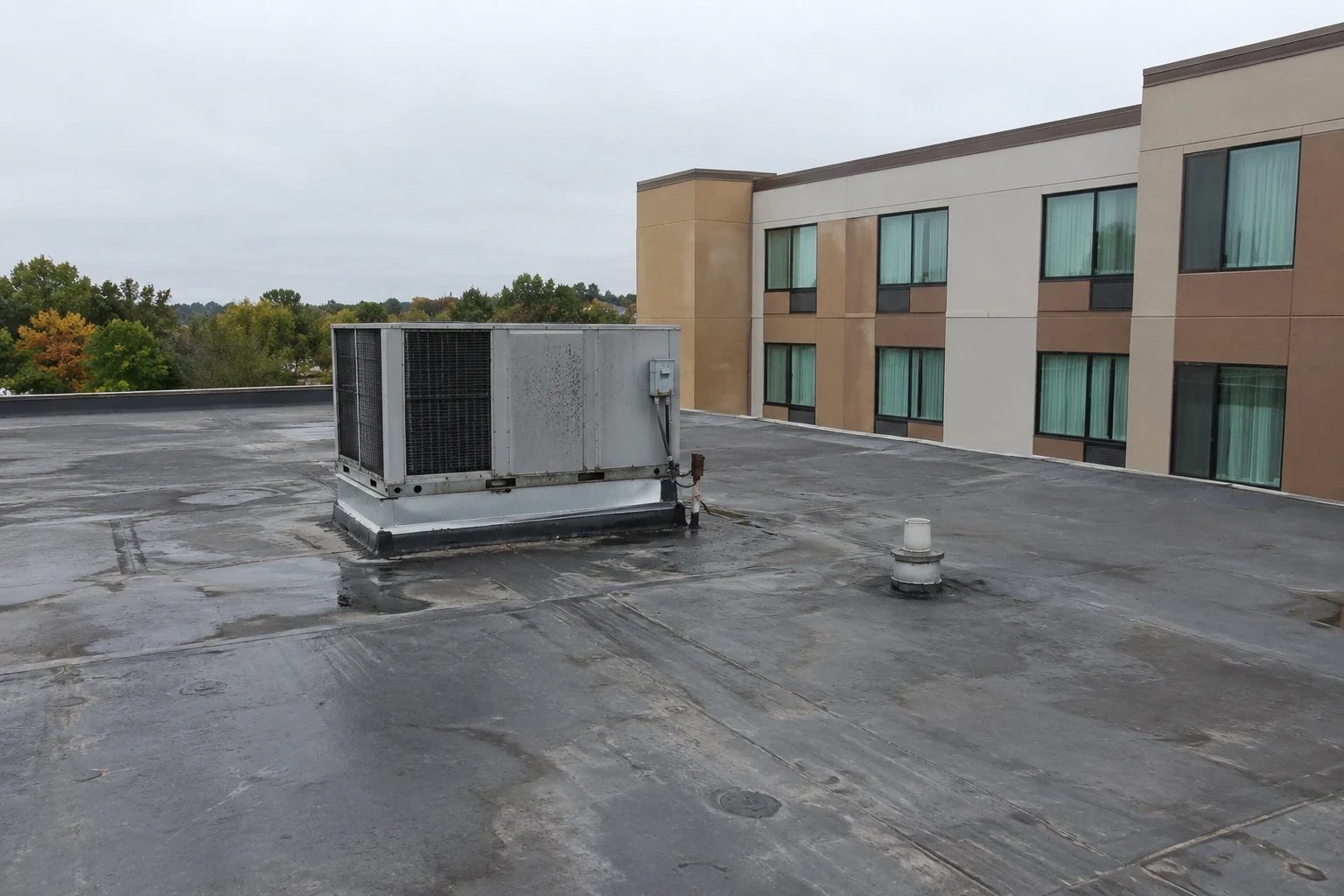
A hotel with a flat or low-slope roof over the top floor usually has a mix of mechanical rooms, stair towers and lift-shaft housings above that. Each of those projections creates a wall flashing, a curb or a termination that sets up a place for water to enter. Water that gets in above a corridor ceiling can travel along the top of a wall and drop into a guest room two doors away.
We number the rooms on the interior plan and match them to the roof plan above, then probe each flashing and seam in line with a reported stain. If the housekeeping or engineering staff keeps a log of wet-ceiling reports, we ask for it, since the dates often line up with melt events. The roof report ties each finding to the room numbers affected, which helps the general manager decide which rooms to hold from sale during repair.
Drainage and melt around the roof edge
A hotel roof has to handle the same winter the whole valley gets, with snowfall, freezing nights and then warm summers, as the airport climate record in Salt Lake City shows. That record is not a measurement from any West Jordan hotel, but the pattern is the one a roof must handle: snow that melts by day and refreezes by night. Hotels with parapets and internal drains may hold water against the wall if a drain strainer clogs, and an exterior gutter may freeze and pull away from the fascia.
After a thaw, we check drains, scuppers and gutters, and we look at the edge metal and coping where snow and ice sit longest. A porte-cochere or entry canopy often has its own small roof and its own drain, and these are easy to forget. A canopy that ponds above a guest entrance can drip onto the walkway, so we include it in the roof walk and in the written plan.
Mechanical rooms, laundry and pool exhaust
Hotels run more equipment than most building types, and the roof shows it. Laundry exhaust, kitchen hoods, pool dehumidification, boiler flues and large rooftop heating and cooling units all penetrate the membrane. Laundry and pool exhaust carry heat and moisture, and the humid air can condense on cold surfaces beneath the roof, which looks like a leak but behaves differently from one.
We examine the roof around each of those discharge points for staining, softened adhesive and failed sealant. Where condensation rather than a roof opening is the cause, we say so, and we point to the ventilation or insulation detail that needs correction. A false leak call wastes a repair visit, so we compare the pattern with the weather before cutting. Where lines and conduit cross the roof, supports are checked and pads are added along the service routes.
Quiet hours and guest comfort
Roof noise is a guest-comfort issue, and no manager wants a tear-off at seven in the morning above a full top floor. We plan the noisiest tasks for late morning and early afternoon, when most guests are out, and we keep staging away from the main entrance, the pool deck and the loading area. Hoists are placed where falling debris cannot reach a walkway, and fencing and spotters protect any path that guests might use.
For a larger project, we split the work by wing or by stair tower, so the top floor of one section can stay in service while another is covered. The crew gets a single point of contact at the front desk and a short list of rooms to avoid. Weather holds are agreed in advance, so a crew does not leave a section open when a storm is forecast.
Lodging near the valley's highways and rail
West Jordan reports access to I-15 and I-80, and UTA's Red Line stops at the West Jordan City Center and Jordan Valley stations. Midvale's Main Street plan anticipates lodging alongside residential, civic, retail and office uses, and Salt Lake City's North Temple corridor connects downtown toward the airport. Lodging in these places shares roofs with a wide mix of neighbors, and construction nearby can change crane access and snow drift patterns.
Owners and operators in West Jordan, Midvale and Salt Lake City can use a common plan format across several properties. A group that runs many hotels can build an hospitality roof program around the rooms and seasons that matter most. A hotel with a ground-floor restaurant may also need the guidance on a restaurant roof, since kitchen exhaust is the same issue, and a lodging building with apartments above ground-floor space may relate to an apartment roof.
Repair, recover or replace
A hotel roof that leaks in several rooms at once is usually telling the owner something about the whole assembly. A moisture survey charts where the insulation is wet, and the chart splits repairable areas from areas that must come out. When the insulation is dry, a recover can add a new membrane with less noise and less debris than a tear-off. When wet areas spread, replacement is the better value. The owner gets a written comparison with the price drivers laid out, so a decision can be made before the next busy season.
Timing for a hotel follows occupancy more than it follows the calendar. The roofing materials need dry, moderate days, and the lodging calendar has its own slow weeks, so we ask the general manager for the dates when the fewest rooms are sold and plan the heaviest work for those. Material lead times are set against that window, and any warranty paperwork is reviewed before the first cut so that notice requirements are met.
Commercial Roofing Questions
Which rooms should be held from sale during a repair?
Those directly under the work and any that sit under the staging or hoist path. We match room numbers to the roof plan, so the manager receives a short list instead of a whole floor.
A guest room smells damp but the ceiling looks dry. Is that the roof?
Possibly. Wet insulation above the ceiling can hold water for weeks before a stain forms. A moisture scan of the roof above the room shows whether the source is overhead or in the ventilation.
Can the roof be worked on when the hotel is full?
In sections, yes. We schedule noisy tasks for late morning, protect entrances and pool areas, and close each section before evening. Weather holds are agreed ahead of time.
What is the risk of pool exhaust near the membrane?
Warm, humid air condenses on cold surfaces and can soften sealants and adhesives. We check the roof near discharge points and recommend sealant and flashing details that suit that exposure.
How should an owner decide between a recover and a full replacement?
Moisture readings answer it. Dry insulation supports a recover. Wet insulation across several areas points to tear-off of the wet sections, and we write both options down with their costs.
Give us the room numbers
Tell us which rooms show water, when it appears, and how roof access works. We will plan the roof walk around check-in and checkout, match each stain to the roof plan, and mark the repair line before any schedule is set.