
A strip center leak rarely stays with the tenant who reports it. Water that enters above a nail salon on a Tuesday can travel along a shared deck and drip into the shoe store two bays over on Thursday, and by the time the landlord hears about both, the roof has been wet for a week. Shopping center roofing in West Jordan, UT starts with a simple question: where does the roof drain, and who sits under each stretch of it? Winter snow and the thaw that follows give that question a deadline every spring.
Retail roofs are long, low and shared. The plan for repair has to start from that layout.
Shared roofs and shared leaks
Most strip retail is built as one continuous roof with demising walls that divide the tenant spaces below. The membrane runs across those walls, and the walls are where the trouble tends to concentrate. A parapet between two bays may have a different flashing height than the one next door, a roof drain may sit over a party wall, and a rooftop unit installed for one tenant may sit on a curb that was flashed years before the next tenant arrived.
When a leak is reported, we ask for the bay, the day and the weather, then walk the roof and trace the path back to the nearest drain, seam or curb. A stain on a ceiling tile is a symptom. The opening may be a bay or two away, and the repair line is drawn from the roof side, not the ceiling side. Photographs and measurements tie each fix to a fixed point such as a unit or a scupper.
Drainage and melt in a long, low roof
Long retail roofs often drain toward the front or the back through scuppers and downspouts, with only a few internal drains. The winter record kept at the Salt Lake City airport, with its snowfall, freezing spells and warm summers, is only a valley-wide guide for any West Jordan center. Even so, the routine is familiar on a flat retail roof: snow sits, softens in the afternoon and hardens again overnight.
At the front of a center, that cycle can freeze a scupper solid and push water back across the roof. At the back, a downspout that empties onto a service drive can leave ice across a loading path. After a thaw, we clear scuppers and drain strainers, check the slope toward each outlet and note any low area that still holds water a day later. Roofs that pond routinely are candidates for tapered insulation or additional drains.
Tenant work and rooftop equipment
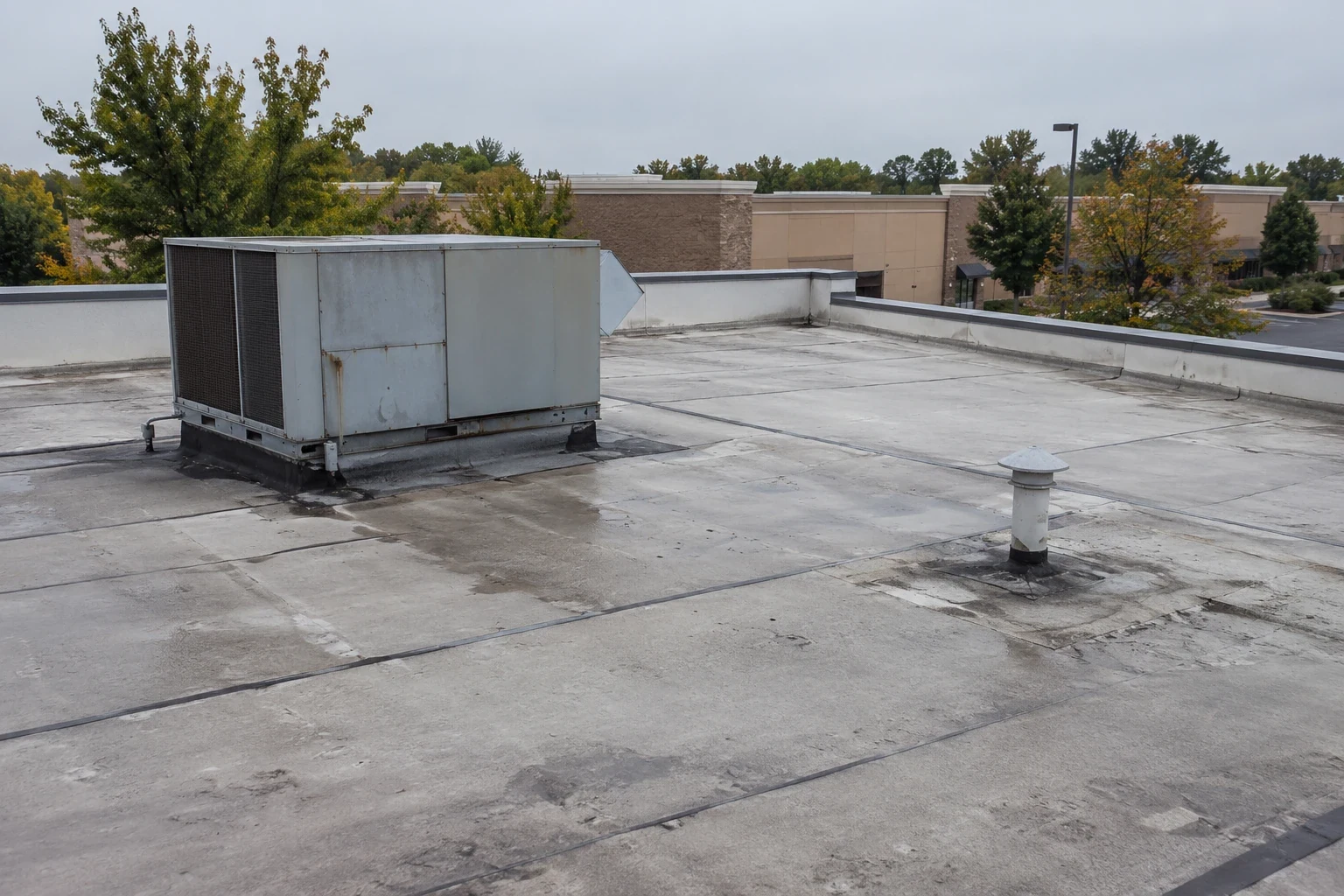
Every new tenant brings changes to the roof: a kitchen exhaust for a restaurant, a bigger air handler for a fitness studio, a new antenna for a wireless store. Each penetration is cut by whichever trade did the work, and not all of them are flashed to the standard of the original roof. Over time a retail roof collects abandoned curbs, capped pipes and conduit supports that no one remembers installing.
We build a rooftop inventory during the roof walk and mark which penetrations are active, which are abandoned and which have flashing in poor shape. For landlords, that inventory is useful for lease conversations, because it shows who is responsible for which opening. Abandoned curbs can be removed and the membrane patched, which reduces future leak points.
A supermarket or a pharmacy in the center brings its own load, since refrigeration condensers, kitchen exhaust and vent stacks all sit on the roof above food and medicine. A grocery store roof in the same center is walked with that equipment in mind, and any refrigerant or condensate lines that cross the membrane are flagged for support so that foot traffic from service techs does not wear a path through the surface. Walkway pads placed between the access hatch and the most visited units protect the membrane where the service visits actually go.
Phasing around open stores
A center cannot close for a roof project, so the plan phases the work by section. We choose an order that keeps the main entrance and the largest tenant's entrance open, stage materials where they do not block fire lanes or loading docks, and schedule noisy tear-off before store hours when the lease allows. Walk-off protection goes over canopies and awnings, and sidewalk covers go up where hoisting happens above a pedestrian path.
Tenants get a short written notice that names the day, the noise window and the part of the roof involved. Restaurants and food sellers get extra attention: grease from exhaust fans is cleaned from the roof surface before new membrane goes down, since grease can attack some membranes and loosen adhesives.
Retail along the valley's corridors
West Jordan's corridor zone permits stand-alone commercial and office uses along Redwood Road, and the old downtown core at the corner of 7800 South and Redwood Road is a City Center planning area. Taylorsville describes regional, community and neighborhood commercial centers along its main corridors, and Sandy plans reinvestment in areas such as Sandy Corners. A dry roof keeps those centers open and leasable.
Owners in West Jordan, Taylorsville and Sandy call us, and so do property management companies that hold several centers at once. A multi-site roof program lets a manager rank all the centers on one list and place the worst roof first.
Roof-walk notes for the landlord file
Lenders, buyers and incoming property managers ask for roof history, and the file we hand over answers them. It identifies the roof type, grades each stretch, pins each repair to a bay wall or a unit, names the materials and notes the readings taken next to the fix. Every photo carries a bay number, which lets a tenant's leak call be traced to the roof above in minutes. The following spring, earlier repair lines are rechecked before anything new goes on the list.
Repair, recover or replace
Many centers fit a middle path. When the insulation tests dry, a recover adds a new membrane at less disruption than a full tear-off. When wet readings spread, replacement is the sounder choice. For a large store attached to the same center, the roof may be separate, and a big-box retail roof is often handled on its own schedule.
Commercial Roofing Questions
A tenant reports a leak, but the stain is on the other side of the wall. Who is right?
Both can be, since water travels along the deck. We trace the path from the roof side and mark the actual entry point, which may sit in a different bay than the stain.
Can the center stay open during a reroof?
Yes, in phases. We keep the main entrance and the largest tenant's access clear, stage materials away from fire lanes and docks, and give each tenant written notice of the day and the noise window.
What happens to old equipment curbs on the roof?
Active ones are checked and reflashed if needed. Abandoned ones can be removed and the membrane patched, which cuts the number of places water can enter.
Why does a scupper freeze and back water up?
Melt runs to the scupper during the day and freezes there at night. Once the opening is blocked by ice, the next melt has nowhere to go and spreads across the membrane.
Does restaurant exhaust affect the roof surface?
Grease from a fan can soften some adhesives and stain the membrane. We clean the area before repairs and recommend grease containment where fans discharge onto the roof.
Name the bay where water shows up
Tell us which tenant space sees the stain, when it appears, and how roof access works at your center. We will walk the roof, map every opening and mark the repair line before any schedule is set.