
A bucket on the sales floor at nine in the morning tells a store manager what a roof inspection would take an hour to confirm. A big-box store in West Jordan, UT typically sits under a wide, flat roof with few drains for the area it covers, and when winter snow melts in the afternoon and refreezes at night, the water has a long way to travel before it finds an outlet. The question for an owner or a store operations team is not only where the leak is, but how a single opening can reach a checkout lane, a stockroom or a pallet aisle.
The roof walk begins at the drains and works outward, because on a roof this wide the drain layout explains most of the damage.
Wide roofs and few drains
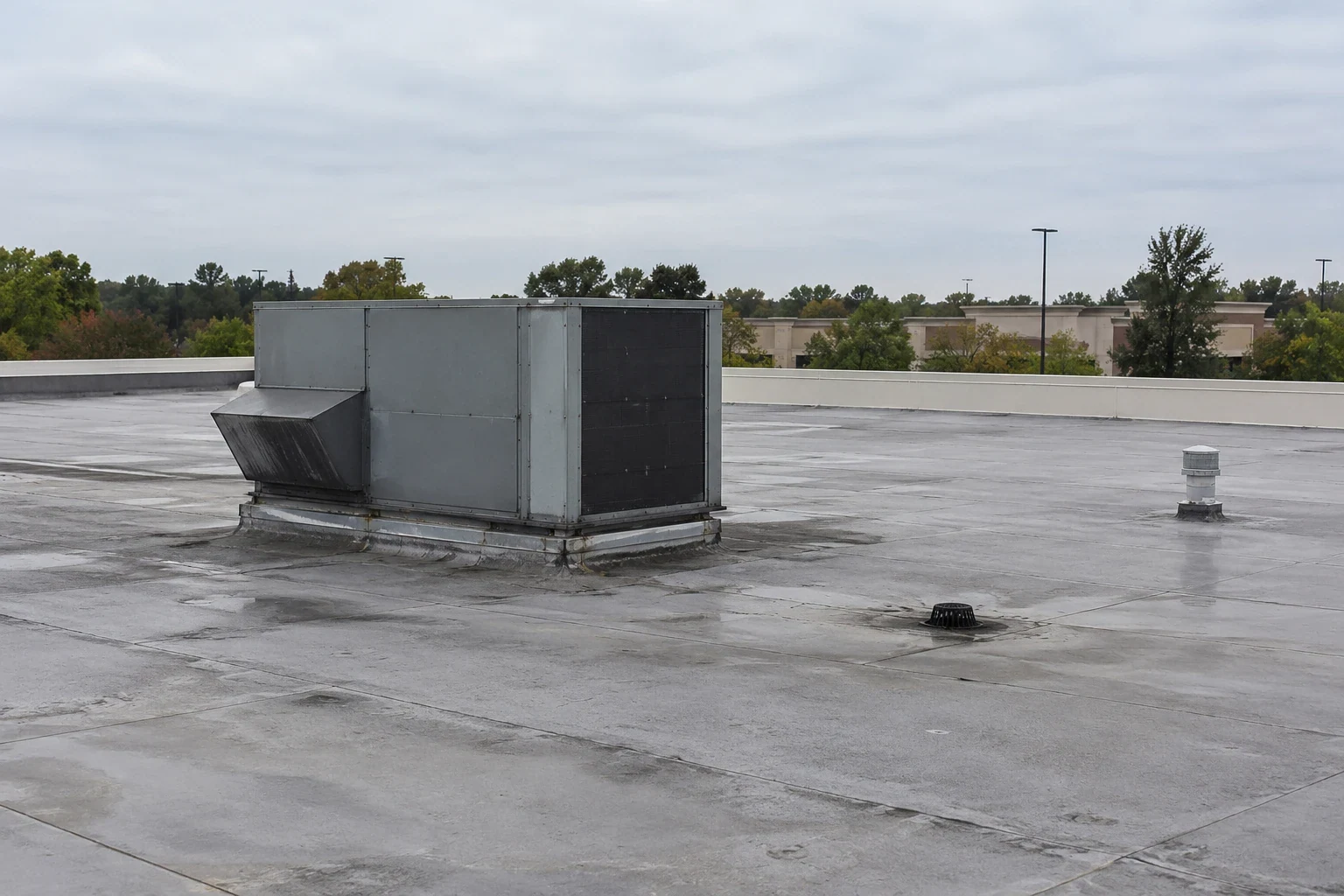
A freestanding store may have a roof deck stretching a long way in each direction, with a small number of interior drains and a handful of overflow scuppers at the parapet. That arrangement works only when every drain stays open and the roof stays on its design slope. When a drain strainer clogs or insulation settles around an outlet, a shallow pond forms and grows with each storm. Standing water adds weight, speeds membrane aging and puts constant pressure on every seam beneath it.
We map the drains on a roof plan and then check each one for blockage, for the condition of the drain ring and clamping ring, and for the slope of the surface leading to it. Ponding that lasts more than a day after rain or melt is flagged and photographed. Where the deck has deflected, tapered insulation can be added during a recover or replacement to direct water to the outlets that already exist.
Drainage and melt: what snow does to a big roof
Valley weather records from the airport in Salt Lake City list recurring winter snowfall, cold-season freezing and warm summers. They serve as a proxy, so a store near Redwood Road may see different conditions from one at another elevation. The cycle itself still applies: snow on the roof, afternoon melt, overnight freeze.
On a wide roof, drifted snow collects against taller walls, rooftop units and any change in roof height, and the melt from those drifts runs across a larger area than a small building would see. Ice at a parapet scupper can hold water on the roof after the snow is gone. We check scuppers and gutter connections after the first hard freeze and again in early spring, and we note any place where ice has pulled flashing from the wall or loosened the edge metal.
Rooftop equipment and refrigeration
Big-box roofs carry rows of heating and cooling units, and many stores also have refrigeration condensers, kitchen exhaust or garden-center equipment. Each unit sits on a curb that has to be flashed to the membrane, and each curb is a place where movement, vibration and sunlight wear on the seal. A technician who walks the same path to the same units every week also wears the membrane along that path.
We look for cracked curb flashing, loose fasteners at the base of a unit, and wear along service routes. Walkway pads placed between the access hatch and the busiest units protect the membrane from foot traffic. Where refrigerant lines or conduit cross the roof, we check that supports lift them off the surface and that the penetrations are sealed.
Working around trading hours
A store does not close for a roof project, and most retailers will not accept noise or dust on the sales floor during peak hours. We plan the work in sections that match the store's receiving schedule, staging materials near the loading area and away from the main entrance, and using night or early-morning shifts for tie-ins near interior spaces. Tear-off is done in areas small enough to be closed up each day, so a sudden storm does not find an open roof.
Smell and noise matter in a store that sells food, clothing or home goods. Hot-applied systems are avoided near fresh-air intakes, and low-odor adhesives or mechanically fastened systems may be chosen when the sales floor cannot be vacated. The crew follows a sign-in routine with the store manager and keeps fire lanes clear at all times.
Retail pads along the valley's corridors
West Jordan's plan leaves room for large commercial users, offices and mixed-use blocks, and the corridor zone along Redwood Road allows stand-alone commercial buildings. West Jordan reports access to I-15 and I-80. Farther along the valley, Sandy keeps plans for areas such as South Towne Promenade, and Bluffdale reserves Wardle Business Park for retail and flex-office buildings.
Owners and operators in West Jordan, Sandy and Bluffdale may manage several stores at once. A retail chain program lets a regional facilities team rank all of its roofs and place repair money where it matters most. A store that shares a lot with a strip of smaller tenants can be compared with a shopping center roof, though the two usually follow separate schedules.
Repair, recover or replace
Many big-box roofs reach a point where patching costs more each year and a decision is due. When the insulation tests dry, a recover can add a new membrane over the old one without a full tear-off, which keeps the store open with less disruption. When a moisture survey shows wet insulation across several areas, the better path is replacement of those areas or the whole roof. A written comparison of both paths lets the operator pick the one that fits the lease term and the capital calendar.
Stores with a food department add another question, since a refrigerated section places condensers, drain lines and heavier loads on the roof, and a grocery store roof is walked with those lines marked on the plan. Cost drivers are the same on any wide roof: the area to be covered, the thickness of insulation that needs to come out or go in, the number of curbs and penetrations to be flashed, and the amount of hoisting needed to reach a rear loading area. The time a crew needs is set mostly by how many sections the store allows to be opened at once, so the schedule is agreed with the operations team before material is ordered.
Commercial Roofing Questions
Why does a big roof pond even when drains are open?
Decks deflect and insulation settles over time, so the surface can dip between supports. Water collects in those dips even when the outlet itself is clear. Tapered insulation added at recover or replacement can correct it.
Can a store stay open during tear-off?
In most cases, yes. We work in sections small enough to be dried in each day, use night or early-morning shifts near interior tie-ins, and choose low-odor systems where the sales floor stays occupied.
How do you protect the membrane from service technicians?
Walkway pads go along the paths between the hatch and the busiest units. They spread foot traffic and prevent the wear lines that open into seams over time.
What do you check around a rooftop unit?
The curb flashing, the sealant at the unit base, the fasteners, the drain pan connection and the support for any lines that cross the membrane. Cracks or movement at any of those points can let water in.
Should a chain look at roofs one by one or as a group?
As a group, with the same plan format on every store. That way the worst roofs rise to the top of the budget, and a repair at one store informs the plan for the next.
Tell us where the bucket sits
Share where water appears on the sales floor, when it shows up, and how roof access works at your store. We will plan the roof walk around trading hours, mark the repair line and confirm what must be settled before a schedule is set.