
Condensation dripping from a ceiling grid above the produce case is easy to blame on the roof, and sometimes the roof is guilty. Grocery stores in West Jordan, UT run more equipment overhead than most retail buildings, and every refrigeration line, condenser pad and kitchen exhaust fan is another opening through the membrane. When winter snow melts and refreezes on that roof, the water finds the weakest of those openings, and what leaks into a grocery store is not only an inconvenience but a food-safety matter.
A roof walk over a grocery store starts at the equipment and works toward the drains, because that is the order in which water tends to fail the building.
Condensers, exhaust and the membrane under them
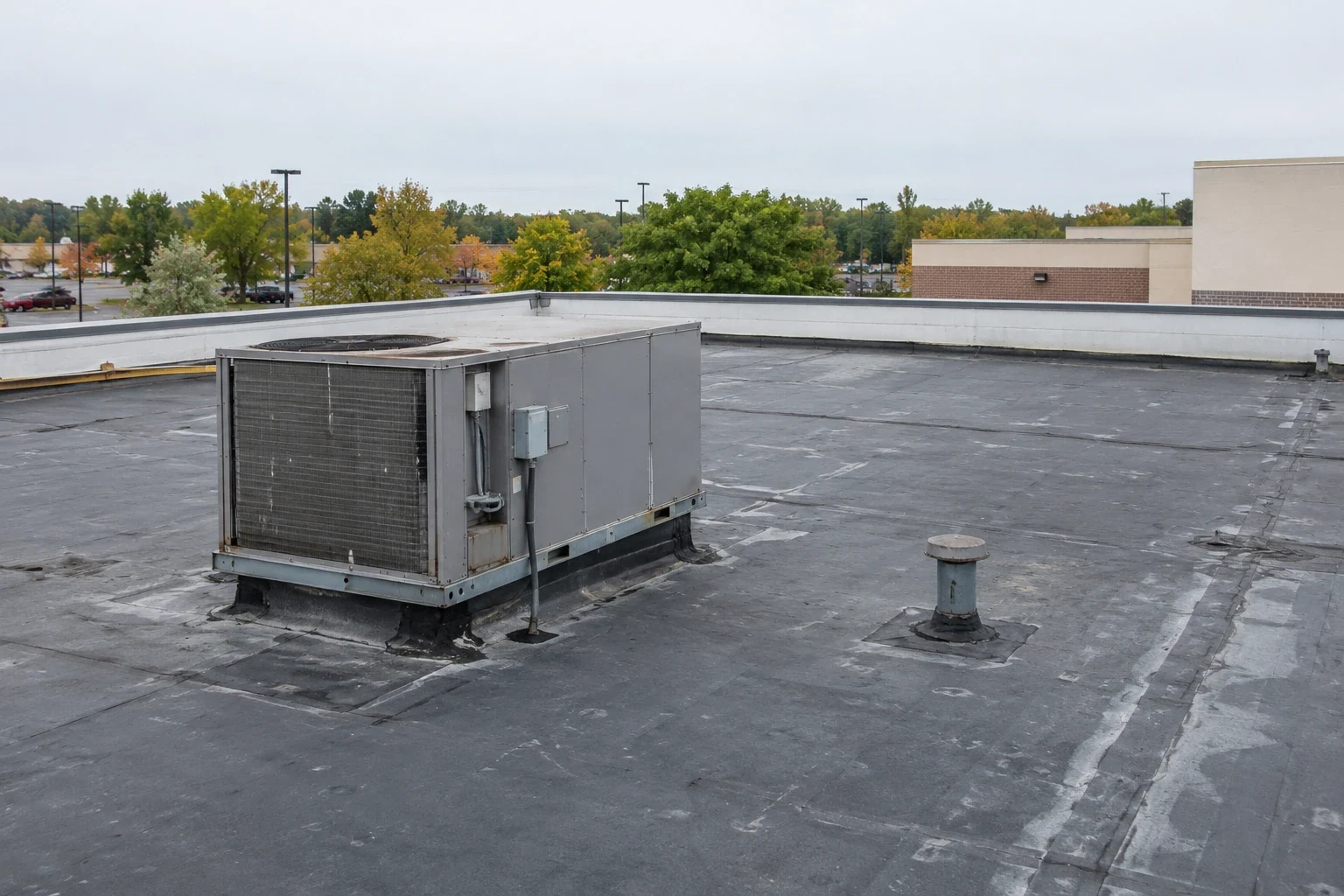
A supermarket roof usually carries a group of refrigeration condensers, one or more makeup air units, exhaust fans from a deli or bakery, and the usual heating and cooling equipment. Condensers vibrate, and over time that vibration works at the sealant around the supports and at the flashing on the lines that run to the units. Heat from the units can age nearby membrane faster, and the surface beneath a condenser often shows chalking or cracking before the rest of the roof.
We check support legs, pitch pockets, refrigerant line penetrations and curb flashing, and we probe the seams within arm's reach of each unit. Where lines cross the roof on the surface, we make sure supports lift them clear of the membrane. If a leak has been reported, we follow the water back along the line to the opening instead of stopping at the nearest stain.
Food-safe work practices
Roofing above food is a matter of planning, not luck. Before tear-off or cutting begins, we agree with the store manager on which areas below need to be covered, which cases need protection and which doors are the safe route for materials. Debris, dust and odors have to stay out of the sales floor and the stockroom, so we avoid open torches and strong solvents near air intakes and choose low-odor adhesives or mechanically fastened systems where intakes sit close to the work area.
Exhaust from a kitchen or fryer leaves grease on the roof, and grease attacks some membranes and adhesives. Before repair, we clean the surface around exhaust fans so patches can bond, and we recommend a grease containment tray at discharge points. At the end of each shift the area is closed and swept so no debris waits for the morning crew.
Drainage and melt around the loading dock
Valley-wide climate data from the Salt Lake City airport points to recurring snowfall, freezing winters and warm summers. It is a guide rather than a reading at any West Jordan store, but it describes the cycle that matters at the loading dock end of a grocery roof. Delivery trucks pull in early and late, and a downspout that freezes can leave ice across the apron where drivers walk.
After a thaw we check scuppers, downspouts and gutters at the rear of the building, where the roof edge meets the dock canopy. Dock canopies and awnings often have their own small roof sections with their own drainage, and they are easy to overlook. A canopy that ponds above a receiving door can drip onto pallets and floors that must stay dry. We include them in the same roof plan as the main field.
Night shifts and early mornings
A grocery store sells around the clock for much of the week, so a roof project is a schedule puzzle. We usually split the roof into sections that can be opened and closed within a single shift, with noisy tear-off done before the first customers arrive or after the last. Materials are staged away from the front entrance and fire lanes. Safety zones are marked at the doors below the work so customers and employees do not walk under a hoist line.
For stores that run all night, we coordinate with the overnight manager and the maintenance team so that anyone who sees water inside during the work has a clear line to call. Temporary dry-in material is on site before any cutting begins, and a standby crew is available when a forecast calls for rain or snow during a section that is open.
Grocery roofs near the valley's traffic routes
The city reports I-15 and I-80 access, and its plan leaves room for commercial, service and mixed-use growth around its Red Line stations, among them the Jordan Valley stop. Grocery roofs in the south valley sit under the same snow cycle as the offices and warehouses around them, and a store on a busy road such as Redwood Road may have limited room to stage a crane. Murray identifies retail and transportation among its economic sectors, and Taylorsville describes neighborhood commercial centers along its corridors.
Store owners in West Jordan, Murray and Taylorsville can book a roof walk. A store that is part of a shopping center may share the roof with other tenants, while a freestanding store can be handled like a smaller big-box retail roof. Chains with several stores can set up a program across stores so that every roof is reported on the same sheet.
Repair, coat or replace
On a grocery roof, a recurring leak near the same condenser often calls for more than another patch. We confirm the extent of wet insulation with a moisture survey, and we price each path on what drives it: how much insulation must come out, how many units have to be disconnected and reset, and whether refrigeration contractors must work alongside the roofers. Those trades affect timing as much as the membrane itself, and the plan names them in the order they are needed.
Timing also follows the weather. A new membrane needs dry surfaces, so the cleanest window is the stretch of warm, dry weeks after the spring melt, with replacement of the worst sections moved earlier if a leak is reaching product. If the store has a manufacturer warranty, we read its terms before work starts and record who was notified, because a repair that ignores the notice rule can put coverage at risk. The finished file lists each unit that was lifted, each curb that was reflashed and each moisture reading taken beside the work, so the next spring check begins with a clear map of the roof.
Commercial Roofing Questions
Can the roof be worked on without disturbing the sales floor?
Mostly, yes. Noisy work is done early or late, intake areas are protected, and each section is dried in every shift. Areas directly below are agreed with the store manager before cutting begins.
Is a ceiling drip near a condenser always a roof leak?
No. Condensation on cold lines can drip too. We check the roof first for open flashing and cracked sealant, then compare the pattern of the drip with the weather to tell the two apart.
Do refrigeration contractors need to be on site?
When a unit must be lifted or disconnected, yes. We schedule that trade alongside our crew so that food loss is kept to a minimum and the unit is back in service the same day.
How does grease from a deli fan affect the roof?
It softens adhesives and stains the surface, and patches over it fail to bond. We clean the area before repair and suggest a containment tray at the fan discharge.
What happens when snow is forecast during the project?
The open section is closed up with a temporary dry-in before the storm, and a standby crew is ready if more is needed. We do not leave a cut-open roof overnight.
Point us to the drip
Tell us where water or condensation shows up, what time of day it appears, and how roof access works at the store. We will plan the roof walk around deliveries and trading hours and mark the repair line before any schedule is set.