
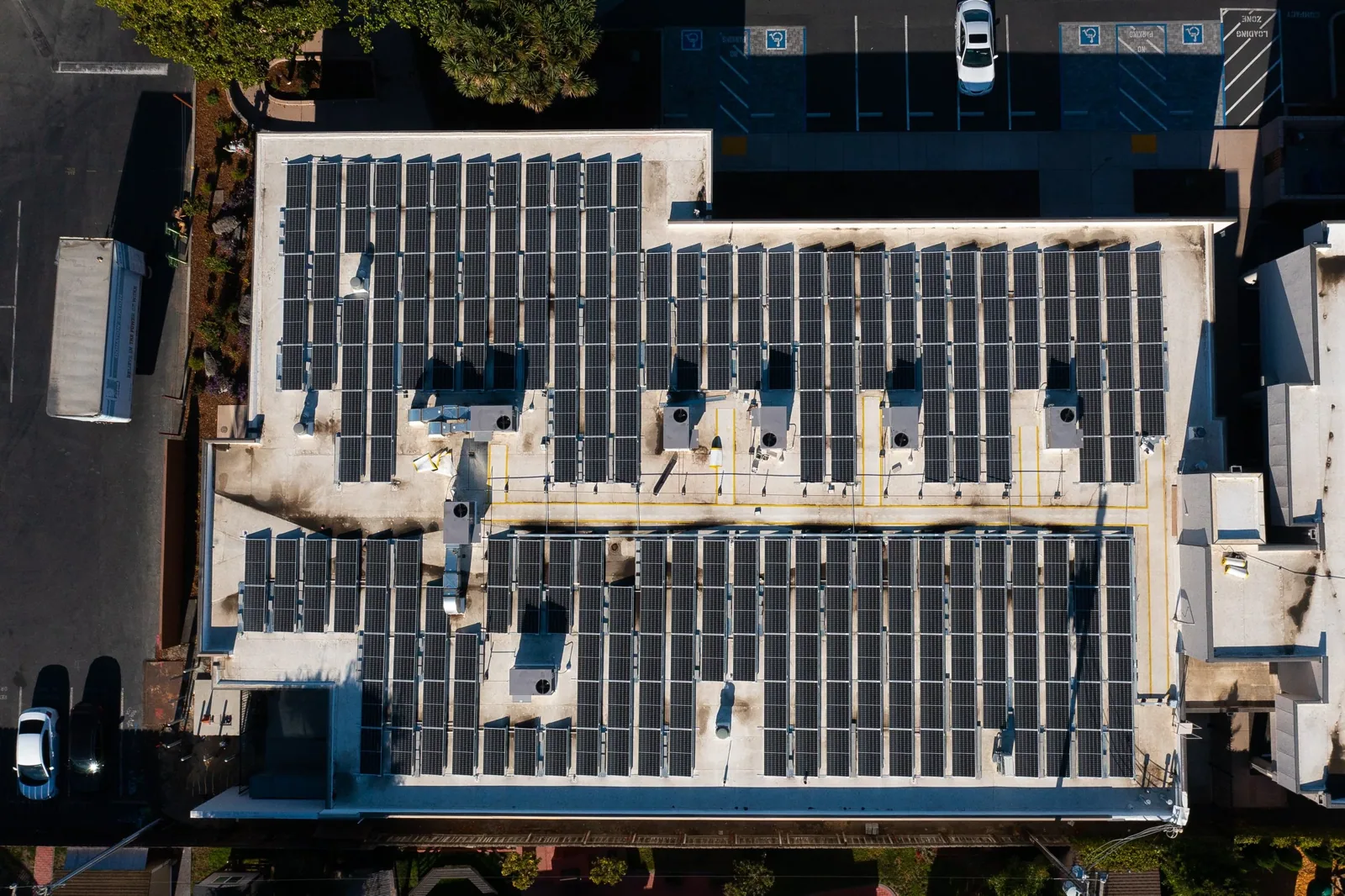
A solar proposal usually arrives with a tidy drawing of panels laid across a roof, and the drawing says nothing about the membrane under them, the seam that runs through the array footprint, or the drain bowl that sits where a row is meant to go. A roof that carries panels for the life of the array has to stay dry under them for the same stretch, and the roofer who puts the panels' footing in place is the one who either keeps that promise or breaks it. In West Jordan, UT, where flat roofs hold winter snow and shed it through repeated melt cycles, the array and the roof share the same weather.
Solar-ready roofing means getting the roof to a condition where panels can go on without shortening its life, and keeping a roof workable once panels are there. It also means sequencing: reroof first, array second, so the roofing never has to be done around hardware.
Roof age before array
The most common mistake is installing an array on a membrane that will need replacing in a few years. Removing panels to replace a roof is a project of its own, with electrical shutdown, removal, storage and reset, and the roof under the array may be wet or worn out by the time anyone looks. A roof walk before any contract is signed tells the owner whether the membrane, the insulation and the deck can carry another full service life.
We check seam condition, the amount of ponding, the state of the flashing and whether moisture has reached the insulation, using an infrared moisture survey where the surface allows. When the roof is near the end of its service life, replacing it first is the sounder order, and a replacement can include the added insulation, a cover board or a higher-grade membrane that an array will be sitting on.
Attachments, ballast and penetrations
Panels reach a flat roof in two broad ways. A ballasted system rests on the surface with weight holding it down and no holes through the membrane, which keeps the roof closed but adds load. A mounted system is fastened through the membrane to the deck or a structural member, which holds firmly and requires every attachment to be flashed. Each carries a roofing cost. Ballast needs protection pads beneath it, since a concrete block shifting a quarter inch in a windstorm will wear through an unprotected surface. Mounts need base flashing that survives a quarter century of thermal movement.
Wherever a mount goes through the roof, it becomes a penetration, and it follows the same logic as any other. We prefer manufacturer-detailed boots or pitch-pan alternatives that suit the membrane in place, and we locate them so water does not collect on the upslope side. Careful layout can also keep the array off seams and away from skylights and other penetrations, where the roof is already working hard.
Snow load, slide and the roof edge
The weather normals recorded at Salt Lake City International Airport show recurring winter snowfall and freezing periods. On a flat roof with panels, that snow behaves in particular ways. Tilted panels shed snow in clumps toward their low edge, and the low edge often sits near a parapet, a scupper or a drain. Rows spaced tightly trap drifts between them and slow the melt, and the water that finally runs off may have a long way to travel across a field of footings.
We look at the row spacing against the drain layout, at whether the lowest panel edge discharges onto the roof edge or into a protected area, whether past snow and ice damage has already left its mark, and at whether the structure was sized for the added dead load plus snow. That last point belongs to the building's engineer, not to us, but we flag it early when we see deflection, ponding or sagging decking that the array would make worse.
Wiring, conduit and equipment pads
Panels do not work alone. Conductors have to travel from the array to inverters and a disconnect, often through the roof or across it, and that path crosses the membrane somewhere. Conduit laid directly on the surface blocks water, wears the membrane under its straps and becomes a seam of trapped debris. A pipe support or a raised rack carries the run clear of the surface; a defined roof penetration with a proper curb carries it into the building.
We decide those routes with the solar installer before work begins, which means picking one entry point, flashing it properly and keeping the conduit off the membrane. A rooftop inverter or combiner box needs a pad of its own, and the pad is treated like a small equipment support, with protection under it and flashing around each fastener.
Roofing around an array already in place
Panels are on many roofs already, and the membrane under them still ages. A leak beneath an array is harder to track, because water runs along a row's footings before it drips, and a repair means working in tight lanes between rows. For small repairs we work through the gaps, and the panel owner or installer handles any needed disconnection. For larger work, a section of panels has to be lifted, parked and reset, and that is a scheduled event with an electrician on the roof.
The cost of that process is why we try to catch trouble early. A commercial roof inspection that includes the footings, the wiring runs and the drainage between rows finds the problem while a spot repair is still enough. Foot traffic from panel cleaning and service visits also matters, so a marked walkway with protection pads is worth adding.
Local buildings and new roofs
The city's plan favors regional commercial, office, service and mixed-use growth, and it treats a 1,700-acre southwest quadrant as one of two large areas ready for future growth, with commercial, employment and community uses to be balanced there. A building roofed new has an advantage an old one does not: the structure, the insulation and the penetrations can be laid out for panels from the beginning. In the roughly 40-acre planning area north and northeast of Jordan Valley Hospital, where the city seeks a mix of commercial, professional office, civic and residential uses, the same planning logic applies to any West Jordan building that will carry panels.
For a new roof we recommend leaving clear lanes for panels, setting drains away from planned rows, and thickening the insulation and cover board where the array will be placed. For an existing building, the same decisions are made as retrofits. Whichever the case, we put the roof's condition in writing so the solar contractor and owner know what the array will rest on.
Commercial Roofing Questions
Do solar mounts void a roof warranty?
They can, depending on how the manufacturer treats penetrations and traffic. The warranty terms for the roof in place decide it, so we read them before the array is designed and flash each mount to the manufacturer's detail.
Should the roof be replaced before panels go on?
If the membrane will need replacing within the array's life, yes. Panels have to come off for a replacement, and the cost of removal and reset is avoided by roofing first.
Is a ballasted array safer for the membrane?
It avoids penetrations but adds weight and rubbing points. The structure has to carry the added load, and protection pads under the ballast keep movement from wearing the surface.
Who is responsible for a leak under the array?
That depends on the contracts and where the water entered. A moisture survey and a roof walk can show whether water came through a mount, a seam or a flashing, and that finding settles the repair boundary.
Can panels be cleaned without hurting the roof?
With care, yes. Marked walkways and protection pads keep cleaners off bare membrane, and the cleaning water should drain freely across the roof instead of pooling between rows.
Plan the roof before the panels
Send us the building use, the age of the roof and the proposed array layout if you have one. We will schedule a roof walk and confirm what the membrane, drains and penetrations need before the installer's schedule is set.