
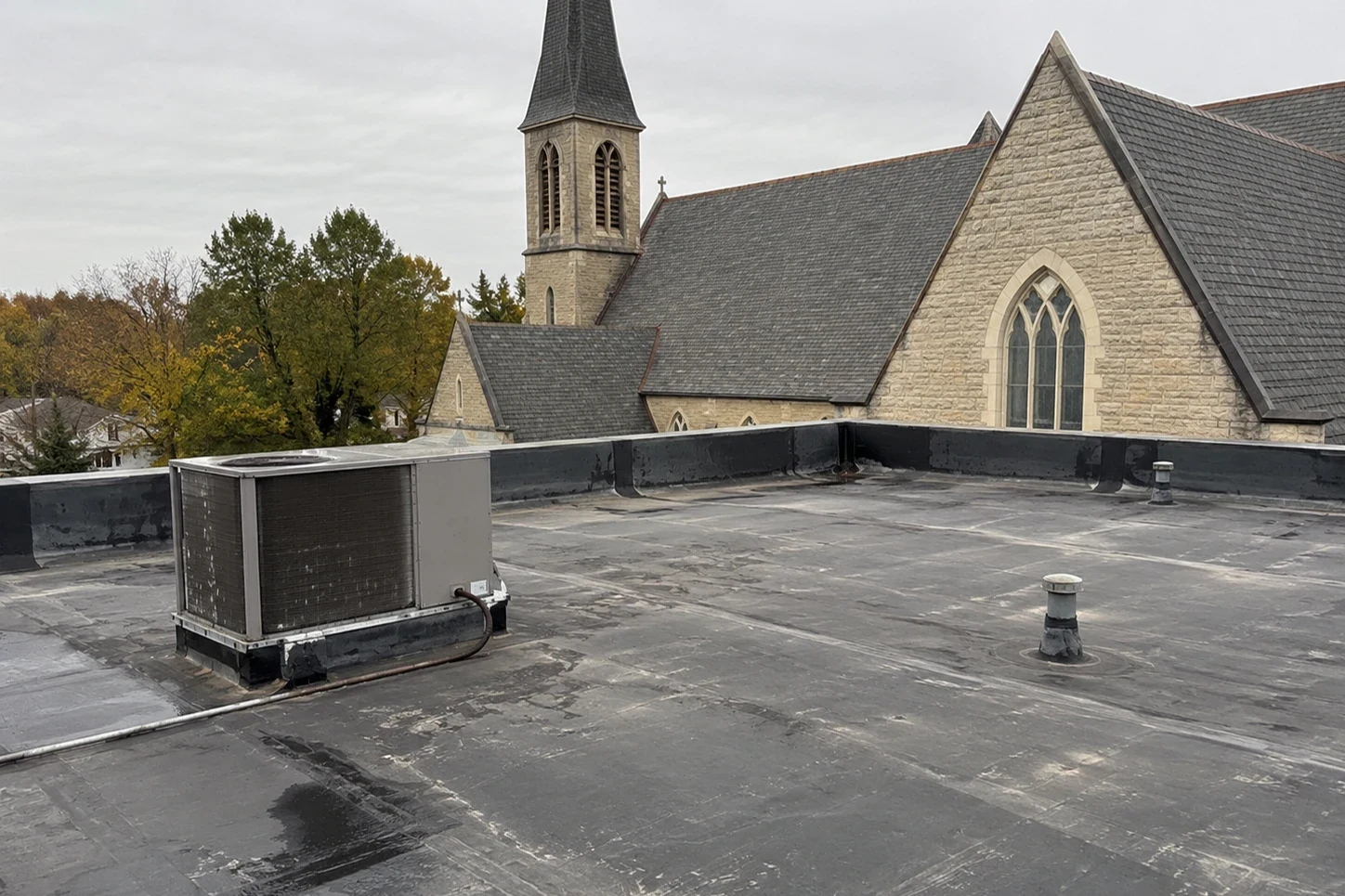
Water marks climbing the wall of a sanctuary, a few paint flakes on the pews after a thaw, a drip that sounds in the quiet before a service: congregations notice roof trouble in ways that other buildings do not, because the room is built to be still. A house of worship in West Jordan, UT usually combines a tall sanctuary roof, a lower flat or low-slope roof over classrooms, a fellowship hall and offices, and a few special details such as a steeple, a bell tower or a skylight over the nave. Each carries winter snow in its own way.
The roof walk begins by separating the tall roof from the low ones, since they fail for different reasons.
High sanctuary, low wings
The sanctuary roof is often steep or tall, and it sheds snow quickly. That speed is the problem: snow slides from the high roof onto a lower flat roof and lands in a concentrated strip, adding weight and wearing the membrane where it hits. A lower roof beneath a tall wall can carry a drift much deeper than the same roof would hold without the wall above it. The seam where the two roofs meet is where the load is highest.
We check the lower roof along the base of every tall wall, looking for a worn strip, a split seam or a flashing pulled away by the weight of sliding snow. Where a snow slide threatens a door or walkway, we note the need for snow guards or a diverter. The tall roof itself needs a different inspection, from a lift or from drone images, because ladders and walking surfaces are limited.
Drainage and melt: gutters, valleys and leaders
The weather history logged at Salt Lake City's airport lists steady winter snowfall, sustained freezing and warm summers across the valley. A West Jordan church is not at that airport, so the record is a general guide, but it fits what happens at a gutter edge: melt by day, ice by night. Gutters and valleys are the weak point, since ice that forms in a gutter can back water under the roof edge and into the wall.
After a thaw, we examine gutters, valleys, internal leaders and the roof edge. Some church buildings have built-in gutters or box gutters lined with metal or membrane, and these are hard to see and easy to neglect. A box gutter that fills with leaves and ice can overflow into the wall and stain the plaster inside. We clear them, check the lining and note any seam that has opened.
Steeples, skylights and special details
A steeple or bell tower sits on a base that has to be flashed to the roof, and the flashing has to allow for movement while keeping water out. Skylights and clerestory windows add curbs and glazing seals, and any of them can let water in as sealants age. Stained glass and old wood framing deserve extra caution, since a leak that runs down a window frame can damage materials that are expensive to replace.
We inspect each of these details close up, using a lift, a drone or a roof ladder as the building allows. Photographs show the base flashing, the seal on each skylight and the condition of the fasteners. Where a detail needs specialty work, such as copper or lead-coated metal, we write it up as a separate item so the congregation can compare costs and plan.
Services, funerals and the weekly rhythm
A church building has a weekly rhythm and a seasonal one, and a roof project has to respect both. We ask for the service times, the schedule of classes and the dates of major events, then plan noisy work for weekday mornings and keep the crew off the roof during funerals, weddings and services. Staging and parking are arranged so members can reach the doors and so the fire lane stays clear.
A congregation paying for roof work often has to raise the money, so a clear written plan matters. We separate urgent repair from work that can wait, and we price each item so a building committee can decide in steps. The plan states what stops active leaks now, what extends the life of the roof, and what a full replacement would involve if the committee wants to plan for it later.
Congregations across the south valley
The city's 2023 General Plan names Redwood Road and 7800 South as its historic downtown, and the planned station areas along the UTA Red Line are meant to host civic and residential buildings. Murray counts education and community services among its sectors, and Sandy has set Sandy Corners aside for reinvestment. A house of worship can stand in any of those settings, from a neighborhood street to a busy arterial.
Building committees and caretakers in West Jordan, Murray and Sandy can ask for a walk of the roof. A church with a school wing has needs similar to a school roof, and one that hosts large gatherings shares some features with a municipal building roof, such as public access and fixed event dates. A condition report from our roof condition reports gives a board a basis for planning several years ahead.
Repair, restore or replace
A congregation weighing a roof decision often has a limited budget and a long horizon, so the useful question is how much life a repair buys. When the membrane or metal is sound and the trouble is a detail, a targeted repair may last for years. When a low roof is dry underneath and its surface is worn, a coating restoration can extend it. When wet insulation or failing seams spread, replacement is the safer investment, and we set out what each option costs and why, in terms a building committee can weigh.
Committees turn over, so the record has to carry the memory. After each walk we leave a plain account of the roof type, the state of each section, where each repair sits relative to a chimney, a tower base or a drain, and the dampness tests next to it. Photos are tied to rooms, so a stain in the nursery or the fellowship hall leads to the roof above it, and the next volunteer inherits the whole story.
Commercial Roofing Questions
How do you inspect a steep sanctuary roof safely?
With a lift, a drone or fixed access points, depending on the building. We photograph the base flashing, the fasteners and the gutters, and we walk the lower roofs on foot.
Why does the low roof beside the sanctuary wear out first?
Snow slides off the tall roof and lands on it, adding weight and scouring the membrane along the wall. A strip of wear or a split seam at the base of the tall wall is a common finding.
Can work avoid Sunday services and funerals?
Yes. We take the service and event schedule at the start, keep noisy work to weekday mornings, and keep the crew off the roof during gatherings.
A box gutter overflowed into the wall. What now?
We clear it, check the lining and seams, and look at the wall below for wet insulation or damaged plaster. Larger relining work is written up as a separate item.
How can a building committee plan for roof costs over several years?
By starting with a written report that ranks each roof section by urgency and prices each item. That lets the committee fund the worst section first and schedule the rest.
Tell us where the stain shows
Share where water appears in the building, when it shows up, and how roof access works. We will plan the roof walk around your service times and mark the repair line before any schedule is set.