
A ceiling tile with a brown ring over a classroom desk on the Monday after a thaw is the kind of finding that sends a facilities director up a ladder before the first bell. School roofs in West Jordan, UT carry the same winter snow load and spring melt as any other flat roof in the Salt Lake Valley, but they carry it over rooms full of children, gym floors that warp when they get wet, and kitchens with wet-floor rules. The first job is to learn where the water traveled, because the stain is rarely where the opening is.
A school roof is also a calendar problem. Most of the work that matters has to fit between the last day of one term and the first day of the next, so the plan starts with the schedule and the roof walk together.
What fails first on a school roof
Schools usually grow in pieces. A main classroom block, a later gymnasium, a cafeteria wing and a few add-on rooms each arrive with their own roof edge, their own height, and their own seam where the new roof meets the old wall. Those meeting points are where water finds the open seam first. A step flashing that was sound when the addition went up can pull away after many freeze and thaw cycles, and the drip lands in a hallway rather than under the break.
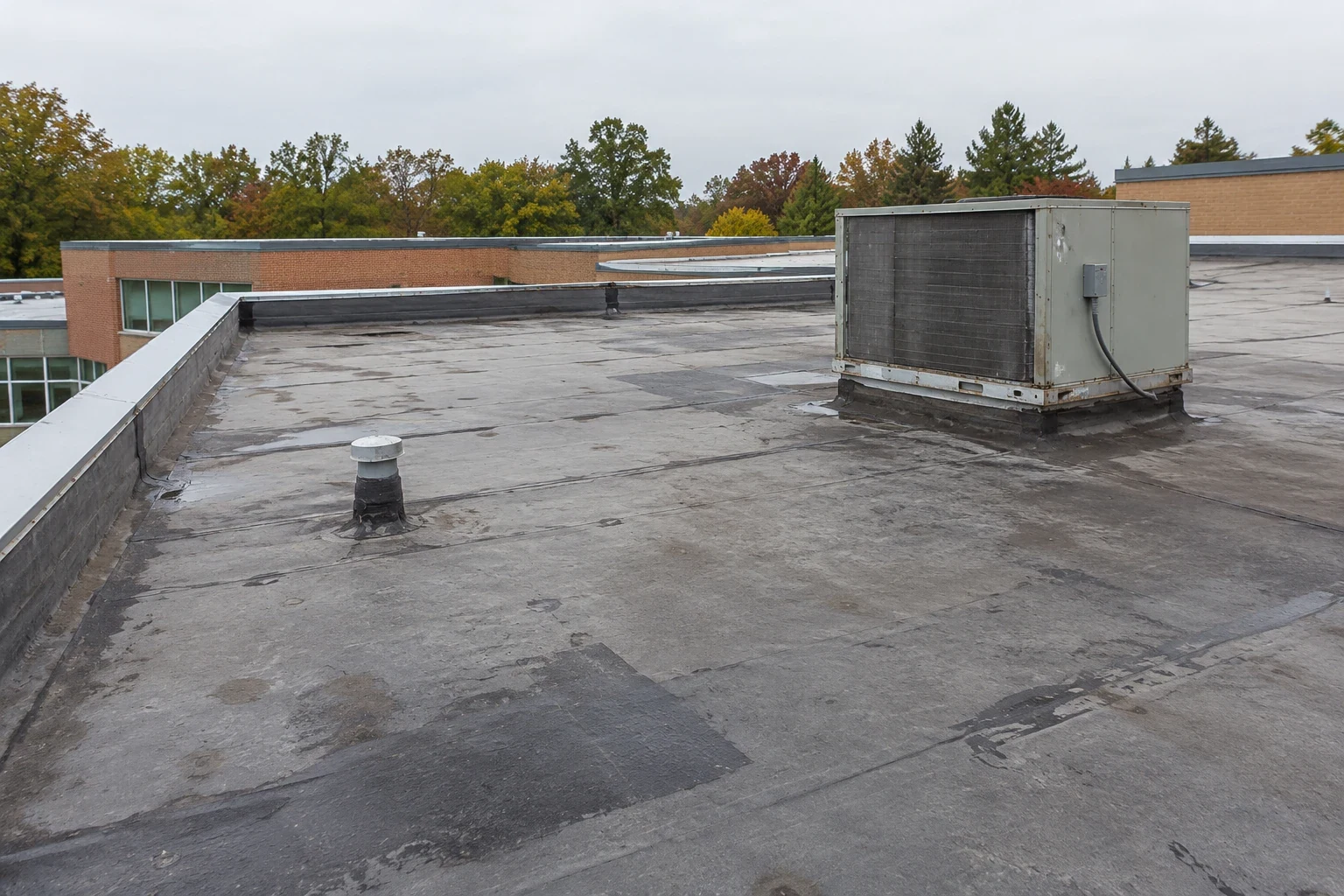
Penetrations add to the list. Kitchen exhaust fans, science room vents, boiler flues and rooftop air handlers all cut through the membrane, and each one has a curb or a boot that ages in the sun. On a roof that sits under a bright July sky for months, a cracked pipe boot is a common starting point. On the roof walk we press on each curb base, probe the seams around it, and mark any low spot where water stood the morning after the last storm.
Drainage and melt: spring check
Snow load and spring melt follow the Salt Lake Valley's winter, which the climate record at the city airport describes as one of recurring snowfall and freezing. A school near the foothills may hold snow differently from one on the valley floor. What carries across is the pattern: snow sits, melts in the afternoon, and refreezes at night, and a drain bowl that is partly blocked turns that cycle into ponding.
School drains collect more than leaves. Playground debris, balls, stray paper and construction scrap from past work all end up in the strainers. A spring check clears them, confirms the slope toward each outlet, and notes any low area that still holds water a day after the melt. Where a roof has internal drains and no overflow, we point that out in writing, because a plugged drain on a roof with no secondary path sends water to the nearest wall opening.
Repair boundary: patch, recover or replace
School budgets are often set a year or more ahead, so the useful report separates three outcomes. A contained repair stops a known leak and buys a season. A recover over a dry base adds a new membrane without a full tear-off when the insulation below tests dry. A full replacement becomes the right call when wet insulation has spread across the field or the membrane has gone brittle.
We mark each finding on a roof plan as patch, fix or replace, with photographs and moisture readings taken beside it. A district or a charter operator can carry that plan into a budget meeting and show which sections are urgent and which can wait for next summer. Where a gym or a cafeteria roof is older than the classroom wing, the plan can split them so the worst section is handled first and the rest scheduled behind it.
Summer window and occupied-building work
The best time for a large school project is the break between terms, but material lead times and crew schedules mean the order should be placed well before the last class lets out. For work during the school year, we plan around the daily rhythm: deliveries before arrival or after dismissal, hoisting kept away from bus lanes and drop-off lines, and a fenced staging area that students do not cross. Noise and fumes matter too. Torch work is avoided near operable windows and air intakes, and a low-odor system can be chosen where the building cannot be vacated.
Access is written into the plan. A roof reached through a custodial closet or a hatch above a stage needs a named person to open it and a route that does not cross a classroom in session. The same notes help the next person who has to walk the roof, which saves a phone call when an emergency leak shows up on a school night.
Schools along the valley's commercial corridors
West Jordan is planned around regional commercial, office and mixed-use development, including the original downtown at 7800 South and Redwood Road and the station areas along the UTA Red Line, such as the one north and northeast of Jordan Valley Hospital. A school near those areas has neighbors, and the roof conversation includes them: rooftop equipment on an adjacent building, shared drive lanes for crane access, and new construction that can change how snow drifts onto a lower school roof.
Owners in West Jordan, South Jordan and Taylorsville can use the same roof plan format across several buildings, so a district with older and newer campuses sees every roof described the same way. For districts planning many buildings at once, a school district program can sequence the work over several summers.
Records a facilities office can keep
A facilities office needs something it can file. We leave a written walk-through that names the roof type, grades each section, pins every repair to a drain or an equipment pad, lists what went into the repair and gives the wet or dry reading taken beside it. When a manufacturer warranty is in play, the notes show who was told and on what date. A condition report from our roof condition reports work gives a business manager a clear picture to compare with the next spring walk. If an older gym or classroom block is also being compared with a college building roof or an administration office roof under the same owner, the same format makes that comparison easy.
Commercial Roofing Questions
Can a school roof be replaced while classes are in session?
Sometimes, in sections. We split the building into areas, keep hoisting away from bus lanes and pickup lines, and avoid torch work near operable windows and fresh-air intakes. The summer break remains the cleanest window for the largest wings.
Our gym roof leaks only after a thaw. Why?
Snow melts slowly and the water travels along the deck before it drops. The opening may sit at a drain bowl, a wall termination or a curb well upstream of the stain, and a thaw gives it the volume to show up. A roof walk follows the water back to its start.
What do you record for a district that owns several buildings?
Each roof gets the same plan format: type, condition, repair locations, moisture readings and photographs. That lets a business office compare buildings side by side and place the worst roofs at the front of the budget.
Will a repair affect a roof warranty?
It can, since many warranties set rules for who repairs the membrane and how the work is documented. Send us the paperwork before we start and we will follow its notice requirements.
How do you keep students away from the work area?
Staging is fenced, material hoists are placed away from entrances, and the crew follows a gate and delivery schedule agreed with the front office. Roof access is controlled so no student route crosses it.
Bring us the stain and the schedule
Tell us where water shows up, when it appears, and how roof access works on your campus. We will plan the roof walk around the school day, mark the repair line on a plan, and confirm what must be settled before a summer schedule is set.