
A roof that feels spongy underfoot, a membrane that blisters in the afternoon sun, heating bills that climb while the roof looks fine from the lot: these are symptoms of what lies under the membrane, not on it. In West Jordan, UT, insulation and cover board do more work than their hidden place under the membrane suggests. They hold the heat in during freezing winters, hold the membrane up against foot traffic and hail-sized impacts, and, when tapered, they point the water toward the drains.
Three related layers are involved: the insulation itself, the tapered layers that create slope and the cover board that sits between insulation and membrane. The choices made here decide how the roof performs for years, and they are the choices that a tear-off or recover makes possible and a surface repair cannot.
Wet insulation: finding it and cutting it out
Insulation that has taken on water loses most of its insulating value and gets heavy, soft and sometimes crumbly. It also holds moisture against the deck, which can corrode steel. The surface rarely shows the damage right away. A roof can look sound for years while the insulation below stays wet.
We look for it with an infrared moisture survey, ideally on a clear evening when the roof releases the day's heat unevenly and wet areas show as warmer patches. Core cuts confirm the findings, and the moisture boundary is drawn on the roof plan. Wet insulation is removed and replaced, never covered, and the boundary becomes the repair line for the scope. A dry-looking section next to a wet one is tested to the edge before the crew decides where to stop.
Insulation types and what each does on a roof
Polyisocyanurate board is a common choice for low-slope commercial roofs because it offers high insulating value for its thickness, though its performance can change with temperature and it needs protection from moisture. Extruded and expanded polystyrene resist moisture better and are used where wet conditions are likely or in protected-membrane assemblies. Mineral wool offers fire resistance and stability. Spray foam insulates and seals in one step and is the basis of a spray polyurethane foam roofing system, where the foam is both the insulation and the substrate for the protective coating.
The choice depends on the deck, the roof's use, the energy requirements and the membrane that will cover it. A roof over a heated warehouse and one over an unheated shed do not need the same package, and we describe the reasoning for the option we recommend. Compressive strength, moisture tolerance, fire rating, insulating value per inch and cost per square foot all pull in different directions, so the scope lists the two or three that decided the choice.
Existing insulation can sometimes stay. If the moisture survey shows it dry and the boards are still firm and bonded, a recover keeps them and adds a cover board on top. If boards are crushed along walkways or crumbling at the edges, those areas are cut out and replaced with matching thickness so the surface stays flat. Mixed thicknesses create a lip that wears through the membrane, so the transitions are tapered or shimmed.
Energy code and what a reroof has to meet
Two codes matter here: the 2024 IBC and the 2024 IECC, which Utah put into effect on July 1, 2026 with statewide and local amendments, and a newer statutory edition is already scheduled to replace the current one on January 1, 2027. A reroof that removes the existing roof down to the deck generally brings current insulation requirements into play, and a recover may not. Which edition applies is the building department's call, and we confirm it before the insulation thickness is set.
Thickness also interacts with everything above it. Added insulation raises the roof surface, so wall flashings, curbs, hatches and edge metal must be extended. We take those heights on the roof walk and list each affected detail in the scope.
Tapered systems: giving water somewhere to go
Tapered insulation is a set of boards cut at a slight slope, laid in a pattern that guides water to drains or scuppers. It is the usual fix for ponding on a roof that is flat in practice, and for new roofs it builds drainage into the design. Layout drawings show each board, its thickness and where the high and low points fall.
The layout is built from measurements taken on the roof, including deck elevations, drain locations and the height of existing details. Crickets, the small ridges that divert water around curbs and units, are part of the same system. Drainage matters in West Jordan because the valley's winter snow and melt put water on the roof for weeks, and a tapered layout that works in October must also work in March. The taper only works if the roof drains and scuppers at its low points are the right size and kept clear.
Cover board: the layer that takes the abuse
A cover board is a thin, dense panel installed over the insulation and under the membrane. It protects soft insulation from foot traffic and hail, gives the membrane a flat firm surface to bond to, adds fire resistance in many assemblies and can reduce blistering. Common boards include high-density polyiso facers, gypsum-based boards and fiber or perlite boards, each with its own tolerance for moisture and its own compressive strength.
Choosing a board involves the membrane and attachment method. Adhered systems depend on a smooth, clean surface; mechanically fastened ones depend on holding power. On a roof recover, the cover board is often what separates the old membrane from the new, making a dry, flat base for the new roof. We select a board that suits the membrane manufacturer's requirements for the system, and the scope states the product type.
Installation: layers, joints and fasteners
Insulation layers are laid with joints staggered between layers so that heat does not travel straight through a gap. Boards are attached to the deck with fasteners or adhesive according to the wind uplift rating the roof needs, and the fastener count follows a pattern that is heavier at corners and edges. Cover boards are offset again so their joints do not align with the insulation below.
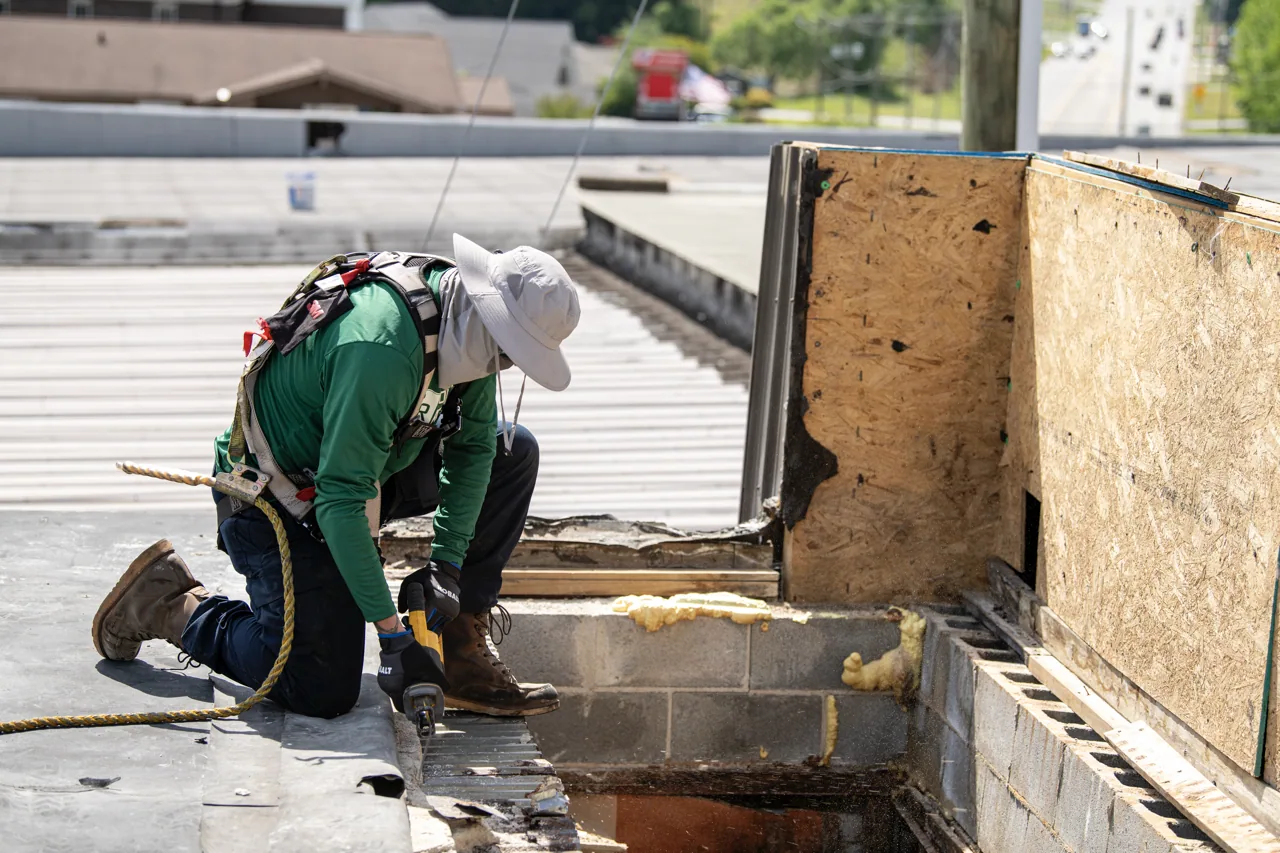
Work is sequenced so that no more insulation is laid than can be covered by membrane the same day. Insulation left open overnight can take on water. In occupied buildings, the crew coordinates noise and fastener penetration with the tenants below, since screws that reach the deck can be heard and felt. A replacement schedules this layering around the dry window.
Where the work applies
Any low-slope commercial roof has an insulation story, from buildings along Redwood Road and 7800 South to those near the Gardner Village and Old Bingham Highway stations. On a roof in West Jordan, the walk checks insulation condition with moisture readings, and the findings guide whether the roof gets a repair, a recover or a tear-off.
Commercial Roofing Questions
Can wet insulation dry out on its own under a membrane?
Rarely enough to matter. Water trapped below the membrane has little way to leave, so the wet material is removed and replaced.
Does thicker insulation always mean a better roof?
It raises the energy value and the roof surface. Details must be raised to match, and the deck must carry it, so thickness is set from the code and the building.
Is a cover board required on every roof?
Not always. It is common on adhered systems, on recover projects and where traffic or hail exposure is a concern, and the membrane maker's requirements decide the rest.
How does taper get priced?
By the area, the number of different board thicknesses in the layout and the added flashing height at walls and curbs.
Can new insulation be installed in winter?
Cold, damp weather limits adhesives and membranes. The work is generally planned for the dry months, with temporary protection in place if a roof must be opened early.
Find out what is under the membrane
Tell us where water appears, when it appears and how the roof is reached. We will walk the roof, check the insulation with moisture readings and explain what must be confirmed before a repair line or schedule is set.