
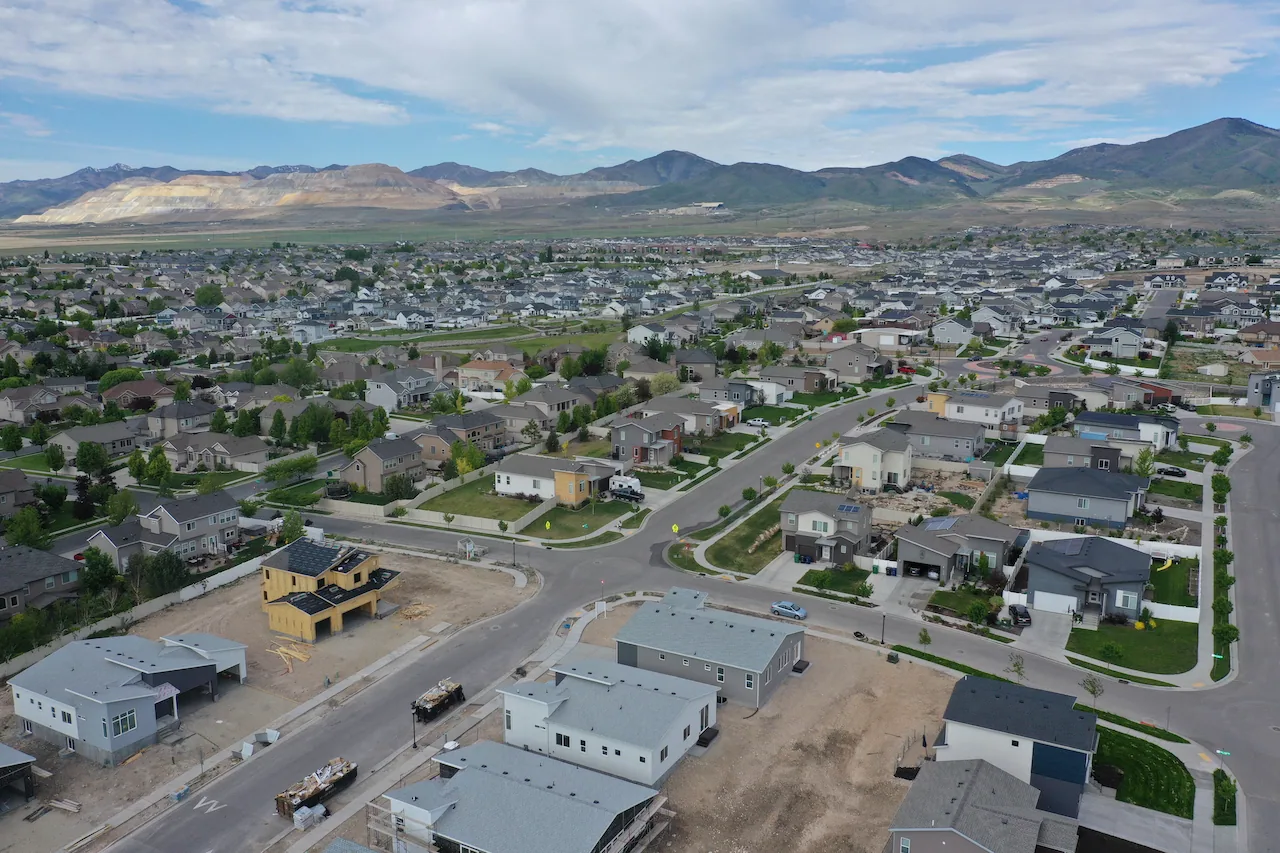
The long, shallow stain that runs across a warehouse ceiling a few feet from the wall almost always follows a seam or a drain line on the roof, and it grows a little with every thaw. A 1,700-acre southwest quadrant is one of two large areas West Jordan considers ready for future growth, and the city describes planned development there as an economic-development effort involving landowners, developers, and businesses, balancing commercial, employment, and community uses. Employment buildings tend to have large low-slope roofs, so the first questions are about distance: how far water has to travel to reach a drain, how far a membrane has to span between expansion joints, and how many roofs one owner will be responsible for as the area fills in.
Large-roof drainage: distance is the problem
A drain serves an area, and that area has a limit. When a roof is wide, the slope to the drain is small, the water has a long way to go, and a small settlement in the deck or a stretch of compressed insulation puts a pool in the middle of the field. We measure the pools two days after melt, mark their depth, and trace each to the nearest outlet. Often the fix is a short tapered saddle or a drain sump lowered by a fraction of an inch.
On a roof with many drains, we check the line below each bowl. A line that clogs under the slab sends water back up through the bowl and onto the roof, where it looks like a roof leak but is a plumbing one. A flow test during the survey separates the two, and the findings go into the file with the drain locations and the date of the test.
Thermal movement across long spans
Salt Lake City airport averages put warm summers and freezing winters in the same year, with snow in between. They come from one station and not from this quadrant, yet the swing from summer heat to winter cold is wide enough to move a long membrane. Over a wide roof the membrane expands in July and contracts in January, and the movement concentrates where it is restrained: at walls, at curbs, at the ends of long seams.
Signs of movement include a membrane pulled tight at a wall base, wrinkles that point toward a curb, and a seam that opened at its end and nowhere else. We record the location of each, because a pattern of movement tells us where a detail needs more room to flex. A repair that ignores movement fails again in the next cycle, while a repair that adds a slack loop or relocates a termination can hold.
A growing district: one owner, several roofs, one record
A quadrant planned for phased growth may bring one owner several buildings built in different years. Their roofs will age at different speeds, and each will have its own installer, warranty, and repair history. The risk is a set of files that do not line up. We keep one format for every roof an owner holds: membrane type, area, drain count, equipment count, age, repair log, and the date of the last walk.
With that format, the owner can compare roofs, tell which roof is due next, and plan spending across several years. A multi-site roof program turns the records into a schedule, and capital planning puts replacement years on a budget before failures set the dates. The first set of walks is the baseline for everything that follows.
Repair line on a large roof
On a large roof the repair line often runs along structural lines, such as the edge of a bay or the line of a purlin, because water follows the deck and insulation along those lines. A repair that slices across a bay can leave wet board behind on one side. We draw the line after the moisture map, along the boundary of the wet zone and the nearest structural break, and we list what is inside it.
Owners then decide among a repair, a coating over dry sound areas, a recover, or a replacement. On a large roof, the cost difference among them can be large, which is why the proposal puts the evidence for each choice on paper before anyone commits.
Roof-walk notes: what the first visit records
The first visit sets the record that later visits are compared with. We walk the full roof on a grid, so that no bay is skipped, and write down the membrane type, the seam condition, the number and condition of drains, the equipment and its curbs, the perimeter metal, and any ponding. We photograph from fixed points and number the frames to match the notes.
Findings are sorted into three groups: sound, worn, and open. Sound items need only a date for the next look. Worn items get a watch date and a note on what would make them open. Open items get a proposed method and a place on the repair list. The owner receives one summary page and the full photo set, and the summary is short enough to forward to a lender or a tenant without editing.
Seasonal timing: when large scopes should be scheduled
Large scopes depend on weather windows more than small ones do. A tear-off section that must close before dark needs dry air and surface temperatures above the minimum for adhesives and welds. In this valley the warm, dry months give the most room for large sections, while winter work is limited to temporary protection and small repairs that are labeled temporary.
Scheduling also depends on lead times for insulation, membrane, and equipment, which can stretch when many projects compete for material. The proposal gives the earliest start and the deadline for deciding to hold a summer window. A spring check after the last hard freeze and a fall visit before the first snow keep the program on a rhythm that makes those decisions routine.
Wind, access, and trades on the roof
A large roof is exposed. Wind lifts at edges and corners, and a long perimeter has many places to start. We check perimeter metal by hand, looking for movement and for missing or short fasteners, and we photograph each run. Corners get extra attention because uplift is highest there.
Large roofs also host many trades: mechanical, electrical, fire protection, and sometimes solar. Each leaves marks. Walkway pads, a trade log at the roof hatch, and a rule about hot work keep damage down. When a trade does cause damage, the log and a dated photograph show who was there. Owners elsewhere in the city, such as in the Old Bingham Highway station area or the wider West Jordan market, can use the same logs and the same maintenance visit schedule.
Commercial Roofing Questions
Why does a large roof pond more than a small one?
Water has farther to go, slopes are shallow, and small settlements matter more. A short saddle or a lowered sump usually fixes a pool without touching the rest of the roof.
How is a drain line problem told apart from a roof leak?
With a flow test. Water is run into the bowl, and we watch whether it drains and whether the line backs up. The result separates plumbing from roofing.
Does a large roof need expansion joints?
Often it does, depending on the structure and membrane. Where they exist, they are inspected for open flashing and torn membrane. Where they should exist and do not, movement shows up at walls and curbs.
Can one inspection cover a whole portfolio of roofs?
One visit per roof, with one format for all of them. The comparison across roofs is what shows which needs work first.
What happens if another trade damages the roof?
The trade log and photographs identify who was on the roof and when. The repair is made, and the cost is pursued under the contract that governs that trade.
Send the roof list and the drain locations
Send a list of the roofs you hold, with membrane type and age if known, and any drawings showing drain locations. We will walk each roof, record what we find in one format, and set the repair line or next test from the evidence.