
A roof budget written in the month the roof fails is written under pressure. A ceiling tile stains, a tenant calls, and suddenly the building needs a replacement that nobody planned for, in a season when crews are booked and material is on a long lead. A capital plan exists to move that decision earlier, to a quiet week when the roof can be examined, the options compared and the work scheduled for the right window. For owners in West Jordan, UT, where winter snow and freeze-thaw cycles load every drain path and seam, the plan also has to say which roofs can ride another winter and which cannot. We build those plans from roof walks, not from age tables alone.
What failed first sets the order
A plan starts with the evidence from each roof: the type of system, the visible condition of seams, flashing and surface, the drainage pattern, moisture findings under the membrane and the repair history. Age is one input, but a young roof with wet insulation can be in worse shape than an older one that has stayed dry. We rank roofs by the condition findings first and by age second.
Each roof receives a remaining-life estimate expressed as a range, with the reason for the range. A roof with isolated seam failures and dry insulation may have years of life with maintenance. A roof with ponding at multiple drains and soft spots has a shorter horizon. The range, and the evidence behind it, goes into the plan so the owner can see why a roof sits where it does.
Moisture is the evidence that moves a roof up or down the list fastest. A scan or a set of cores that finds wet insulation across a large share of a roof rules out extension and points toward replacement, whatever the surface looks like. Where the scan finds dry insulation under a worn surface, extension stays on the table. We run that test before a roof is assigned a target year, because a year assigned without it is a guess.
Repair boundary: three paths for every roof
For each roof the plan lists three paths. The first is repair and maintain: a defined set of fixes that keeps the roof serviceable for a stated period. The second is extend: a coating or recover that adds service years without tear-off, available only when the roof is dry and sound underneath. The third is replace: removal and a new commercial roof replacement with insulation and drainage corrected.
Each path carries a scope, a cost range driven by area, access, insulation, tear-off and penetrations, and a note on what it leaves open. The owner can see that a cheaper path now may mean a larger decision in a few winters, and that a larger path now may remove a recurring repair line from the budget.
Cost drivers are the same on every path and worth stating plainly: roof area, tear-off depth, the amount of insulation to be replaced, the number of curbs and penetrations, how crews reach the roof and what the building does underneath. Occupied buildings add phasing, and phasing adds time. The plan lists these drivers beside each range, so a number is never a bare figure.
Seasonal timing: the dry window sets the year
In the Salt Lake Valley, cold and snow close much of the winter to adhesives and many membranes, so replacement and recover work concentrates in the warmer months. Airport normals from Salt Lake City describe the region and elevation and exposure differ from roof to roof, but the pattern is clear enough for planning: snow and freeze-thaw in the cold season, warm summers after.
That shapes the calendar of a plan. Design and permit work belongs in late winter and early spring. Material is ordered ahead of the season. Construction runs in the dry window, and winter is used for inspection, drain clearing and temporary repairs. A plan that names the year for each roof should also name the month decisions are due, because a replacement decided in June may not start until the following summer.
The plan also records what can be done between projects. A roof scheduled for replacement in two years still needs drains cleared each fall, edges checked after wind and any new leak traced and repaired. Those repair lines are part of the capital picture, since a roof that is patched carelessly for two years can arrive at replacement with more wet insulation than it needed to have.
Code and energy changes in the schedule
Utah's 2024 building and energy codes took effect July 1, 2026, with state and local amendments. A replacement that exposes the roof assembly is where energy requirements are usually reviewed, so the plan notes when insulation thickness and air-sealing details may change what a replacement includes. Owners who budget from an older scope may find the new requirements add materials, and a plan that anticipates this avoids a surprise at permit review.
We write replacement scopes to the code in force on the permit date and flag any item that a reviewer may question. That ties the budget to insulation and drainage, which are the two parts of a roof most affected by energy rules.
Planning around where the city is growing
Growth plans in the city favor regional commercial, service, office and mixed-use building, and the general plan sets out planned station-area districts at Gardner Village, along Redwood Road and 7800 South, north and northeast of Jordan Valley Hospital and at Old Bingham Highway. An owner with a building in West Jordan near those areas may see construction nearby over time. Neighboring projects can bring dust, debris and equipment traffic, and a roof plan should include a drain check after nearby work.
Owners who may redevelop or sell a property in the next several years need a different plan from owners who intend to hold. We build both versions where the future is unclear, so the choice is made with the roof's evidence in hand.
Utility work, new curbs for rooftop equipment and added antennas all open roofs after the replacement is done. The plan can include a rule for that: any trade that opens the roof notifies the owner, and a roof walk follows. It is a small habit that protects a new warranty and a new membrane.
Next check: turning the plan into a calendar
The finished plan is a table and a calendar: each roof, its rating, its path, its target year and its cost range. We update it after each inspection, so a roof that has aged faster moves up and a roof that has held moves back. Linked to a roof asset management file and backed by roof condition reports, it gives a board or lender a clear picture. Owners with several properties can extend it across a portfolio through multi-site roof programs.
Commercial Roofing Questions
How far ahead should a roof replacement be planned?
Two to three seasons for a large roof, one for a small one. Design, permit review and material lead times each add weeks before a crew arrives.
Is a coating a replacement substitute?
Only when the roof is dry and sound underneath. It adds service years but does not fix wet insulation or failed seams.
What if the budget does not cover every roof?
The plan ranks roofs by evidence, so the money goes to the ones most likely to fail first, with repair lines to bridge the rest.
Does the new energy code change my cost?
It can, mainly through insulation and air-sealing requirements at replacement. The plan flags those items before the permit stage.
Who owns the plan after delivery?
You do. We deliver it as a written report with photographs and update it at each inspection.
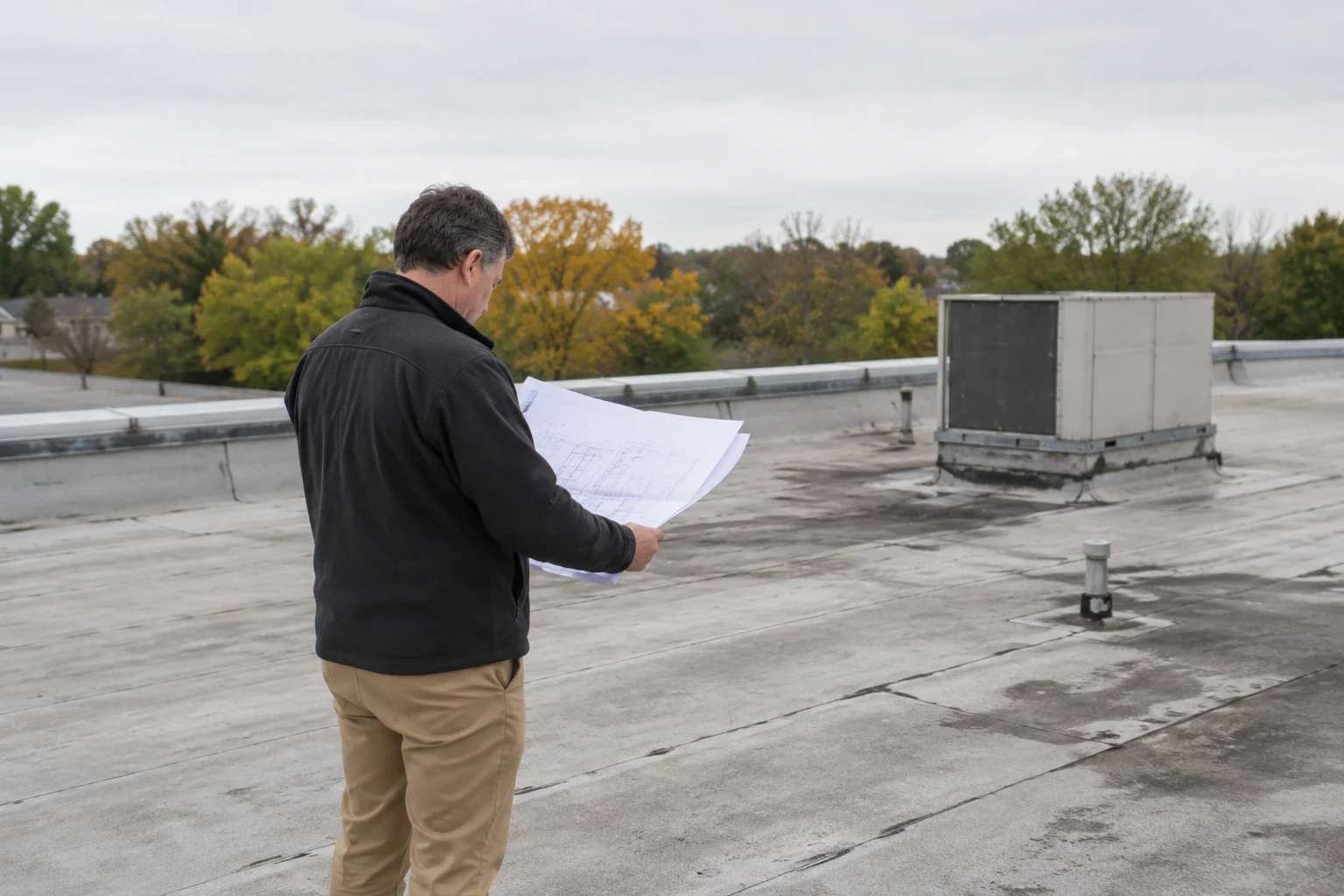
Share where water appears and how roof access works
Send the building list, repair history and any plans for sale or redevelopment. We will walk the roofs, confirm what the records say and set out a plan with paths, ranges and a calendar.