
Drips on a new car are the quickest way to turn a roof problem into a sales problem, and a service writer who points to a wet spot on a parts counter is looking at the same leak from the other end. Auto dealerships in West Jordan, UT combine a glass-walled showroom, a service drive, several repair bays, a parts department and a row of canopies, and each of those sections has its own roof, its own height and its own seams. Winter snow melts off the high showroom roof onto the low service roof, and the water that follows tests every joint between them.
The roof walk starts at the showroom, because that is where a leak costs the most.
Showroom glass and the roof above it
A showroom has tall glass walls and a roof that overhangs or ties into the glazing frame. The joint between the roof and the curtain wall is a complex detail, with flashing, sealant, metal trim and a gutter or scupper that must all work together. Sealant at that joint cracks as the building moves, and flashing that was lapped correctly can fail when the metal trim pulls loose.
We inspect that joint closely, checking sealant, flashing laps and fasteners. A leak at the glass line can run down the frame and drip onto a vehicle or a customer, so we trace it from the interior stain to the roof and back. Where the showroom roof drains through an internal leader behind a column, we check the leader for blockage and the roof drain above it for debris.
Drainage and melt: showroom to service roof
Climate data collected at the Salt Lake City airport describes a valley with steady winter snowfall, long spells of freezing weather and warm summers. Treat it as background, since no dealership sits at the airport. What it explains is why the step between a showroom roof and a service roof gets so much attention: snow and melt from the high roof land on the low one in a concentrated strip, and a membrane that holds up under ordinary rain can wear along that line.
After a thaw, we check the lower roof beneath each step in height. We look for scuffing, splits and flashing pulled from the wall, and we add splash protection or a downspout extension where needed. Parking-lot-facing canopies and awnings carry their own drainage, and a canopy that freezes at a scupper can drop ice on a customer's car. We include these in the roof plan.
Service bays, exhaust and heavy equipment
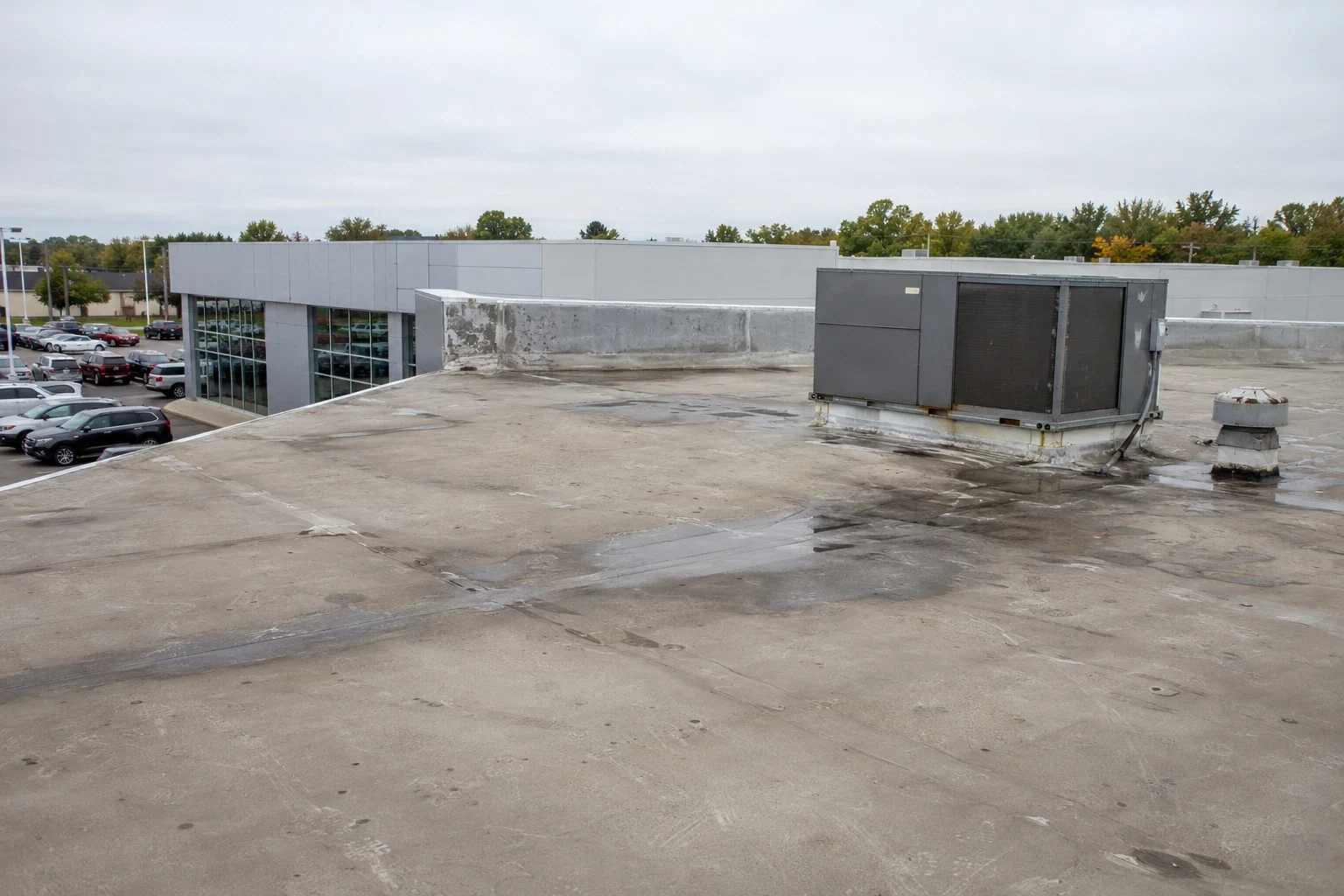
Service roofs carry more equipment than the showroom: exhaust fans for the bays, makeup air units, hoist-related vents, oil-water separator vents and sometimes compressors. Exhaust discharges heat and fumes that age the surface near the fan, and oil mist from some operations softens adhesives and stains the membrane. A patch applied over a stained surface will not bond.
We check the area around each unit for staining, softening and cracked flashing, and we clean the surface before repair. Vibration from compressors and fans works at curb sealant, so we check the fasteners and the base of each unit. Roof access for a service building often runs through a hatch or a ladder inside the parts room, and we plan the route so the crew does not cross a customer area.
Keeping the showroom and service drive open
A dealership sells and services vehicles six days a week, and the roof schedule has to respect both. We plan noisy tear-off for early morning, before customers arrive, and stage materials in a corner of the lot away from the display area and the service drive. Hoists are placed where they do not block vehicle flow, and walkways stay open for customers. Cars stay out of the fall zone below the work, and the manager moves the inventory in advance.
Odor and dust matter near a showroom. Low-odor systems are chosen where intakes are close to the work, and the crew covers or cleans debris from the lot at the end of each shift. A written notice for the sales and service staff states the days and the noise window, and a single manager is the point of contact.
Dealerships along the valley's arterials
Taylorsville feeds its commercial traffic through I-215, Redwood Road, Bangerter Highway and a string of numbered South streets, while Murray reaches I-15, I-215, TRAX and FrontRunner and lists retail and transportation among its sectors. West Jordan's corridor zone permits stand-alone commercial uses along Redwood Road. A dealership on one of these routes depends on being seen from the road, which makes a tarped roof or a stained ceiling in the showroom costly.
Dealers in West Jordan, Taylorsville and Murray can book the roof walk through us. A dealership with a large flat sales and service building resembles a big-box retail roof in its drainage and equipment questions, and one with a parts warehouse behind it resembles a warehouse roof. Groups with several stores can use a multi-site roof program.
Roof-walk notes for the store manager
The general manager keeps a file after each visit. It covers the showroom roof, the service building and any canopy, with a grade for each, the position of every repair measured from a drain, a unit or a column line, and the moisture checks done beside the work. Photos are labeled by department, so a drip in parts points straight to the roof above it. A landlord, lender or buyer can be given the same file, which saves a second walk when a sale or a refinance comes up and gives the next manager a reliable starting point for the spring check.
Repair, recover or replace
If a remodel of the showroom or service area is planned, the roof decision should be made alongside it, so new finishes are not put under an old leak. A repair suits a roof that is sound with a few failed details. A recover suits a dry roof with a worn surface. Replacement suits a roof with wet insulation or widespread seam failure. Each path gets a price built from the roof area, the number of openings to flash, the insulation depth and how much of the lot can be given over to staging. Dry insulation can stay and be recovered, wet insulation comes out, and the written comparison shows both so the owner can weigh them against the lease term and the plans for the building.
Commercial Roofing Questions
Can the roof be worked on while customers are in the showroom?
In sections, and with care. Noisy tasks go early, staging stays out of display and service areas, and the crew uses a route that does not cross customer space.
A drip falls near the glass wall. Where do you look first?
At the joint between the roof edge and the glass frame: sealant, flashing laps, trim fasteners and the gutter or scupper. We trace the water back from the stain to that joint.
What do oil and exhaust do to the roof?
They soften adhesives and stain the surface, and patches over them do not bond. We clean the area first and check the flashing around each fan.
How do you protect vehicles during the work?
The manager moves inventory out of the fall zone, a fenced staging area keeps material off the display lot, and the crew sweeps debris at the end of each shift.
Is a recover possible over an existing roof?
Yes, if the insulation tests dry and the roof can carry the added layer. A moisture scan tells us which areas qualify.
Point us to the drip
Tell us where water shows up, whether it falls over inventory or a work area, and how roof access works. We will plan the roof walk around sales and service hours and mark the repair line before any schedule is set.