
Most of the seams on a prefabricated roof were welded in a factory, and that changes where a roof walk should look. Duro-Last is known for prefabricated PVC single-ply membranes, cut and welded to a building's measurements before they reach the site, so the field work is mostly joining large sections and flashing around what is on the roof. Owners of commercial buildings in West Jordan, UT who hold such a roof have fewer field seams to worry about and a different set of weak points. We install, repair and maintain prefabricated PVC systems, and our first visit goes to the joins between sections and the details at every penetration.
What failed first: field joins and custom details
A prefabricated sheet is welded in the shop under controlled conditions, so the weak points shift to what was done in the field. Section-to-section joins, wall terminations, edge metal attachment and custom flashing around equipment are all done on site, in whatever weather and by whatever hands the day provided. When water gets in, it is usually at one of those.
On a walk we probe field welds, check the perimeter and press-test edge details. We look closely at prefabricated boots and corners, which are factory-made but still depend on a good field tie-in. Photographs and a sketch record each finding, tied to numbered roof sections so the next visit can compare.
Edge details deserve their own pass. The sheet terminates at metal, and the metal is fastened to the wall or deck. Wind and ice work on that connection first. We press-test coping and edge metal, check fastener spacing and sealant and look at how the sheet is held at the perimeter. If a section of edge has moved, it can be reset, resealed or replaced as a small job, and doing that early protects the field of the roof.
Roof-walk notes: penetrations after the roof is in
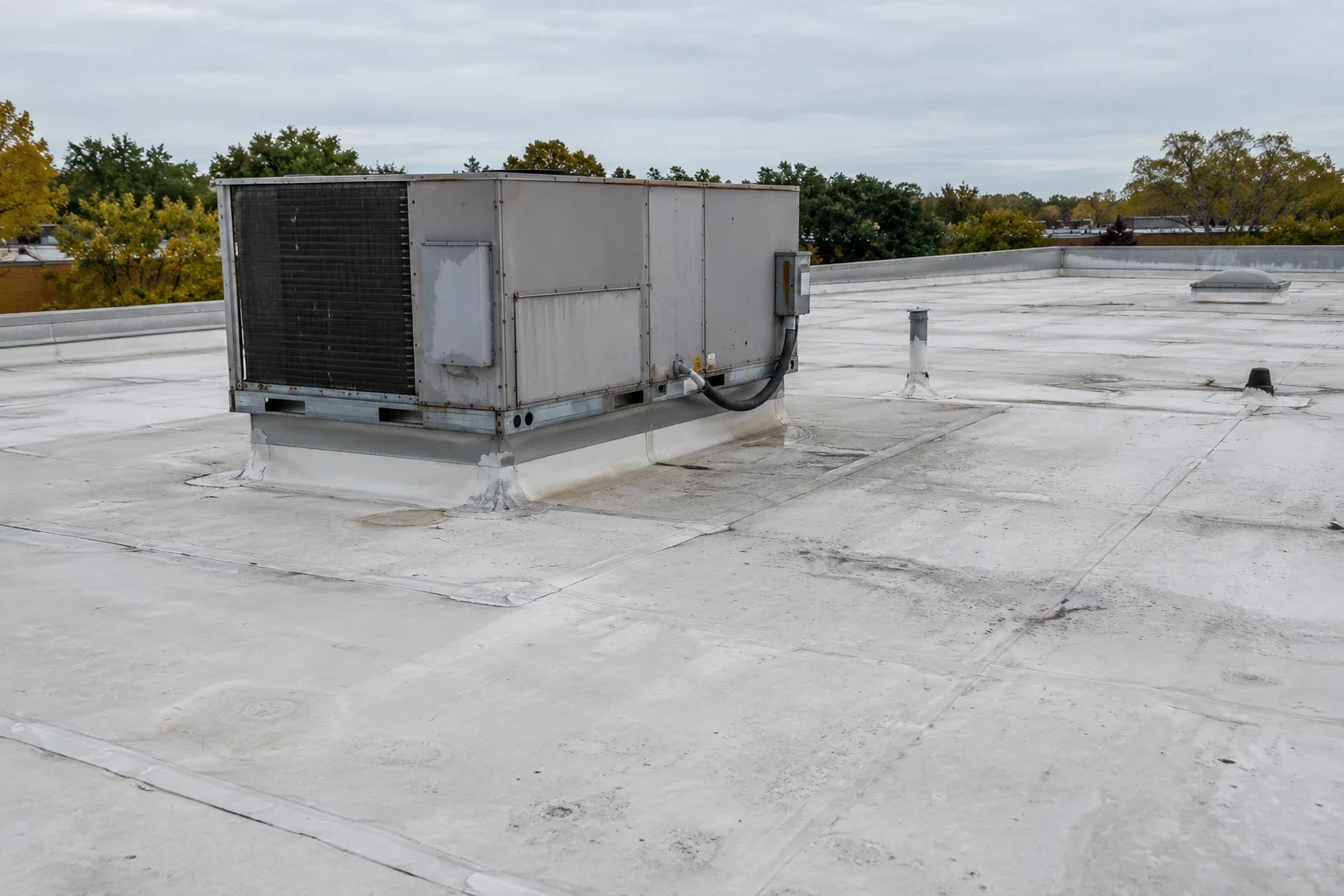
A roof built to measure fits the equipment that was on it that day. When a unit is replaced, a vent added or conduit run later, someone has to cut into a membrane that was made without those openings. Done well, the new opening gets a proper boot welded to the sheet. Done poorly, it gets a sealant bead, and sealant does not last through freeze-thaw and sun.
We list every penetration on the sketch and mark which ones were part of the original build and which were added. Any opening sealed only with a bead is a repair item. The fix is a welded or bonded flashing of compatible material. We also check that new curbs and supports sit on protective pads and not directly on the sheet.
Equipment pads and walkways are the other half. A technician who walks to the same unit every month wears a path, and PVC under repeated foot traffic scuffs, thins and eventually punctures. Walkway pads welded or bonded along service routes are inexpensive, and the sketch marks where they belong. Where a roof has none, we recommend placing them at the routes that already show wear.
Drainage and melt: snow, ice and thermoplastic sheets
Winter snow and freeze-thaw periods are the regional stress in the Salt Lake Valley, as NOAA normals for Salt Lake City International Airport show; local elevation and exposure change the picture from one West Jordan roof to the next. On a prefabricated PVC roof, meltwater moves across large smooth sections, and where it cannot leave it stands on joins and details. Ice at edges and gutters can lift metal and pull at the sheet.
After melt, we check drains and strainers, note ponding marks and look at the first stretch of leader. We also look for ice damage at edge metal. PVC is stiffer in cold weather, so a roof that is stressed by cold movement shows it at corners and folds. A spring walk with dated photographs becomes the baseline.
A building near either interstate and a building tucked into the downtown core at Redwood Road and 7800 South get the same walk: drains, joins, edges and details.
Repair boundary: weld, patch or replace
A repair on a thermoplastic sheet means cleaning the area, welding a compatible patch and testing the result. Winter repairs are usually temporary because welding needs suitable temperature and dry surfaces. A roof with wet insulation or widespread failures points to replacement, sometimes with new PVC roofing and sometimes with another system, depending on the building.
Cost follows area, tear-off, insulation, penetrations and access. Utah's 2024 building and energy codes, in force from July 1, 2026 with state and local amendments, put insulation values under review whenever a replacement opens the roof. We state proposed values in the scope.
Insulation under a prefabricated sheet is tested the same way as under any other: a meter, a scan where it makes sense and a few small cores. If the boards are dry, the roof can be repaired or even recovered. If they are wet, the wet area must be opened. Replacing a prefabricated sheet usually means ordering a new made-to-measure sheet, so measurements and lead times go in the schedule from the start.
Warranty terms, records and the next owner
A manufacturer warranty can limit repairs to particular parties and call for notice ahead of the work. The warranty is read next to the roof, and the repair scope is written to stay inside its conditions. The roof warranty management file holds the document, the notices, the dated photographs and the repair details.
Because prefabricated roofs are built to a drawing, the original drawing is valuable. It shows section layout, penetration locations and detail types, and it makes later repairs faster and more accurate. If you have it, send it; if not, our sketch will become the working record.
Utility and equipment contractors often open a roof without telling the owner. A simple rule helps: any trade that opens the roof notifies the property manager, and a roof walk follows when they leave. We provide a one-page notice owners can share with tenants and service companies. The notice costs nothing, and it keeps the record accurate.
Next check: what to send
Send the address, any original drawings or warranty papers and a note on where water appears. Tell us how roof access works. We will walk the roof, probe the field joins and report what the details need. A second building with a Sika Sarnafil or Holcim Elevate roof gets the same walk, and a roof in West Jordan is scheduled around tenant hours and access.
If the original shop drawing or a copy of the warranty is on file, send it with the first message. Either one saves a visit's worth of measuring, because the section layout and the detail types are already drawn.
Commercial Roofing Questions
Do prefabricated roofs have fewer leaks?
They have fewer field seams, so leaks tend to come from joins, terminations and added penetrations. The inspection concentrates there.
Can I add a rooftop unit later?
Yes, but the opening needs a proper welded boot or flashing and a protected support. A sealant bead alone will not hold.
Do I need the original drawing?
It helps. It shows section layout and detail types. Without it, our roof sketch becomes the record.
Can PVC be patched in winter?
Temporary patches yes. Permanent welding needs suitable temperature and dry surfaces, so it waits for a warmer day.
Who keeps the warranty paperwork?
The owner holds the warranty and its terms. We keep the repair records, dated photographs and notices that the terms ask for in one file next to the roof sketch.
Share where water appears and how access works
Send the address, any drawings or roof papers and the leak history. We will walk the roof, probe the joins and report what to repair first.